
SportFits Travel
Avalanche basics: what you need to know off-piste
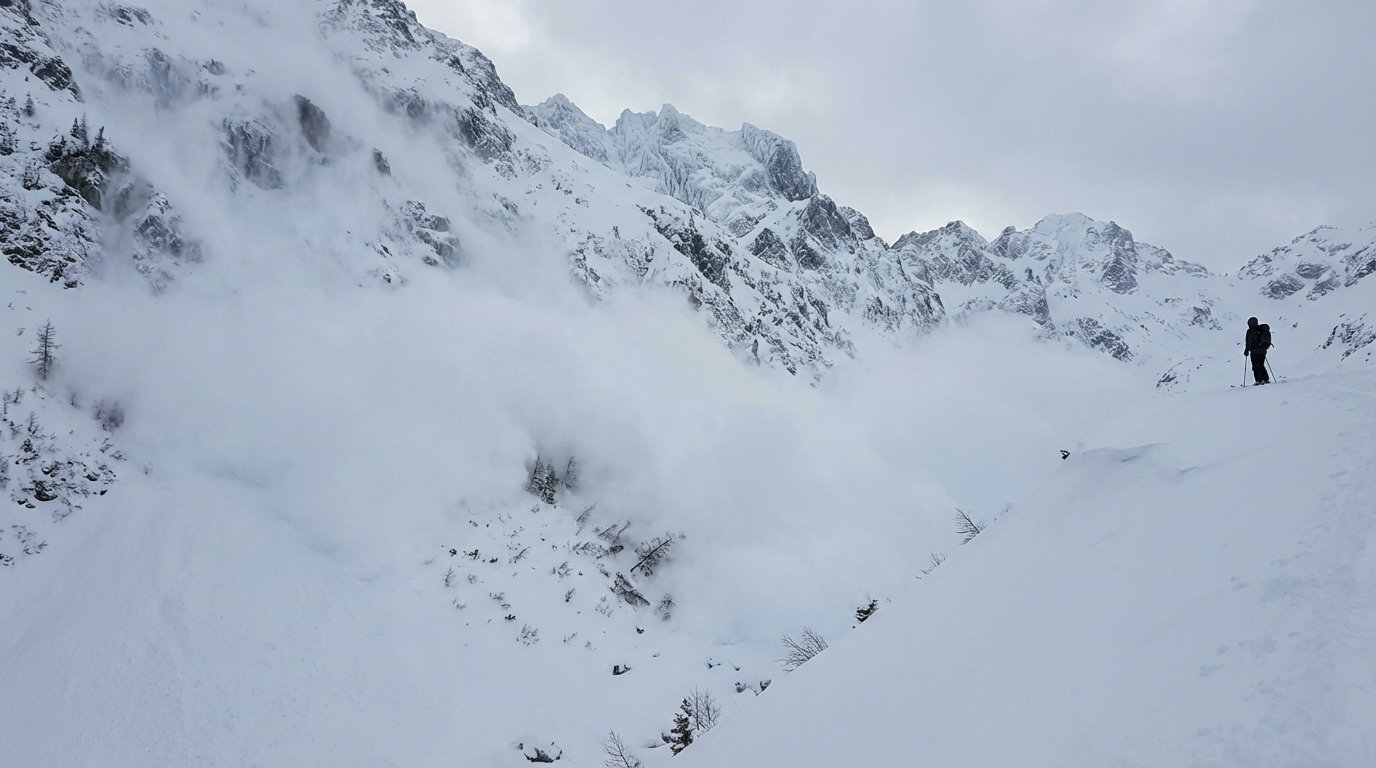
Heading off-piste this winter? Knowing about avalanches can save your life. This guide covers avalanche types, the avalanche forecast, emergency gear and how to move safely in the mountains.
Key points
- 01
90% of avalanche accidents are triggered by the victims themselves
- 02
Read the avalanche forecast before every tour, no exceptions
- 03
Transceiver, shovel and probe are a must, but they only work if you've trained with them
- 04
Most avalanche victims die from suffocation, not from injuries
- 05
The first 15 minutes are critical. After that, the chance of survival drops fast
On average, 100 people die in avalanches in the Alps every year. The sad truth is that most of these accidents could have been avoided. Expensive gear and years of experience are not what makes the difference. Solid basic knowledge is.
This guide gives you the avalanche basics that everyone who leaves the marked pistes in winter should know: avalanche types, the avalanche forecast, emergency gear and how to behave in the terrain.
The three main types of avalanche
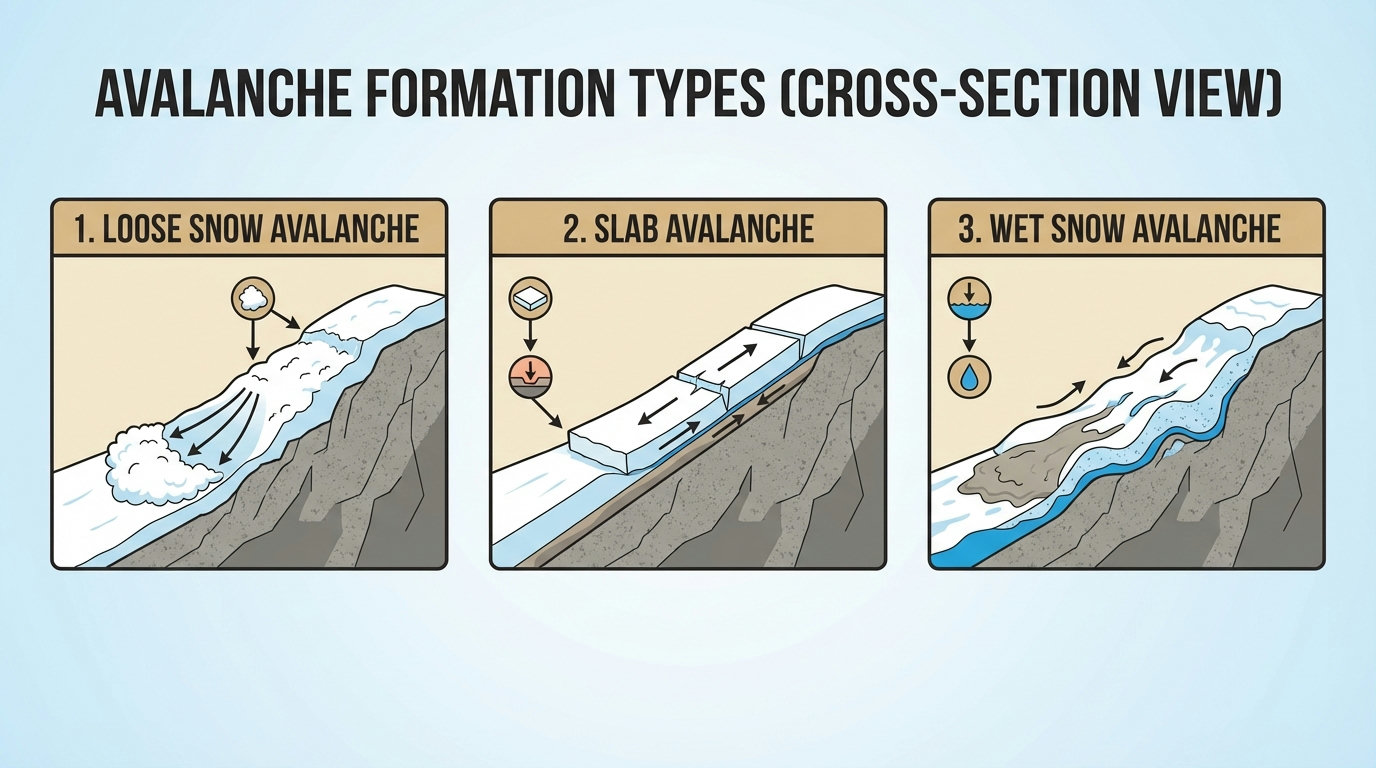
Avalanches differ. The type determines speed, destructive force and how likely it is to be triggered. For ski tourers, three types matter most:
Slab avalanche: the most dangerous type
A cohesive layer of snow breaks away on a weak layer and slides off as a slab. You can recognise it by the typical fracture line at the top.
- Speed: 80–300 km/h
- Trigger: usually people
- Danger: 90% of all fatal avalanche accidents
- Typical terrain: slopes of 30–45 degrees, wind-packed snow
Loose-snow avalanche
Individual snow crystals release at a single point and pull more snow with them, like an hourglass tipped over. It is pear-shaped and starts small. Usually it stays small, but it can grow large, typically in very steep terrain after fresh snow.
Wet-snow avalanche
Soaked snow loses its bond and slides. It tends to happen during the day as temperatures rise, especially in spring. It moves more slowly but carries an enormous mass and a lot of destructive force.
How to read the avalanche forecast
The avalanche forecast is your most important planning tool. Avalanche warning services publish it every day, and it describes the current danger.
The five danger levels:
- Level 1 (low): snowpack well bonded
- Level 2 (moderate): snowpack weakly bonded on some steep slopes
- Level 3 (considerable): snowpack weakly bonded on many steep slopes
- Level 4 (high): snowpack weakly bonded on most steep slopes
- Level 5 (very high): unstable snowpack, large spontaneous avalanches likely
What you must check:
- A danger level is no guarantee of safety: most accidents happen at level 2
- Elevation bands: different altitudes often have different levels
- Aspect: which slope directions carry the main danger?
- Avalanche problem: wind slab, persistent weak layers, wet snow
- Trend: is it getting better or worse?
Key avalanche warning services:
- Austria: lawinen.report
- Switzerland: slf.ch/lawinenbulletin
- Germany/Bavaria: lawinenwarndienst-bayern.de
- South Tyrol: lawinen.report
- France: meteofrance.com/meteo-montagne
Emergency gear: transceiver, shovel, probe
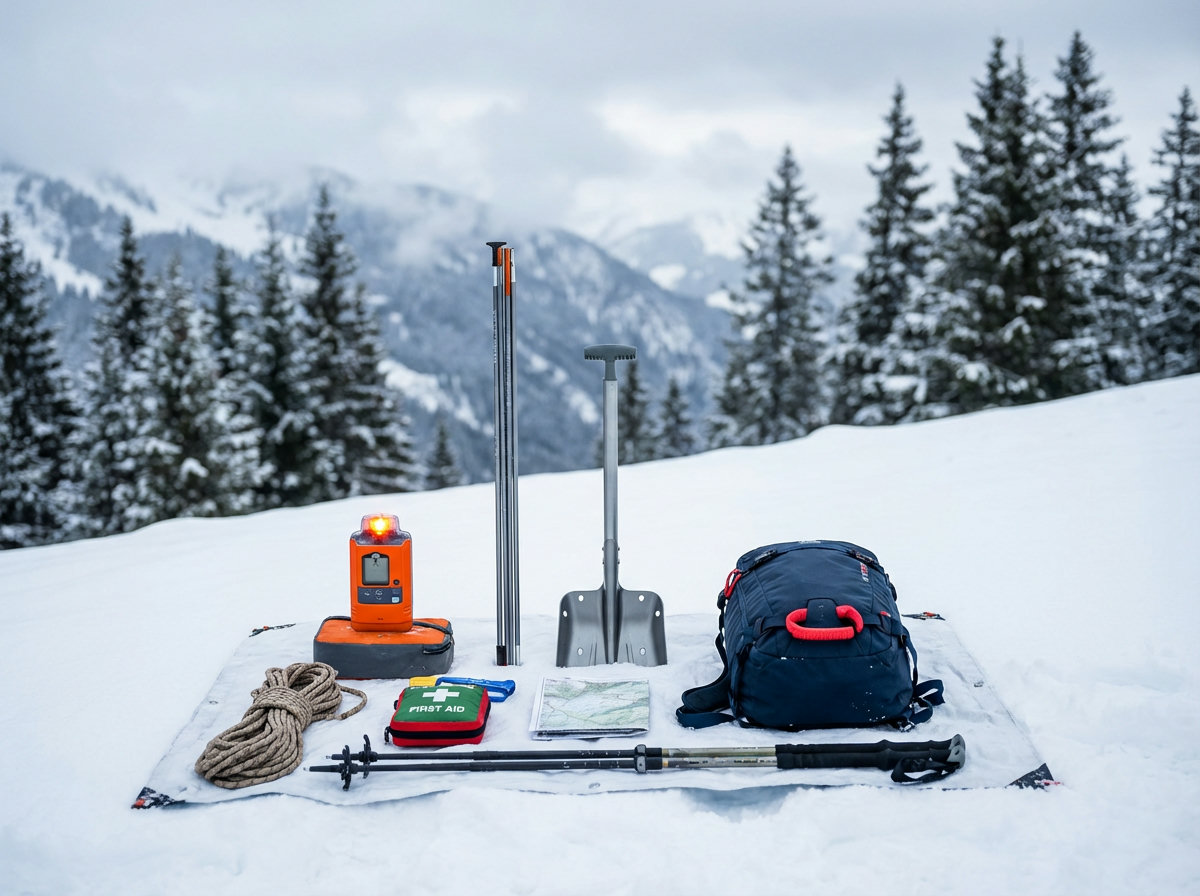
Standard emergency gear for ski touring has three parts. All three are mandatory, without exception. But be aware: the gear alone saves nobody. You only stand a chance in an emergency if you know how to use it.
Avalanche transceiver
It sends and receives electromagnetic signals at 457 kHz. Everyone wears one on their body in send mode. After an avalanche, the searchers switch to receive.
- Range: 40–60 metres on modern devices
- Three antennas have been standard since 2000
- Have it function-checked once a year
- Change the batteries regularly
Avalanche probe
A collapsible pole used to pinpoint the exact position once the transceiver has located someone. Without a probe, you're digging blind.
- Length: at least 2.40 m, better 2.80 m
- Material: aluminium or carbon
- Diameter: at least 11 mm for stability
- Markings: depth scale every 10 cm
Avalanche shovel
A sturdy shovel with a metal blade. A buried person lies under an average of one tonne of snow. Without a proper shovel, you have no chance.
- Blade: aluminium or stainless steel, never plastic
- Volume: blade of at least 2.5 litres
- Shaft: telescopic or detachable
- Weight: 600–800 g as a compromise
Training is mandatory
Owning the gear doesn't mean you can use it. In an avalanche accident, every second counts:
- After 15 minutes, the chance of survival drops below 50%
- After 35 minutes, it is below 20%
- Professional rescue often takes 30–60 minutes to arrive
You and your group are the first responders. An avalanche course takes two days and is the most important investment you can make. On it you'll learn:
- Fast, structured transceiver searches
- Efficient digging with a strategy instead of brute force
- Probing without losing time
- Teamwork and communication
- First aid for buried victims
How to move safely in avalanche terrain
Before the tour:
- Read and understand the avalanche forecast
- Plan your route, with alternatives
- Watch the weather and how temperatures develop
- Check your gear, including a transceiver test
- Brief the group: who leads? Where are the critical sections?
During the tour:
- Keep your distance: at critical points, only one person on the slope at a time
- Watch the slope angle: danger starts at 30 degrees, and 35–40 degrees is the critical range
- Spot wind slab: wind-packed snow sounds hollow and breaks off in slabs
- Whumpf sounds and cracks: turn back immediately, the snowpack is unstable
- Spacing to reduce load: 10 m apart uphill, 30–50 m downhill
- Regroup at safe spots after key sections
Take warning signs seriously:
- Recent avalanches, even small ones
- Whumpf sounds as you walk
- Cracks shooting through the snowpack
- Snow plumes blowing off ridges
- A rapid rise in temperature
What speaks for it
Turning back is a strength; most accidents happen on the way home
Plan alternative routes: north side dangerous? Then pick a different aspect
Small objectives are often the more beautiful ones, and the safer ones
Cautious days build experience without the risk
What to weigh up
"Just this one slope": summit fever is dangerous
Ignore group pressure: better to turn back alone than die together
Time already invested is no reason to take a risk
Powder is tempting, but fresh wind slab can be deadly
In an emergency: what to do in an avalanche
If you are caught in an avalanche:
- Shout loudly so others know your last position
- Get rid of skis or board if you can, to avoid leverage injuries
- Make swimming movements to try to stay on the surface
- Create an air pocket: as the avalanche slows, put your hands in front of your face to keep space to breathe
- Stay calm, because panic uses up oxygen
If someone is buried:
- Remember the point where you last saw them, and watch closely where they disappeared
- Call 112 while you search, not before
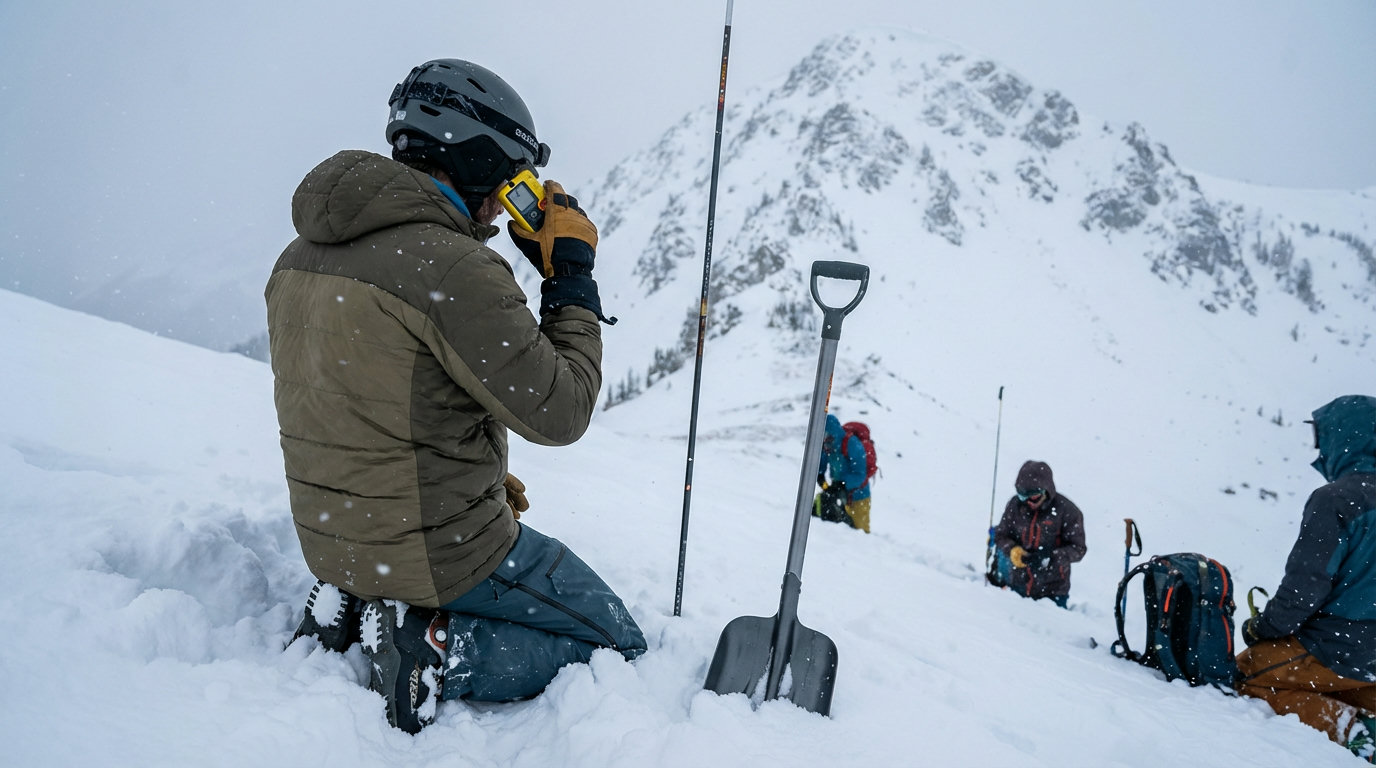
- Start the transceiver search: everyone switches to receive, then a systematic coarse search, fine search and pinpoint search, and probe once the signal is clear
- Dig strategically: in a V shape from below, not straight down from above
- First aid: clear the airway, keep them warm, prepare for rescue
The first 15 minutes decide everything:
- 0–15 min: 90% chance of survival
- 15–35 min: 30% chance of survival
- 35+ min: below 20% chance of survival
You are the only realistic rescue. Professionals arrive too late.
Frequently asked questions
Is a transceiver enough without training?
No. Untrained people need 10–15 minutes to locate a signal, which is too long. With training you can do it in 3–5 minutes. Digging also takes the most time, and here technique helps more than strength.
Can I go ski touring alone?
Technically yes, but the risk rises sharply. If you're buried, there's nobody to dig you out. If you go alone, only do it at the lowest danger levels, on the most cautious routes and in full awareness of the risk.
At what danger level should I stay at home?
It depends on your experience and the terrain. As a rule of thumb, beginners should go no higher than level 2, while experienced tourers can go out at level 3 with a cautious choice of route. From level 4, it is only justifiable for professionals with excellent knowledge of the terrain.
What does an avalanche course involve, and who offers one?
Basic courses usually take two days. Prices vary by provider and country. It's the best investment you can make: cheaper than any piece of gear and potentially life-saving. Many mountain schools and local sections of the alpine clubs offer courses.
How often do I need to check my transceiver?
Do a function test (send and receive with a partner) before every tour. Have it checked once a year by a retailer or an alpine club. Change the batteries before every season, even if they still work.
Does an avalanche airbag protect you better than a transceiver?
An airbag improves your chance of survival because it keeps you on the surface. But it does not replace transceiver, shovel and probe. If you do get buried, you still need to be found. An airbag is an addition to your kit.
Your next step: an avalanche course
This guide is a start, but no substitute for practical training. An avalanche course teaches you the skills that save lives when it really matters.
What you learn on a basic course:
- Interpreting the avalanche forecast
- Assessing terrain: slope angle, aspect, warning signs
- Understanding how the snowpack is built up
- Transceiver searches in realistic conditions
- Shovel and probe technique
- Strategic digging
- Group management and communication
Course providers:
- German Alpine Club (DAV)
- Austrian Alpine Club (ÖAV)
- Swiss Alpine Club (SAC)
- Private mountain schools and mountain guides
- Ski touring operators
A two-day course is the most important investment you can make.
Sources
- SLF Swiss Institute for Snow and Avalanche Research: avalanche bulletin ↗
- Avalanche warning services Tyrol: EAWS ↗
- German Alpine Club (DAV) safety research: avalanche accident statistics ↗
- Harvey, Rhyner, Schweizer: Lawinenkunde, Bruckmann Verlag
Inspiration, knowledge and gear for people who want more from the outdoors.