
SportFits Travel
Climate change in the Alps: what changed in 2025
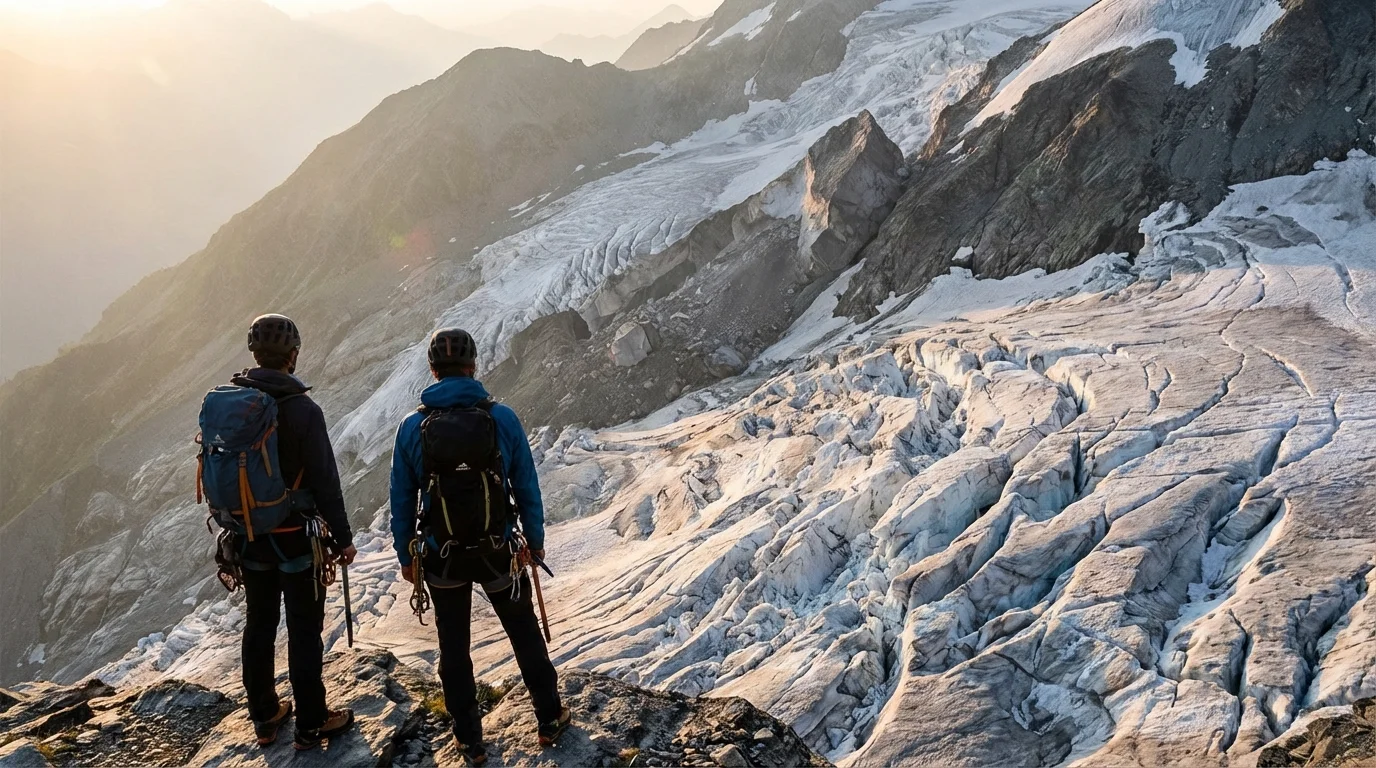
Glaciers are vanishing, rockfall is increasing and routes are becoming impassable. Climate change is reshaping the Alps faster than expected, and here is where things stand.
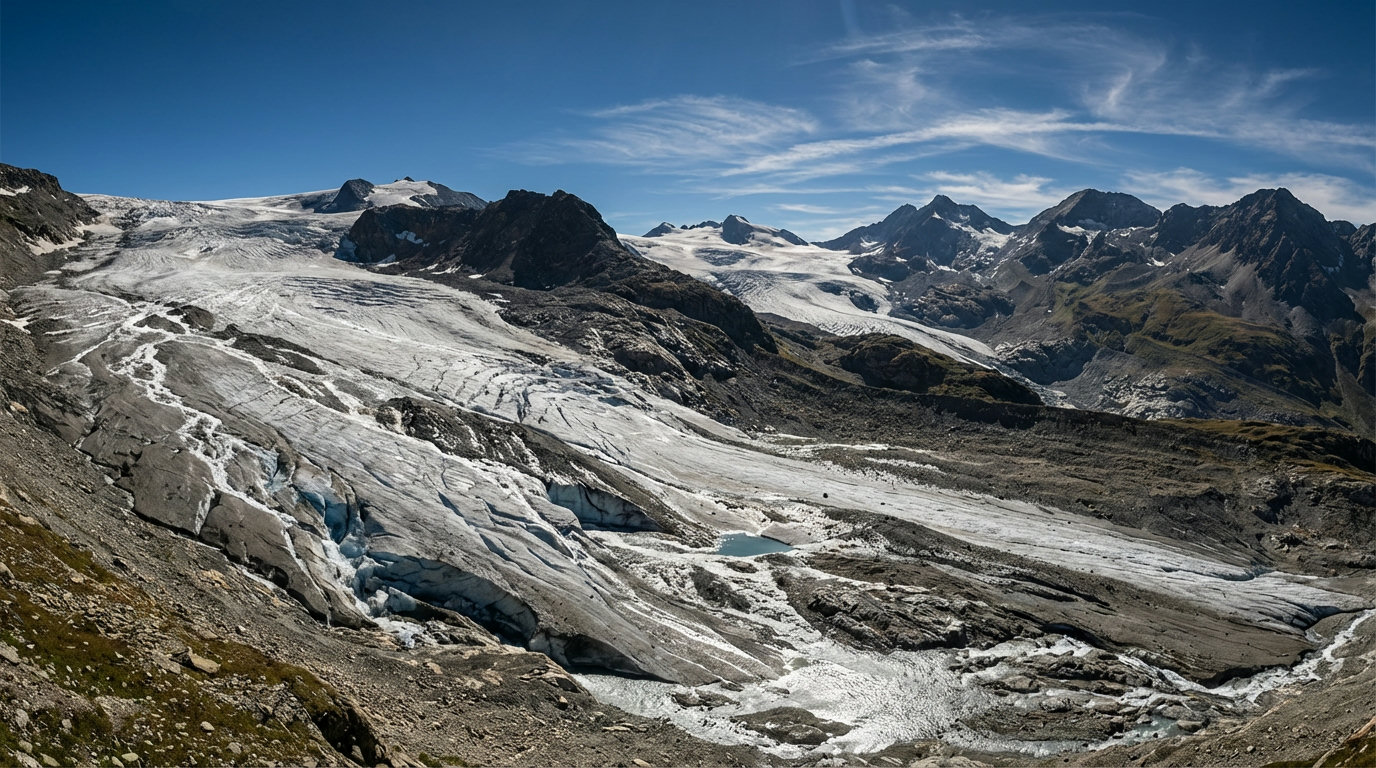
Key points at a glance
- 01
Between 2022 and 2023, the Alps lost ten per cent of their total glacier mass, a historic record
- 02
The Blatten rockslide in May 2025 destroyed 90 per cent of the Swiss village and shows the danger of thawing permafrost
- 03
Glacier melt could peak from 2033 onwards. After that, there will be hardly any ice left to melt
- 04
Classic high-alpine routes are increasingly impassable or dangerous because of rockfall
- 05
The Alps supply 40 per cent of Europe’s freshwater, and this source is under long-term threat
Where things stand: the Alps are warming twice as fast
When I stood at the Aletsch Glacier last summer, I was struck by how far the ice had retreated in just five years. The moraine we once crossed easily to reach the ice now lies hundreds of metres from the glacier’s edge.
The Alps are warming twice as fast as the rest of the world. Global average temperatures have risen by around 1.2 degrees since pre-industrial times; the Alpine region has already warmed by around 2 degrees. At higher altitudes the effect is stronger still, with far-reaching consequences for glaciers, permafrost, water supply and Alpine ecology as a whole.
Globally, 2024 was the hottest year on record. The United Nations therefore declared 2025 the International Year of Glaciers’ Preservation. A clear signal of how urgent the situation is.
Warming in the Alpine region +2°C
Since the late 19th century, twice the global average
Glacier loss 2022–2023 10%
In just two years, Alpine glaciers lost a tenth of their ice mass
Less rain and snow in the southern Alps -10-20%
The southern Alpine regions are recording significantly less precipitation
Glacier retreat: historic losses in record time
The figures are alarming. Worldwide, glaciers lose an average of 273 billion tonnes of ice per year. That is five and a half times the volume of Lake Constance, every single year.
The Alps are hit particularly hard: with 39 per cent mass loss between 2000 and 2023, they have the fastest melt rates in the world. The Austrian Alpine Club recorded its greatest glacier loss since measurements began in 1871 for 2021/22.
You can now see the difference with the naked eye. Routes that crossed ice 20 years ago run over bare rock today, and in many areas old guidebooks no longer match reality.
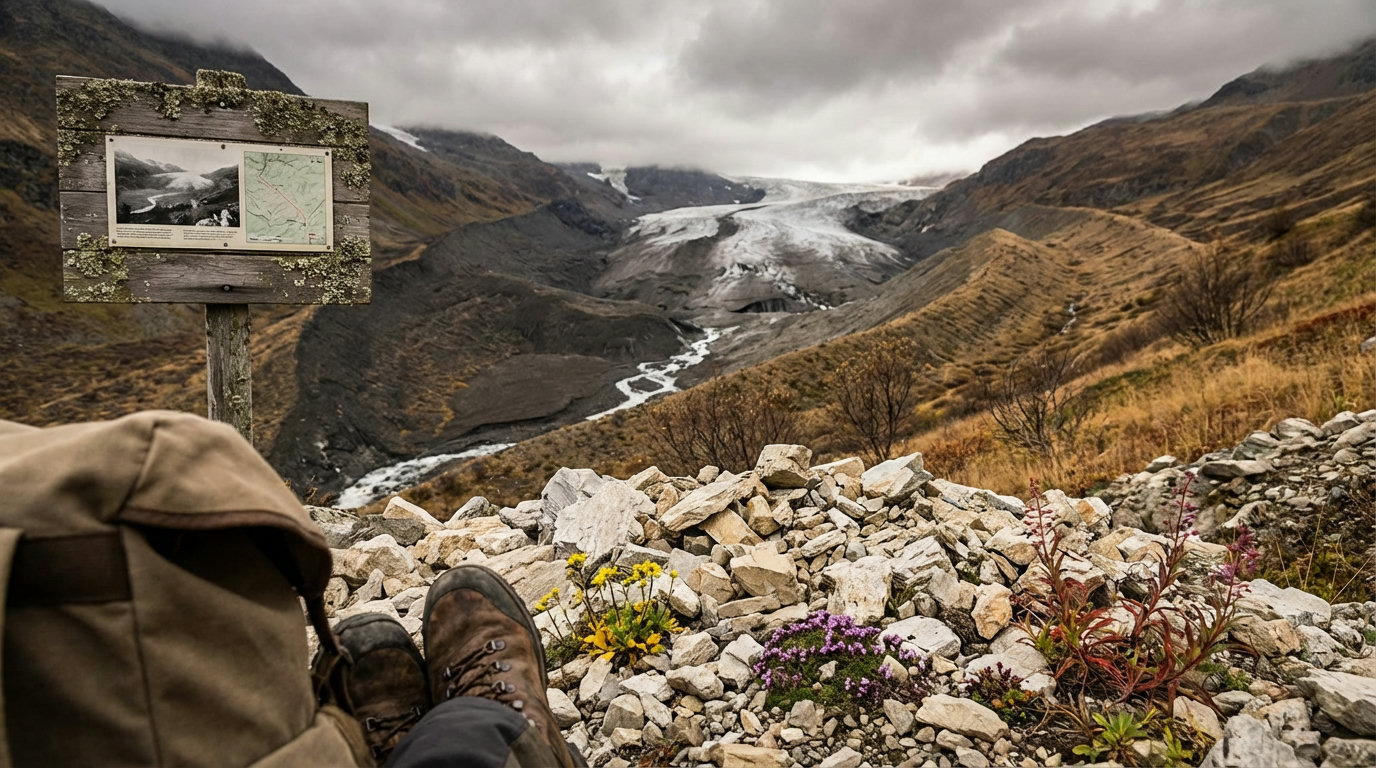
Glacier development in the Alps
| Period | Glacier area | Development |
|---|---|---|
1850 | approx. 4,000 km² | Reference value (end of the Little Ice Age) |
1970 | approx. 2,900 km² | 25% already lost |
2024 | approx. 2,000 km² | Over 50% lost since 1850 |
2050 (forecast) | approx. 1,000 km² | A further 50% loss expected |
2100 (forecast) | close to 0 km² | Alps largely free of ice |
Scientists speak of ‘peak glacier extinction’, the point at which glacier melt reaches its maximum. In the Alps, this could happen as early as 2033. It sounds paradoxical. What it means is that after this point there simply is not enough ice left to melt.
Even in optimistic climate scenarios that limit global warming to 1.5 degrees, only around 430 glaciers (12 per cent) will remain by the end of the century. With four degrees of warming, just 20 would be left: one per cent of today’s glaciers.
The Blatten rockslide: when the Alps start to slide
On 28 May 2025, a disaster in Switzerland’s Lötschental valley showed in the most tragic way how closely climate change and Alpine natural hazards are linked. Around nine million cubic metres of ice, mud and rock broke away above the village of Blatten.
The debris avalanche struck the Birch Glacier below, which gave way under the extra load. Ninety per cent of the village was buried. ‘The unimaginable has happened. We have lost the village,’ municipal president Matthias Bellwald told a press conference.
Blatten was not an isolated event. In 2017, eight people died at Piz Cengalo in Switzerland when around three million cubic metres of rock fell into the valley. The glacier collapse on the Marmolada in the Dolomites in 2022 also claimed lives.
The cause is the same each time: thawing permafrost destabilises the rock, rising temperatures make glaciers collapse, and heavy rainfall speeds up erosion.
Permafrost: the Alps’ invisible glue is thawing
Fewer people know about permafrost than about glaciers, yet it matters at least as much for the stability of the Alps. By area, the Alps actually contain more permafrost than glacier ice. This permanently frozen layer of sediment, rock and soil holds rock masses together like invisible glue. On south-facing slopes it occurs from around 3,000 metres, on north-facing slopes from around 2,400 metres.
When this frozen ground thaws, the rock loses its cohesion.
In many places, the layer of permafrost that thaws each summer is getting deeper. Water seeps into the rock, and the water pressure destabilises the rock mass. Water also collects in cracks, expands as it freezes and literally blasts the rock apart.
Researchers at the University of Geneva have traced rockfall back to 1920 by studying damage to trees. Their conclusion: from the mid-1980s onwards, activity reached a new level never seen before.
Impact on mountain sports
Mountaineers and hikers are feeling the changes more and more. Classic high-alpine routes are becoming impassable or significantly more dangerous. Huts are short of water, paths are destroyed by debris flows, and the risk of rockfall keeps rising.
The Mont Blanc route is particularly notorious: in summer, rockfall sweeps across the ascent route in the Goûter Couloir every 37 minutes. The danger on the Matterhorn has also grown considerably. Routes considered safe decades ago are now high-risk undertakings.
A mountain guide from Chamonix told me: ‘We now have to adjust our route recommendations almost every week. What was possible yesterday may already be too dangerous today.’ Huts report that their dormitories fill up earlier because the safe weather windows are shifting. Guidebooks from the 1990s often no longer reflect conditions on the ground.
What does this mean for planning your tours?
- 1
If you are planning classic high-alpine tours
check the latest conditions with the relevant Alpine club or the hut warden on the day
- 2
If you are travelling in glacier areas
expect routes to differ significantly from older maps
- 3
If you head to higher altitudes during a heatwave
set off early and avoid south-facing rock sections from midday, when rockfall risk is higher
- 4
If you are following a tour from an older guidebook
always check recent reports, as conditions may have changed fundamentally
Right for you if …
Mountaineers, high-alpine tourers and ambitious hikers in Alpine terrain
Probably not for you if …
This mainly affects terrain above 2,500 m. Day hikes at lower altitudes are less affected
The effects reach Alpine infrastructure too. Huts struggle with water shortages in dry summers, damage from heavy rainfall and increasingly unstable ground. In some places, alpine pasture huts are subsiding because the permafrost beneath them is moving.
More frequent debris flows after heavy rain mean more work to maintain paths. As glaciers retreat, many routes can no longer be followed in their original form: approaches have changed, and bridges over crevasses have disappeared.
Skiing in the Alps: for how much longer?
Winter sports are especially exposed to climate change. A study by the WSL Institute for Snow and Avalanche Research SLF in Davos predicts 70 per cent less snow in the Alps by the end of the century. Around 60 ski resorts have already closed down over the past 15 years.
Austria’s Central Institute for Meteorology and Geodynamics (ZAMG) has calculated that snow cover across all altitudes lasts 40 days less than it did in 1961. Munich now has an average of 20 fewer days with snow on the ground than in the 1950s.
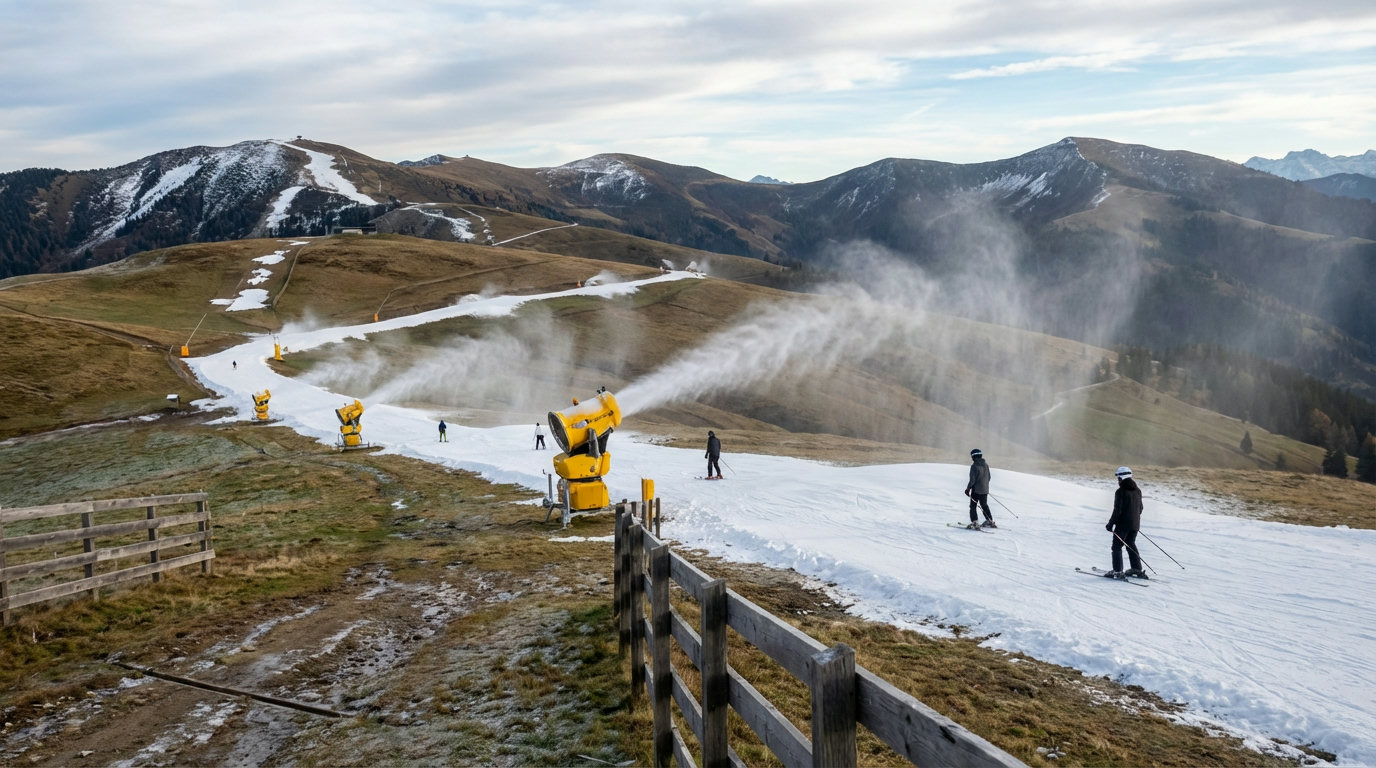
The forecasts leave little room for doubt. By 2100, there will be hardly any natural snow at lower altitudes unless far-reaching climate measures take effect. At 1,000 metres, snow cover would last 70 per cent less time.
Many ski resorts are turning to artificial snow, but it uses a lot of energy and water and simply pushes the problem further uphill. The industry has to broaden what it offers instead of relying on skiing alone.
Europe’s water tower: the blue gold of the Alps
The Alps are more than a place to unwind. They are also Europe’s largest freshwater reservoir, providing around 40 per cent of the continent’s freshwater and supplying millions of people via major rivers such as the Rhine, Danube, Po and Rhône.
With average annual precipitation of around 1,450 mm, the Alpine region sends 216 billion cubic metres of water a year into the surrounding lowlands: along the Rhine to the North Sea, via the Inn, Isar and Danube to the Black Sea, and along the Po and Rhône to the Mediterranean.
In summer, 60 to 70 per cent of the water in high-mountain streams currently comes from glacier melt. By the middle of the century, these streams will carry only 25 per cent of today’s volume, with far-reaching consequences for water supplies downstream.
The Rhône has already shown a marked drop in discharge since 1990. The four major rivers fed by the Alps draw around 50 per cent of their water from the Alpine arc. If this reservoir shrinks, the consequences reach far beyond the mountains.
Biodiversity: edelweiss and gentian at risk
Climate change is not only altering rock, ice and water in the Alps. The entire animal and plant world is affected, and species loss is becoming increasingly likely, warns biodiversity researcher Stefan Dullinger from the University of Vienna.
The problem: as temperatures rise, mountain plants are retreating ever closer to the summits. Warmth-loving species spread upwards and push out the species that live there. At the summit, though, there is nowhere left to go.
Climate change threatens edelweiss and many gentian species with extinction on many mountains. According to studies, some mountain regions could lose more than 80 per cent of their specialised plant species.
Animals face a similar outlook. In the Italian Alps, the tree line will move around 350 metres uphill by the end of the century. That means up to 50 per cent less habitat for ptarmigan, with no higher ground left to retreat to.
What you can do as a mountain sports enthusiast
Climate change in the Alps is a challenge for society as a whole. As a mountain sports enthusiast, you still have real options, both for your own safety and for protecting the mountains.
Rethink your journey
Getting to and from the mountains causes the largest share of a trip’s carbon footprint. Public transport, car sharing or staying longer in one place cut emissions significantly.
Research current conditions
Before every tour, check current conditions with the Alpine club, hut wardens or tour portals. Older guidebooks and maps may be out of date.
Start early in hot weather
In hot weather, set off early and get past south-facing rock sections before the midday sun. Rockfall risk rises with the temperature.
Adapt your choice of tour
Swap classic ice tours for rock climbing routes. Many regions have excellent alternatives that are less affected by glacier retreat.
Protect nature on the ground
Stay on marked paths, take your rubbish home and avoid sensitive areas. At a time of species loss, every bit of habitat you help protect counts.
You can also have an influence at a political level. Organisations such as the German Alpine Club (DAV) campaign for climate protection and for managing mountain regions with the long term in mind. Membership and active involvement make their voice stronger.
The changes of the coming decades are already locked in. How far things go after 2050, however, depends on whether we meet our climate targets. Every tonne of CO2 saved makes a difference.
Frequently asked questions
Will the Alpine glaciers disappear completely?
If current trends continue, yes. Even in optimistic climate scenarios, only around 12 per cent of today’s glaciers will be left by 2100. With four degrees of warming, it would be just one per cent. Smaller glaciers are expected to disappear within the next 20–30 years, and that is considered unavoidable.
Can I still do high-alpine tours in the Alps safely?
Yes, but it takes more preparation and caution than it used to. Up-to-date information on conditions is essential. Early starts, flexibility in your choice of route and avoiding known rockfall zones all make you safer. Some classic routes are, however, considerably more dangerous today than they were decades ago.
Is artificial snow a long-term solution for ski resorts?
Only to a limited extent. Artificial snow uses a lot of energy and water and only works when it is cold enough. At lower-lying resorts, it will not be a long-term solution either. Many experts recommend shifting towards year-round mountain tourism.
What does thawing permafrost mean for hiking trails?
Above 2,500 m, thawing permafrost can lead to damaged paths, rockfall and unstable ground. Trails in affected areas need more maintenance. Up-to-date information on path closures matters more than ever, especially after a heatwave.
How does climate change affect drinking water in Europe?
The Alps provide 40 per cent of Europe’s freshwater. As glaciers shrink, summer runoff falls, and by the middle of the century it could drop to 25 per cent of today’s volume. That affects water supplies far beyond the Alpine region, from Munich to Rotterdam.
Sources
- Deutscher Alpenverein: Glaciers are melting, permafrost is thawing ↗
- FAU: Climate change – glaciers are melting rapidly ↗
- Welt der Physik: The peak of glacier loss ↗
- DWD: The Blatten landslide ↗
- BUND Naturschutz: Climate change in the Alps ↗
- Umweltbundesamt: Climate change – water scarcity in the Alps? ↗
- LBV: Effects of climate change in the Alpine region ↗
Inspiration, knowledge and gear for people who want more from the outdoors.