
Training & Health
UV protection in the mountains: the underestimated risk
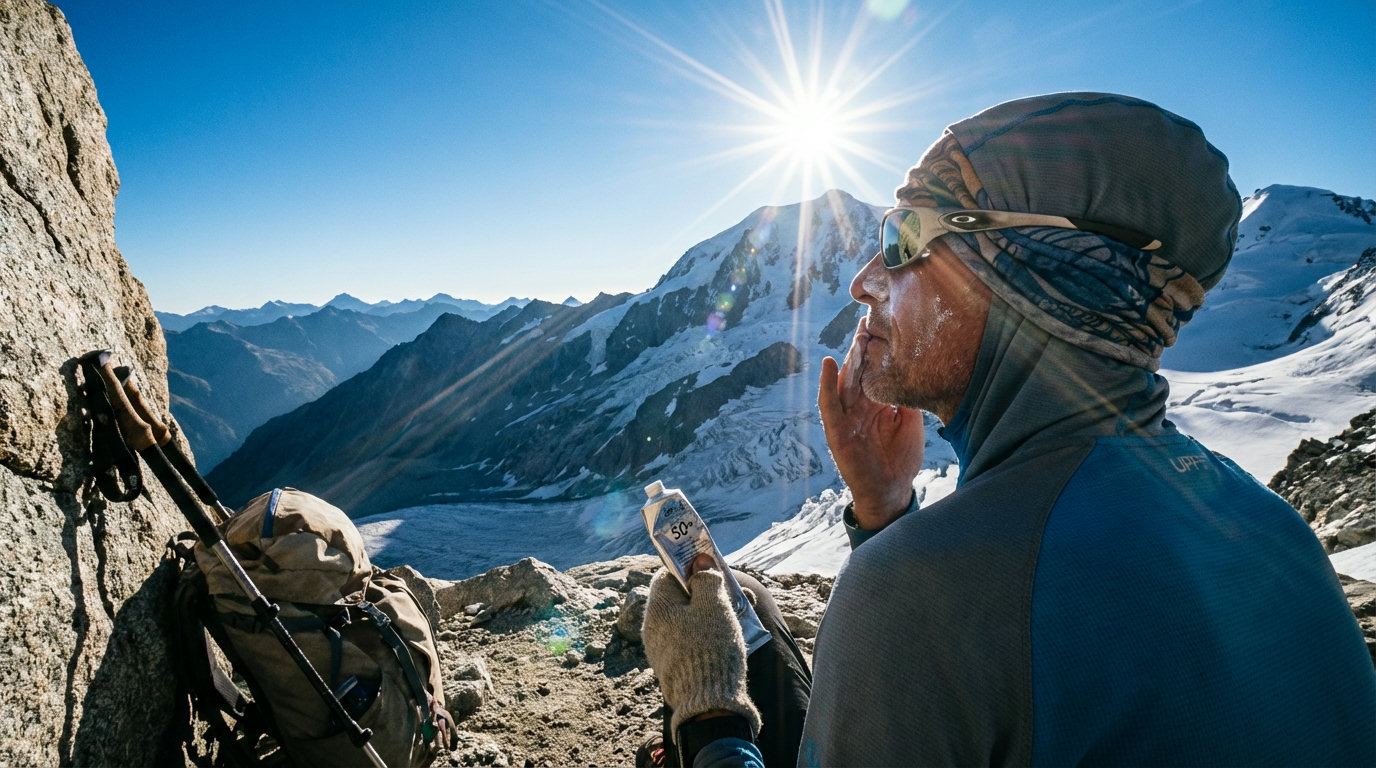
UV radiation rises by up to 18% for every 1,000 metres of altitude, and snow reflects up to 94% of it. What research shows about UV risk in mountain sports and how to protect yourself.
The essentials at a glance
- 01
For every 1,000 metres of altitude, sunburn-causing UV radiation rises by 18%, and short-wave UVB by as much as 24% (Blumthaler et al., 1997)
- 02
Fresh snow reflects up to 94% of UV radiation, which can double or triple the effective dose in the mountains
- 03
43% of mountain guides develop precancerous skin lesions, while sweating reduces the skin’s natural protection time by up to 17%
- 04
UPF clothing blocks over 99% of UVB radiation and outperforms sunscreen across all measured parameters (OHSU study 2022)
- 05
The best strategy: UPF 50+ clothing as your foundation, SPF 50+ sunscreen on exposed skin, reapplied every 2 hours
The altitude effect: why UV radiation is more dangerous in the mountains
The atmosphere is your natural UV filter, and that filter gets thinner with every metre of altitude. The thinner layer of air absorbs and scatters less UV radiation, while the biologically most harmful short-wave UVB levels increase disproportionately.
The pioneering study by Blumthaler et al. (1997) produced the measurements still cited most frequently today. Under clear-sky conditions, researchers measured the following between Innsbruck (577 m) and Jungfraujoch (3,576 m):
- Total radiation: +8% per 1,000 metres of altitude
- UVA radiation: +9% per 1,000 metres of altitude
- Erythemally effective UVB radiation: +18% per 1,000 metres of altitude
- Short-wave UVB (300 nm): +24% per 1,000 metres of altitude
In practical terms, at 3,000 metres you are exposed to 36–54% more sunburn-causing UV radiation than at sea level. Combined with snow reflection, the effective dose can double or triple.
UV reflection: snow as an extreme amplifier
The surface you move across has a major influence on your UV exposure. The review study by Turner & Parisi (2018) compiled all available UV albedo measurements for natural surfaces, and the findings make clear why snow plays a special role.
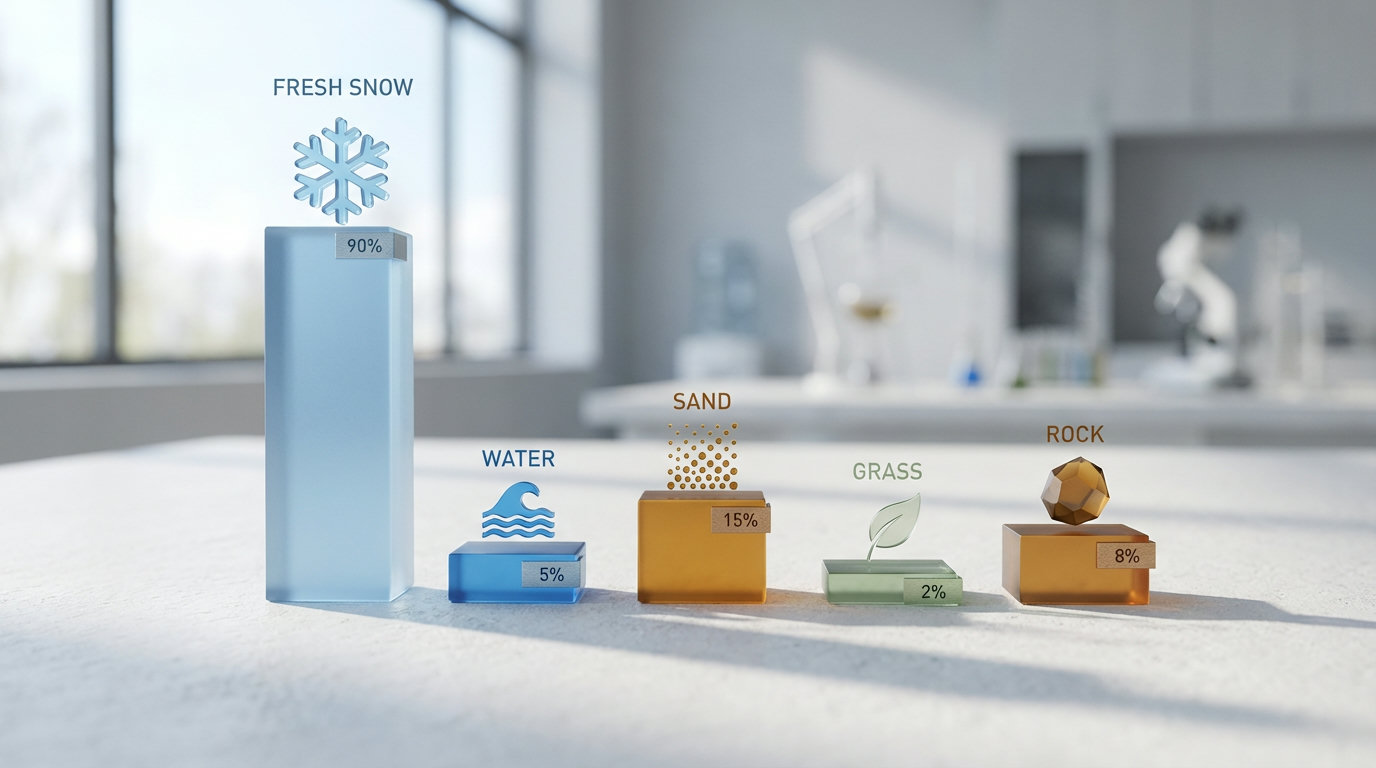
Fresh, dry snow reflects up to 94% of UV radiation, amounting to an almost complete doubling of exposure. Even old, dirty snow still reaches 59%. By comparison, grass reflects just 2% and water 3–5%.
One effect that is often underestimated: radiation reflected by snow reaches the body from below, hitting areas that usually receive very little UV, including the chin, nostrils and beneath the eyebrows. A 3D model by Feister et al. (2016) showed that in snow-covered mountains, UV exposure across the whole body rises by 10% per 100 metres of altitude, significantly more than the altitude effect alone.
UV reflection (albedo) of natural surfaces
| Surface | UV albedoSource: Turner & Parisi 2018 | Relevance for sport |
|---|---|---|
Fresh, dry snow | 85–94% | Skiing, ski touring, snowshoeing |
Fresh, wet snow | ~79% | Spring ski tours, firn snow |
Old snow (dry) | 50–82% | Late winter, pistes |
Sea spray / surf | 20–30% | Surfing, water sports |
Dry sand | 4–18% | Beach volleyball, beach sports |
Limestone / rock | 4–11% | Climbing, via ferrata |
Asphalt / concrete | 2–15% | Running, cycling |
Lake / river water | 3–5% | Swimming, paddling |
Grass / meadow | 0.5–4% | Hiking, trail running |
What the research shows: skin cancer risk among mountain sports athletes
The evidence is clear, and sobering. Outdoor athletes have a measurably higher risk of skin cancer and its precursors. Three groups have been particularly well studied: mountain guides, marathon runners and people living at high altitude.
Mountain guides: the highest UV exposure of any profession
The dosimetry study by Moehrle et al. (2003) produced alarming figures: nine mountain guides wore UV dosimeters for one year. Their average daily dose exceeded the occupational exposure limit sixfold, while peak values were as much as 23 times higher.
The consequences are measurable. Zink et al. (2016) examined 62 mountain and ski guides in southern Germany: 43.5% had skin cancer or precursors (primarily actinic keratoses). Almost half had never seen a dermatologist. In a follow-up study (2018), mountain guides had a 2.6 times higher risk of skin cancer than farmers, despite farmers also working extensively outdoors.
Mountain guides’ annual UV dose 1,273 SED
Median annual dose. For comparison: the occupational exposure limit is 1.08 SED per day. Mountain guides exceed it sixfold on average.
Skin cancer rate among mountain guides 43.5%
Almost one in two mountain guides in southern Germany has skin cancer or precursors (actinic keratoses). Cross-sectional study of 62 state-certified mountain and ski guides.
Sweat effect –17%
Sweating reduces the minimal erythema dose by up to 17%. Sweat hydrates the outermost layer of skin, allowing more UV radiation to penetrate deeper skin layers.
Melanoma risk among athletes +27%
A high level of physical activity was associated with a 27% higher melanoma risk in a pooled analysis of 12,438 cases (HR 1.27).
Marathon runners and endurance athletes
A study at the Medical University of Graz (Ambros-Rudolph et al., 2006) compared 210 marathon runners with a control group. The runners had significantly more atypical moles and sunspots, both of them melanoma markers.
Particularly revealing: Richtig et al. (2008) found an average of 19.6 sunspots on exposed areas (shoulders) and not a single one on covered areas (buttocks). Training intensity correlated directly with the number of melanoma markers. The harder the training, the more skin changes occurred.
96.7% of marathon runners trained in shorts, but only 56.2% used sunscreen regularly. Among trail runners, 66.5% reported sunburn during training.
UPF clothing vs sunscreen: a direct comparison
The first head-to-head comparison study of UPF clothing and sunscreen was conducted in 2022 by Berry et al. at Oregon Health & Science University (OHSU). The result was clear: UPF clothing outperforms sunscreen across all measured parameters.
UPF textiles blocked more than 99% of UVB and 96–98% of UVA radiation. SPF 30 sunscreen achieved 76% UVB protection when applied at the optimal amount, while SPF 50 reached 94%. Under real-world conditions, where people typically apply only half the recommended amount, the gap is even greater.
UPF clothing vs. sunscreen (OHSU study, 2022)
| Parameter | UPF clothingRecommendation | SPF 30 cream | SPF 50 cream |
|---|---|---|---|
UVB protection |
| 76% | 94% |
UVA protection | 96–98% | ~54% | ~82% |
Need to reapply? | No | Every 2 hours | Every 2 hours |
Sweat-resistant? | Yes, consistent | Decreases | Decreases |
Risk of application errors? | No | Common (too little, unevenly applied) | Common |
Protection after 50 washes | 95–100%* | – | – |
Limitation: Not all UPF clothing retains its protective effect over time. A 2023 Cureus study found that two of the seven brands tested lost 70–78% of their UPF rating after 50 wash cycles. These brands relied on nano-zinc additives rather than the fabric structure itself. Clothing with UV protection from densely woven polyester or fibres spun into the fabric retains its effectiveness better than chemically treated textiles.
What to look for when buying:
- Certified UPF 50+ (blocks >98% of UV radiation)
- Choose fibre-based protection where possible (dense polyester, not just a chemical finish)
- Sweat- and water-resistant construction
- Ventilation zones for comfort during sport
Your UV protection plan for the mountains
The scientific consensus is clear: use UPF clothing as your base protection and sunscreen on uncovered skin. This combination provides the best overall protection, without application errors and with minimal effort. Here is your practical plan.
Choose clothing as your first protective layer
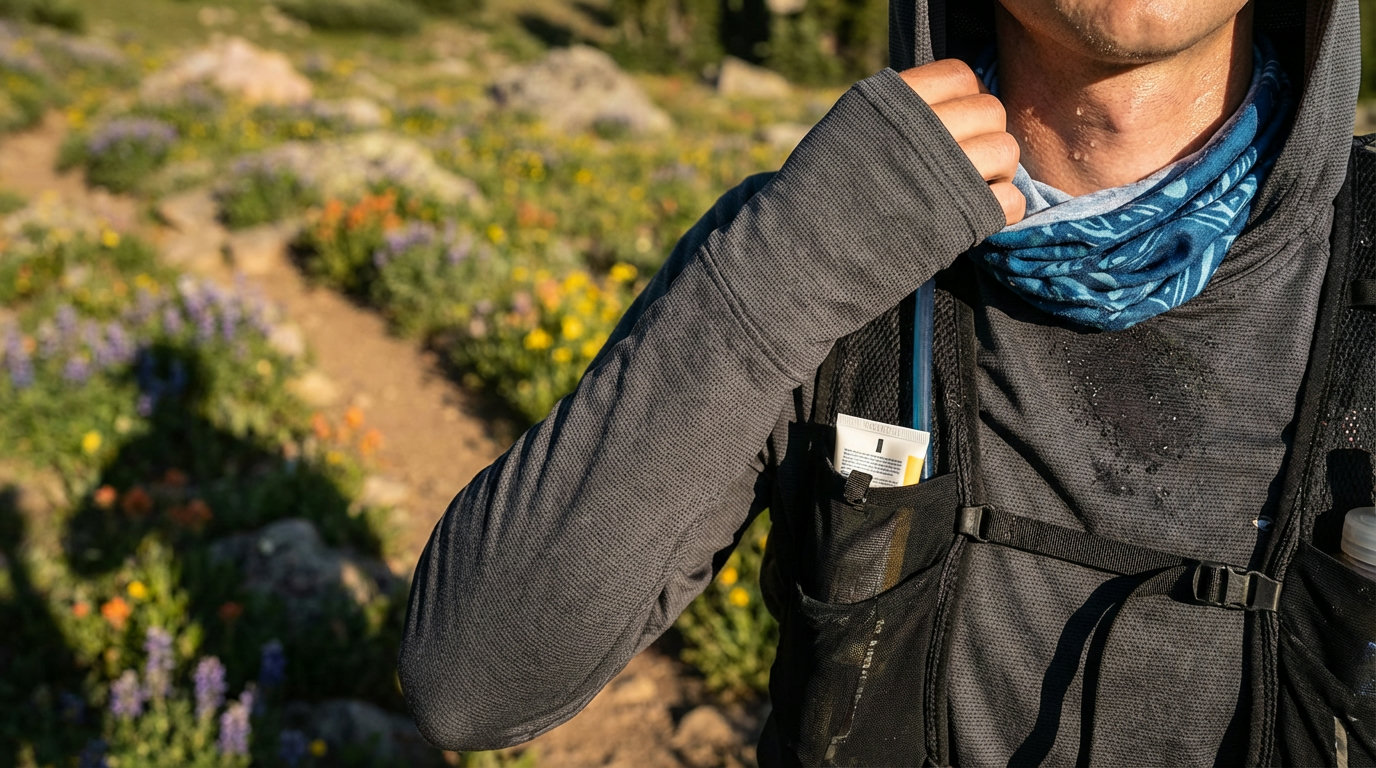
Start with a UPF 50+ T-shirt, hoodie or long-sleeve top. Add a UV neck gaiter for your neck and nape, plus a wide-brimmed hat or a cap with neck protection. Choose fibre-based UV protection rather than a chemical finish alone.
Apply sunscreen generously to uncovered skin
Apply SPF 50+ broad-spectrum sunscreen (UVA + UVB) to your face, ears, neck, backs of your hands and all exposed areas. Put it on 30 minutes before setting off rather than once you are already in the mountains. Choose a sweat- and water-resistant formula.
Reapply every 2 hours
Even water-resistant sunscreen loses effectiveness through sweat and friction. Set a timer or build it into your routine, for example by reapplying at every drink break. Reapply more often in snow, around water or when sweating heavily.
Protect your eyes with glacier glasses or sports sunglasses with a UV filter
UV radiation can also damage the cornea, causing snow blindness, and increases the risk of cataracts. Wear sports sunglasses with a UV400 filter or category 3–4 glacier glasses. Choose side protection in snow.
Consider the time of day and UV index
UV exposure is highest between 10 am and 2 pm. Where possible, plan intense activities for early morning or late afternoon. UV index apps can help you assess conditions.
Have an annual skin check
If you regularly take part in outdoor sports, have a dermatological check-up once a year. Do not ignore unusual moles or changes to your skin.
Which protection strategy suits your activity?
- 1
If you go ski touring or snowshoeing
maximum protection is essential: UPF hoodie, glacier glasses, SPF 50+ and lip protection, because snow reflection can double the UV dose
- 2
If you go on high-altitude tours in summer
choose lightweight UPF long-sleeve tops with ventilation zones and reapply sun cream every 90 minutes, as sweat reduces its protective effect
- 3
If you go trail running or cycling
UPF arm sleeves are a practical solution: quick to put on and take off, with no sun cream needed on your arms
- 4
If you are out in cloudy conditions
do not underestimate UV exposure: up to 80% of UV radiation penetrates clouds, so protection still matters
- 5
If you have sensitive skin or take medication
check whether your medication can cause phototoxic reactions (e.g. doxycycline, ibuprofen) and increase your protection accordingly
FAQ: common questions about UV protection in outdoor sports
Frequently asked questions
Is a standard T-shirt enough for UV protection?
A standard white cotton T-shirt has a UPF of around 5–7, blocking only 80–85% of UV radiation. By comparison, UPF 50+ clothing blocks more than 98%. When wet, a standard shirt’s protection drops significantly further.
How often do I really need to reapply sun cream?
Every 2 hours, and more often if you sweat heavily or come into contact with water. Important: most people apply only half the recommended amount (2 mg/cm²). For the face, that is roughly one level teaspoon.
Does a sunbed tan provide any protective effect?
No. Sunbeds emit mainly UVA radiation and do not build up a protective tan. The WHO and the International Agency for Research on Cancer (IARC) classify sunbeds as carcinogenic. Tanning on a sunbed before a holiday increases the risk of skin cancer.
Do I need UV protection in cloudy weather too?
Yes. Up to 80% of UV radiation penetrates thin cloud cover. The particularly tricky part is that the perceived temperature is lower, so UV exposure is often underestimated. In the mountains, increasing altitude adds to this.
Does UPF clothing lose its protection after frequent washing?
That depends on the technology. Clothing with fibre-based UV protection (dense polyester, spun into the fibre) largely retains its UPF. Chemically treated textiles (e.g. with nano-zinc additives) can lose up to 78% of their protection after 50 washes.
Your protection starts with the right clothing
Discover UV-protective clothing, sunglasses and sun cream for your next day outdoors.
Discover outdoor clothing ↗Sources
- Blumthaler et al.: Increase in solar UV radiation with altitude – J. Photochem. Photobiol. B, 1997 ↗
- Turner & Parisi: UV Albedo and Reflectance in Review – Int. J. Environ. Res. Public Health, 2018 ↗
- Moehrle et al.: Continuous UV monitoring in mountain guides – Int. J. Cancer, 2003 ↗
- Zink et al.: NMSC in mountain guides – Swiss Med. Wkly, 2016 ↗
- Berry et al.: Slip versus Slop – UPF Clothing vs. Sunscreen – Cancers, 2022 ↗
- Gilaberte et al.: Photoprotection in Outdoor Sports – Dermatol. Ther., 2022 ↗
- Moehrle et al.: Reduction of minimal erythema dose by sweating – Photodermatol., 2000 ↗
- WHO: Ultraviolet Radiation – Health Topics ↗
- Skin Cancer Foundation: Sun Protective Clothing ↗
Inspiration, knowledge and gear for people who want more from the outdoors.