

Buying Guides
Hydrostatic head: why 30,000 mm is not always better
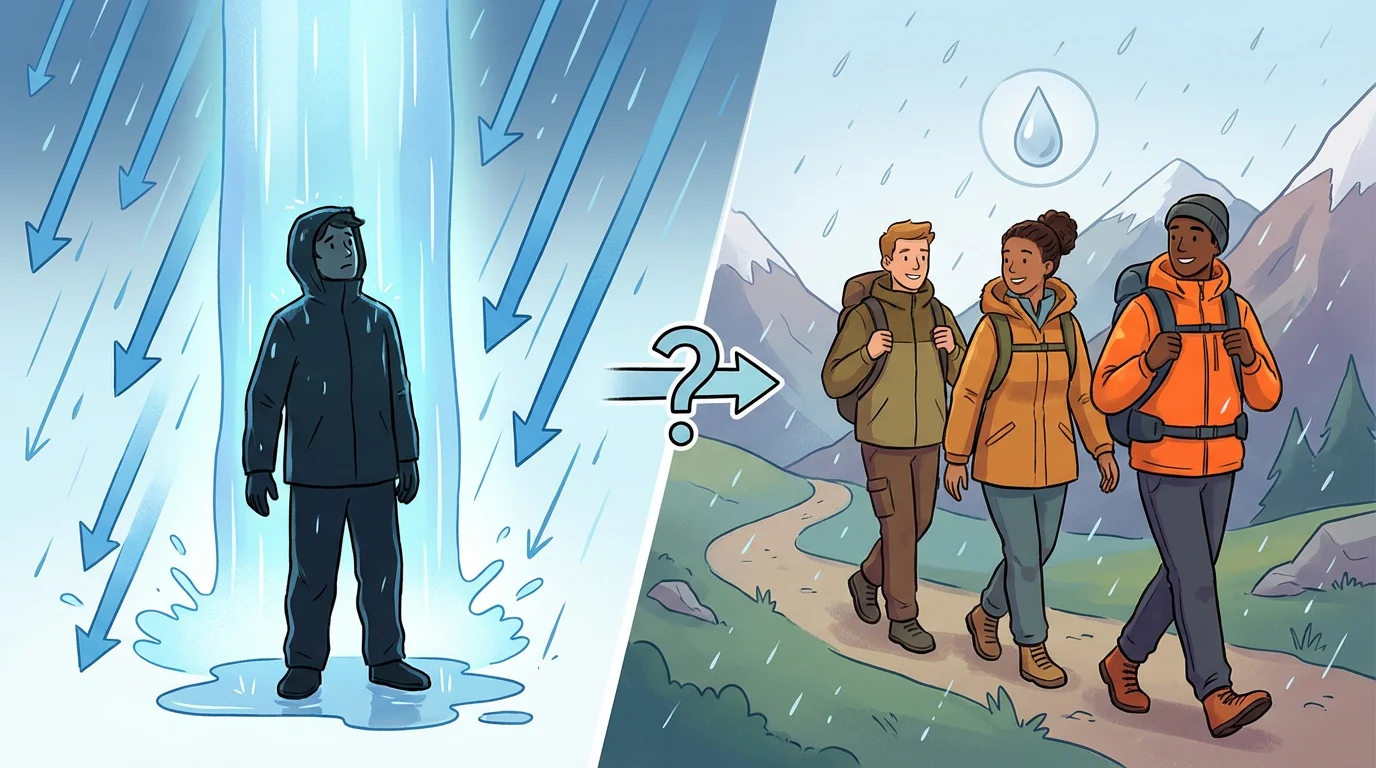
Hydrostatic head is the most quoted buying criterion for rain jackets and tents, and the most misunderstood. We clear up the most persistent myths.
Key points at a glance
- 01
A higher hydrostatic head does not automatically mean better quality. Construction and coating type are often more important.
- 02
The EU standard defines materials as waterproof from 1,300 mm, but at least 10,000 mm is recommended for outdoor use.
- 03
Silicone coatings with 1,200 mm can perform better over the long term than PU coatings with 4,000 mm.
- 04
The DWR treatment often has a greater impact on how dry you feel than the membrane itself.
- 05
Seams, zips and hood construction are the real weak points, not the material.
Hardly any buying criterion is quoted as often for rain jackets and tents as hydrostatic head, and hardly any is so misunderstood. 30,000 mm sounds better than 10,000 mm, right? Not necessarily. Here, you will find out how the test works, which myths persist and what really matters when buying.
What hydrostatic head really measures
Hydrostatic head measures pressure, or more precisely, the water pressure a material can withstand before droplets penetrate it. The test is simple: a piece of fabric is clamped beneath a cylinder that is slowly filled with water. Depending on the standard, the pressure rises by 100 to 600 millimetres per minute. The test ends as soon as the third droplet becomes visible on the inside. The height of water reached is the hydrostatic head.

In figures: a hydrostatic head of 10,000 mm means a 10-metre-high cylinder of water could stand on the fabric before anything penetrates it. That corresponds to around 1 bar of pressure. Sounds impressive. But what does it mean in practice?
| Description | Hydrostatic head | Pressure |
|---|---|---|
Light rain | approx. 1,000 mm | 0.1 bar |
Average jacket | 10,000 mm | 1.0 bar |
Premium membrane | 20,000 mm | 2.0 bar |
Gore-Tex standard | 28,000 mm | 2.8 bar |
Sympatex maximum | 45,000 mm | 4.5 bar |
Myth 1: Higher hydrostatic head = better quality
The biggest misconception of all. The Austrian Camping Club puts it well: if you thought the higher the value, the better, read on. Excessively high hydrostatic-head ratings for tents are often marketing, as real-world use rarely demands such extreme values.
The silicone paradox
Here is the interesting part: a silicone coating rated at 1,200 mm is often more waterproof than a PU coating rated at 4,000 mm. The reason: silicone is smoother and structurally denser than polyurethane. With PU, the hydrostatic head can halve after intensive use and continue to fall. With silicone, it remains almost constant.
| Coating | Typical hydrostatic head | Long-term performance | UV resistance |
|---|---|---|---|
Silicone (SI) | 1,200–3,000 mm | Remains almost constant | Very high |
Polyurethane (PU) | 3,000–10,000 mm | Can halve | Low |
SI/PU hybrid | 3,000–8,000 mm | Good | Medium |
PU therefore needs a much greater safety margin than silicone to deliver the same long-term performance. A high number on paper can quickly diminish in practice.
Myth 2: The EU waterproof standard is relevant in practice
Under EN 343:2003, clothing is considered waterproof from 800 mm upwards (Class 2), and from 1,300 mm upwards as Class 3. That may sound sufficient, but for outdoor use it is virtually meaningless. Swiss EMPA assumes that functional material is only truly waterproof from 4,000 mm upwards.
| Standard | Requirement | Practical relevance |
|---|---|---|
EN 343 Class 2 | from 800 mm | For light drizzle |
EN 343 Class 3 | from 1,300 mm | Legally waterproof |
EN 343 Class 4 | from 2,000 mm | Minimum requirement |
Swiss EMPA | from 4,000 mm | Waterproof in practice |
Outdoor recommendation | from 10,000 mm | Suitable for sustained rain |
USA vs Europe: the difference in test methods
Another stumbling block: the USA and Europe measure differently. European manufacturers test new products, while American brands such as Big Agnes and MSR simulate five years of use. This means that 3,000 mm under the US standard performs significantly better in practice than 3,000 mm measured using the European method.
Myth 3: a jacket rated at 30,000 mm is guaranteed to keep you dry
Wrong. Even Gore-Tex acknowledges that this test is not relevant to real-world use. When worn, there is no static pressure as there is in the lab. EMPA tested clothing with a hydrostatic head below 120 mm: under simulated rainfall, it remained completely dry. Hydrostatic head is a theoretical maximum value that does not reflect real conditions.
The real weak points of a rain jacket
Hydrostatic head tells you about the fabric. The critical points lie elsewhere, in the construction: seams, zips and hood design. Every needle creates tiny holes in the membrane. Uncovered zips are entry points for water. And the hood’s cut determines whether water runs into the collar.
What speaks for it
Taped or welded seams prevent water entering through needle holes
Waterproof zips or storm flaps protect the openings
Well-designed hoods with a peak and adjustment options keep the collar dry
High-quality DWR treatment makes water bead up before it reaches the membrane
What to weigh up
Untaped seams let water through, regardless of the hydrostatic head
Unprotected zips are the most common cause of a wet inner layer
Poorly fitting hoods channel water straight onto the back of your neck
Worn DWR treatment leads to wetting out and a feeling of dampness
Practical pressure values for everyday use
What many people underestimate: everyday activities generate surprisingly high pressure. A person weighing 80 kg produces around 1,000 mm of pressure when lying down. When kneeling, this rises to roughly 14,000 mm. This explains why waterproof trousers need a higher hydrostatic head than jackets.
| Activity | Pressure generated | Recommended hydrostatic head |
|---|---|---|
Standing in the rain | 500 mm | 1,000–2,000 mm |
Sitting on wet ground | 2,000 mm | 3,000+ mm |
Kneeling on wet grass | 4,000–4,800 mm | 5,000+ mm |
Kneeling on the balls of your feet | 14,000 mm | 15,000+ mm |
Rucksack straps on the shoulders | variable, high | 10,000–20,000 mm |
The underestimated role of DWR treatment
A common misunderstanding: the jacket seems to be leaking, but often only the DWR coating has worn out. DWR (Durable Water Repellent) is a surface treatment that does not affect the membrane. Gore-Tex makes it clear: a waterproof jacket remains waterproof even when the DWR wears off.
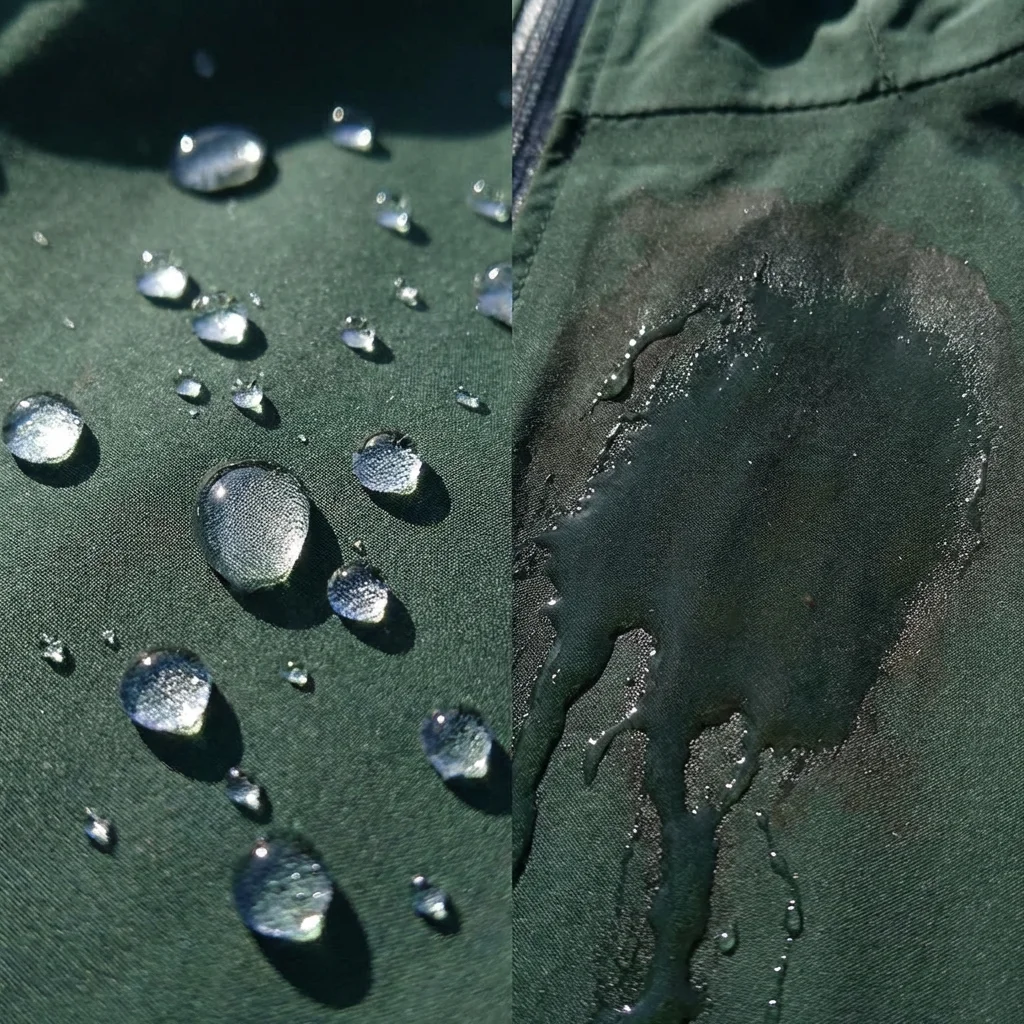
But without effective DWR, the outer fabric becomes saturated, known as wetting out. The result: the jacket becomes heavy and clammy. The film of water blocks breathability. Water vapour condenses on the cold outer layer. You get wet from the inside, even though the membrane is still waterproof.
Check the DWR condition
Let a few drops of water fall onto the jacket. If they bead up and the outer fabric stays dry, everything is fine.
Know when it needs renewing
If the material absorbs water and darkens, it is time to renew the water-repellent treatment.
Wash the jacket
Before reproofing, wash the jacket with a specialist technical wash to remove dirt and residue.
Renew the water-repellent treatment
Apply a spray-on or wash-in reproofer and allow it to dry according to the instructions. Heat often reactivates the DWR.
The physical limits of membranes
Even the best membrane has limits, regardless of its hydrostatic head. Moisture transport requires a temperature difference of at least 15 degrees between the inside and outside. At outdoor temperatures above 20 degrees, or with too many layers, transport slows down or stops altogether.
| RET value | Rating | Typical membrane |
|---|---|---|
0–6 | Very good | Sympatex (RET 1.5) |
6–13 | Good | Gore-Tex (RET 3) |
13–20 | Satisfactory | Standard membranes |
over 20 | Unsatisfactory | Low-cost coatings |
The RET value (Resistance to Evaporating Heat Transfer) is a better indicator of breathability than the hydrostatic head. The lower the RET, the better the moisture transport. For sports, we recommend a RET below 13.
Practical recommendations: which hydrostatic head for which use?
Recommendations for rain jackets
| Intended use | Recommended hydrostatic head | More important than hydrostatic head |
|---|---|---|
Everyday use/city | 5,000–10,000 mm | Fit, hood construction |
Hiking | 10,000 mm | Taped seams, breathable |
Trekking with a rucksack | 20,000 mm | Reinforced shoulder area |
Mountaineering/extreme conditions | 20,000+ mm | Construction, DWR quality |
High-quality rain jackets start at 10,000 mm, well above the standard. For 95% of all outdoor activities, a jacket with 10,000–20,000 mm from an established manufacturer is sufficient, provided the seams are taped and the DWR is high quality.
Recommendations for tents
| Area | Minimum value (DIN) | Recommendation |
|---|---|---|
Flysheet | 1,500 mm | 3,000+ mm |
Tent floor | 2,000 mm | 5,000+ mm |
Ultralight tent | Lower values | Prefer silicone coating |
For tent groundsheets, the hydrostatic head matters more than for the flysheet, as kneeling and lying down create concentrated pressure. For ultralight tents with lower ratings, look for silicone coating: it remains waterproof for longer than PU.
Who needs which hydrostatic head?
Hydrostatic head: when more, when less?
- 1
If you mainly get around in the city
5,000–10,000 mm is more than enough. Focus on fit and style instead
- 2
If you hike with a heavy rucksack
you should choose at least 20,000 mm because of the pressure on your shoulders
- 3
If you are active in warm weather
a low RET value matters more than a high hydrostatic head
- 4
If you are looking for an ultralight tent
lower hydrostatic head ratings with a silicone coating are not a problem
- 5
If you often sit or kneel on wet ground
your waterproof trousers need at least 15,000 mm
Right for you if …
Outdoor enthusiasts who want to make an informed buying decision rather than be swayed by marketing figures.
Probably not for you if …
Not relevant for indoor use only or if you are exclusively out in sunny weather.
Checklist: what to look for when buying
The hydrostatic head alone is not a reliable buying criterion. These points matter just as much, and often even more:
Construction before numbers
Taped or welded seams matter more than an extra 10,000 mm of hydrostatic head. Check the seams on the shoulders, hood and under the arms.
Check the coating type
For tents, choose silicone coating for durability. For jackets, pay attention to the membrane technology.
Question the test standard
American ratings are more realistic than European ones. With US brands, do not compare ratings directly with European values.
Consider DWR quality
Good water-repellent treatment makes a real difference to comfort. Ask about the DWR technology or read long-term tests.
Check breathability
A RET value below 13 is recommended for sporting activities. The MVTR value (g/m²/24h) should be above 10,000.
Factor in brand reputation
Reputable outdoor brands withstand prolonged heavy rain and often offer better warranties.
Frequently asked questions about hydrostatic head
Frequently asked questions
From what hydrostatic head is a jacket truly waterproof?
The EU standard starts at 1,300 mm, but for outdoor use you need at least 10,000 mm in practice. For hiking with a rucksack, we recommend 20,000 mm. But a well-made 10,000 mm jacket outperforms a poorly made 30,000 mm one.
Why does my waterproof jacket still get wet?
Usually the culprit is a worn-out DWR treatment rather than the membrane. The outer fabric becomes saturated, blocks breathability and makes you sweat from the inside. Refreshing the treatment often solves the problem.
What is the difference between waterproof and water-resistant?
Water-resistant means water beads off, but can penetrate in prolonged rain. Waterproof means a membrane or coating prevents water from getting through, measured by its hydrostatic head.
Do I need a higher hydrostatic head for a ski jacket?
Not necessarily. When skiing, you are rarely exposed to prolonged rain. 10,000–15,000 mm is usually enough. Breathability and a snow skirt are more important.
How often do I need to reproof my rain jacket?
It depends on how you use it. Once water no longer beads off and the fabric starts to soak through, it is time. With regular use, this is roughly every 10–20 washes or once per season.
Are more expensive jackets with a higher hydrostatic head automatically better?
No. A higher hydrostatic head does not cost much more to produce. With premium jackets, you are paying for better construction, longer-lasting DWR treatment, higher-quality membranes and well-considered details such as the hood and ventilation.
Conclusion: hydrostatic head is an indicator, not a mark of quality
Hydrostatic head is a useful guide, but it is not a reliable buying criterion on its own. At first glance, it seems simple: the more waterproof something is, the less breathable it is. In reality, it is more complex.
30,000 mm is not automatically better than 10,000 mm: construction and coating type are decisive. The EU standard of 1,300 mm is not enough for outdoor use. Silicone with 1,200 mm can perform better over the long term than PU with 4,000 mm. DWR is often more important for how dry you feel than the membrane. And the real weak points are seams and construction rather than the material.
Inspiration, knowledge and gear for people who want more from the outdoors.