
Buying Guides
Hiking boot tech explained: membranes, soles and lasts
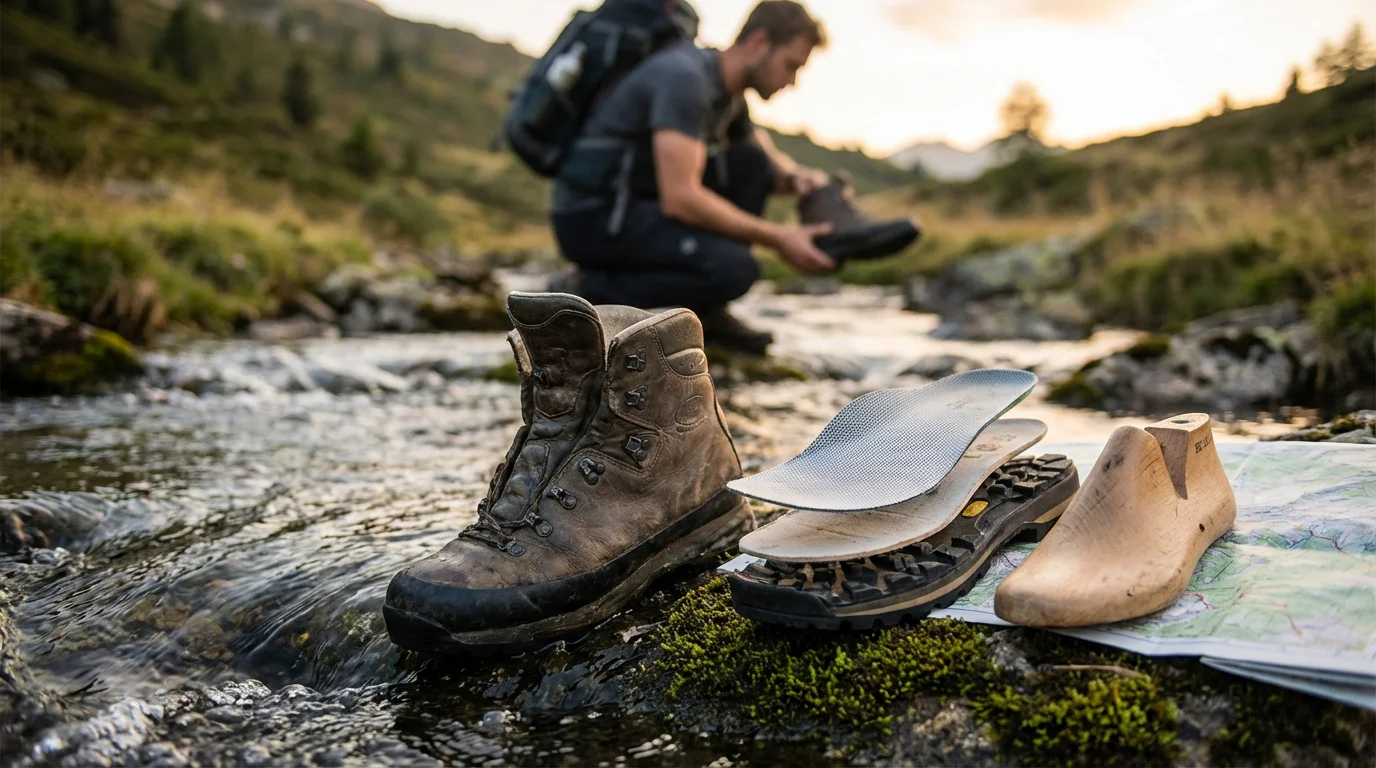
Gore-Tex or Sympatex? Vibram Megagrip or Arctic Grip? The real differences behind hiking boot technology, with practical advice for choosing yours.
Key points at a glance
- 01
Gore-Tex uses 1.4 billion pores per cm², but they can clog. Sympatex is pore-free and easier to maintain.
- 02
Vibram soles come in dozens of variants: Megagrip for all-round use, Arctic Grip for ice and N-OIL for reduced reliance on conventional materials.
- 03
The last largely determines the fit: Lowa tends to be narrow, Meindl wider, and Salomon offers several shapes.
- 04
The wrong fit makes even the best membrane and sole pointless. Always try boots on before buying.
Membranes, lasts and soles: when you buy hiking boots, technical terms come at you from every direction. What do they really mean? Why is Gore-Tex not the only option? And why does a Lowa fit differently from a Meindl? This article takes you behind the scenes of hiking boot technology, with clear explanations instead of marketing talk.
The membrane: the key layer between wet and dry
The membrane is your feet’s line of defence. It sits between the outer fabric and the inner lining, with an apparently impossible job: keep water out while letting perspiration escape.
How does it work? Gore-Tex and Sympatex solve that problem in very different ways.
| Feature | Gore-Tex | Sympatex |
|---|---|---|
Operating principle | Microscopic pores | Molecular-chain transport |
Pores per cm² | 1.4 billion | None (pore-free) |
Breathability | Very high | High |
Risk of clogging | Yes (salts, oils) | No |
Maintenance required | Higher | Lower |
Sensitivity to dirt | Higher (needs regular care) | Lower |
Membrane material | PTFE-based | PTFE-free |
Gore-Tex: the pore strategy
Gore-Tex works on a clever principle: pores. More precisely, 1.4 billion microscopic pores per square centimetre. They are large enough for water vapour, including perspiration, to pass through, but small enough to keep out droplets. A water droplet is 20,000 times larger than these pores.
The result? Perspiration can escape without you getting wet. At least in theory.
Sympatex: the molecular-chain strategy
Sympatex takes a completely different approach. Instead of pores, its membrane uses hydrophilic, or water-attracting, molecular chains to move water vapour outwards.
The major benefit is that a pore-free membrane cannot clog. Salts, body oils and detergent residue do not affect Sympatex, so it keeps working with less maintenance.
The trade-off is lower breathability than Gore-Tex in a direct comparison. In return, it is more dependable.
Vibram: the secret weapon under your feet
Vibram is the Ferrari of footwear: a respected name most outdoor enthusiasts know. But why is it so highly regarded?
The answer lies in its rubber compounds. Vibram does not make just one sole. It makes dozens of specialised compounds for different uses.
Vibram Megagrip All-round
Maximum grip on a wide range of surfaces, water-repellent and highly abrasion-resistant. The all-purpose sole for everyday hikes.
Vibram Arctic Grip Winter
A special rubber hardness for ice and snow. Standard Megagrip can slip here. Arctic Grip holds firm.
Vibram N-OIL N-OIL
Made with more than 90% naturally sourced materials, according to the manufacturer. Slightly less grip than the standard compound.
Vibram Springlug Innovation
The latest technology, with raised rubber lugs for lateral support and improved traction.
The last: the hidden detail that determines comfort
A last is the plastic or wooden model around which a boot is shaped during manufacture. It defines the fit.
The problem is that every manufacturer uses different lasts. Lowa uses different shapes from Meindl, and Meindl differs from Salomon. Your foot will suit one of these shapes, or it will not.
| Brand | Fit tendency | Ideal for |
|---|---|---|
Lowa | Narrow to average | Narrow to average-width feet |
Meindl | Average to wide | Wide feet, hallux valgus |
Salomon | Narrow + variants | Athletic fit, flexible choice |
Hanwag | Average to wide | Classic wide fit |
Scarpa | Narrow | Narrow feet, technical terrain |
Which combination suits you?
The right technology combination for you
- 1
If you have narrow feet, want maximum breathability and have time for maintenance
Lowa with Gore-Tex and Vibram Megagrip
- 2
If you have wide feet and prefer low-maintenance boots
Meindl with Sympatex and Vibram
- 3
If you hike in winter and expect ice or snow
Boot with Vibram Arctic Grip
- 4
If you hike ultralight and prefer a minimalist setup
Salomon with less membrane and a lighter sole
Right for you if …
Outdoor enthusiasts who want to understand what is inside their boots and make the right choice for their needs.
Probably not for you if …
If you simply want “the best boot” without getting into the details, ask for advice in a specialist shop.
Frequently asked questions
Frequently asked questions
Is Gore-Tex really better than Sympatex?
Not necessarily. Gore-Tex is slightly more breathable, while Sympatex is less sensitive to dirt and easier to maintain. The best membrane is the one that suits how you use your boots.
Why are Vibram soles so expensive?
Vibram invests heavily in research and uses specialised rubber compounds. Whether the higher price pays off depends on how often you walk and how well you look after your boots.
Can I measure my foot to find the right brand?
Only to a limited extent. A last is more complex than length and width alone. Try several brands, wear each for at least 15 minutes, and ideally try them in the afternoon when feet are more swollen.
Do I really need Gore-Tex in every hiking boot?
No. For dry summer hikes, a boot without a membrane can be better: it breathes more freely and dries faster. A membrane matters most in wet conditions.
Conclusion
Hiking boot technology is complex, but you do not need to be an expert to choose well. The key point is fit. If the last is wrong for your foot, Gore-Tex and Vibram will not help.
Choose Gore-Tex for maximum breathability when you are prepared to maintain it, Sympatex if you want less maintenance, and Vibram for grip on changing terrain. With the last, trying beats guessing.
Find your perfect hiking boot
Explore hiking boots with Gore-Tex, Sympatex and Vibram soles at SportFits.
Explore hiking boots ↗Inspiration, knowledge and gear for people who want more from the outdoors.