

SportFits Travel
Climate change 2025: what the science shows today
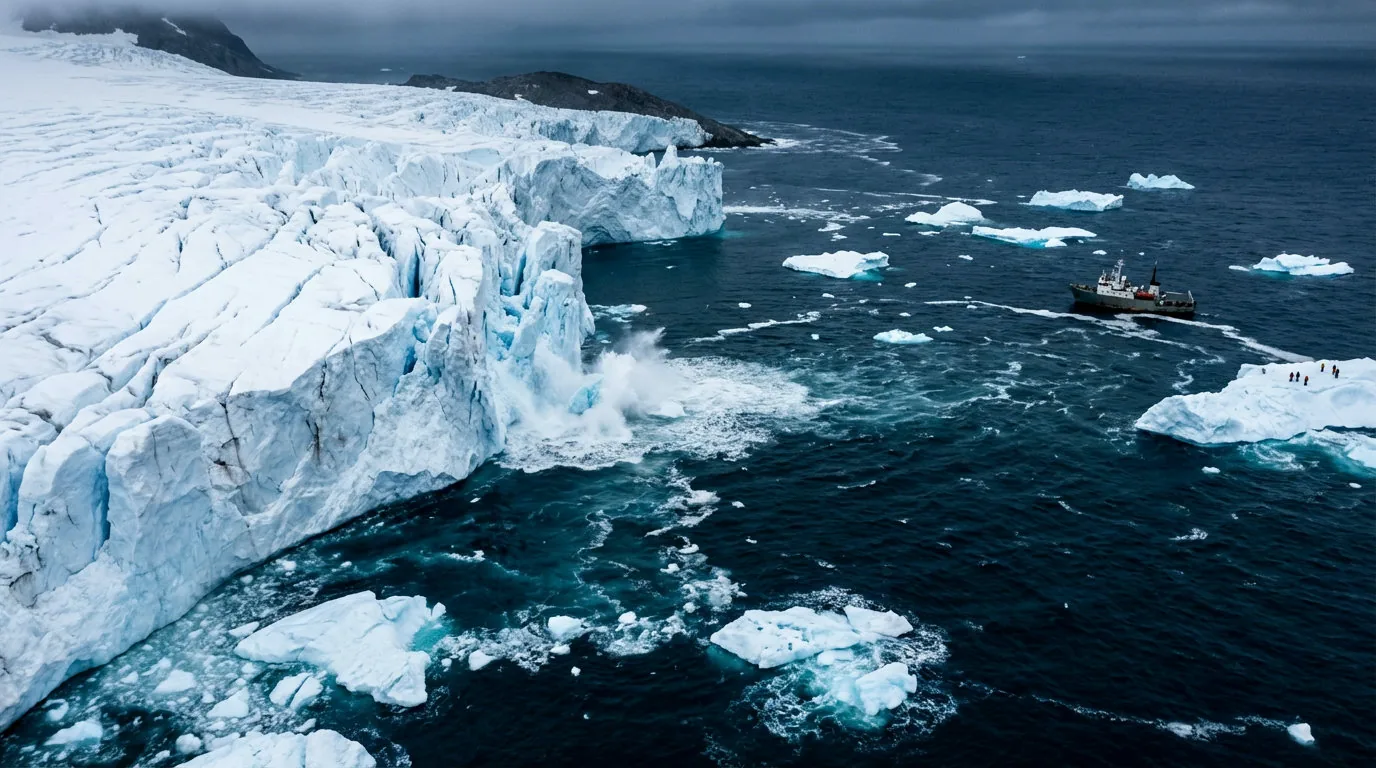
2024 was the warmest year on record and the first full year above 1.5°C. A factual overview of where climate research stands, with the key figures.
Key findings
- 01
2024 was the warmest year since 1850, with the 1.5°C threshold exceeded for an entire year for the first time
- 02
The remaining CO2 budget for 1.5°C will be exhausted in around four years
- 03
The first climate tipping point has been crossed: tropical coral reefs are dying off on a large scale
- 04
Arctic sea ice reached its lowest winter extent in 47 years in 2025
- 05
2024 saw the highest number of climate-related displacements in 16 years
The headlines are familiar: record temperatures, melting glaciers, extreme weather. But what does the science actually say today, without alarmism or playing things down? This article sums up the current state of climate research. No opinion, just data.
The sources are leading scientific institutions: the Intergovernmental Panel on Climate Change (IPCC), the World Meteorological Organization (WMO), the European Earth observation programme Copernicus and peer-reviewed journals. The figures are as current as possible, as of autumn 2025.
Record temperatures: where do we stand?
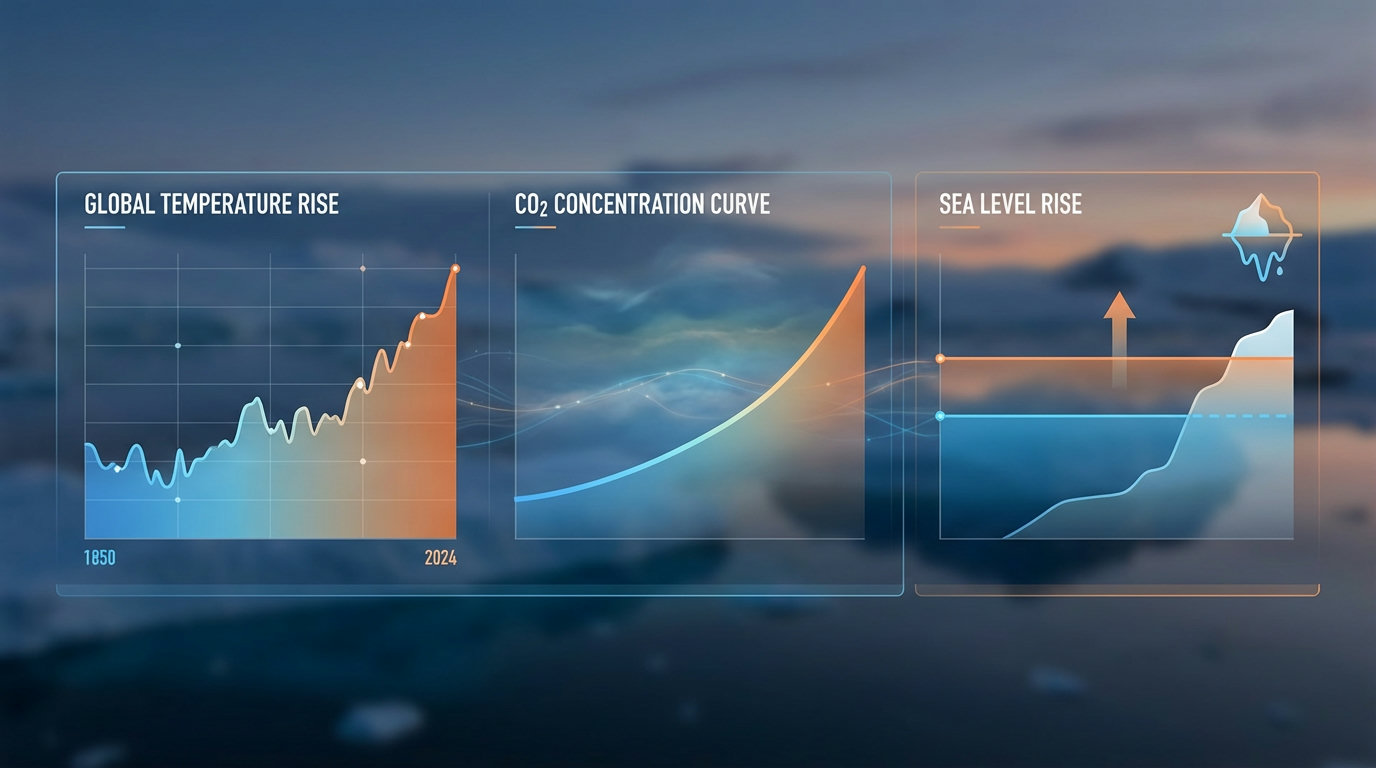
2024 was the warmest year since systematic weather records began in 1850. The global average temperature was 15.10°C, or 1.60°C above pre-industrial levels (reference period 1850–1900).
This marked the first time that the symbolically important 1.5°C threshold of the Paris Agreement had been exceeded for an entire calendar year. The trend continued in 2025: over the first eight months, temperatures were 1.42°C above the pre-industrial average.
Europe is warming twice as fast as the global average, making it the fastest-warming continent on Earth. Antarctica recorded its warmest annual temperature since records began in 2025.
CO2 and greenhouse gases: the figures
The concentration of carbon dioxide in the atmosphere reached a level in 2025 that had not occurred for more than two million years. In May 2025, 429.6 ppm (parts per million) was measured, the highest level in all of human history.
The increase is accelerating: between 2023 and 2024, CO2 concentration rose by 3.58 ppm, the highest annual increase ever recorded.
| Indicator | Value 2024/2025 | Context |
|---|---|---|
CO2 concentration (May 2025) | 429.6 ppm | Highest level in 2+ million years |
Annual increase, 2023–2024 | 3.58 ppm | Highest increase ever recorded |
Fossil CO2 emissions, 2025 | 38.1 billion t | New record |
Total emissions (including land use) | 42.4 billion t | 10% higher than in 2015 |
Oceans and sea level
The oceans are the climate system’s great heat store, having absorbed more than 90% of the additional heat. The heat content of the upper 2,000 metres reached an unprecedented high in 2024.
In 2024, sea surface temperatures averaged 0.61°C above the 1981–2010 baseline. Marine heatwaves are becoming more frequent and more intense, with direct consequences for fisheries, coral reefs and coastal ecosystems.
Global sea level is rising faster than at any point in the past 3,000 years. In 2024, a rise of 5.9 mm was recorded, well above the average annual increase of 3.4 mm since 1970.
1.5-degree limit
The Paris Agreement aims to limit warming to a maximum of 1.5 degrees. This threshold was exceeded for the first time in 2024. At the current pace: 2.6–3.1 degrees by 2100.
CO2 concentration
427 ppm (2024), the highest level in 800,000 years. Pre-industrial level: 280 ppm. Annual increase: around 2.5 ppm.
Sea level
+21 cm since 1900. Rate of increase: 4.4 mm/year (2013–2023). Projection for 2100: +0.3 to 1.0 m, depending on emissions.
Extreme weather
2024: warmest year on record. Europe is warming twice as fast as the global average. Heatwaves are four times more frequent.
Arctic sea ice: record low in 2025
Arctic sea ice reached its lowest winter extent since satellite observations began 47 years ago in March 2025. At 14.33 million km², the area was 1.31 million km² below the 1981–2010 average and 800,000 km² below the previous record low in 2017.
Particularly stark: in the Northwest Passage through the Canadian Arctic Archipelago, sea ice cover fell to just around 3% of its total area by the end of September 2024, the lowest extent ever observed since 1960.
Climate tipping points: the first has been crossed
Scientists have identified around two dozen subsystems within the global climate that may have so-called tipping points, thresholds beyond which changes become irreversible and self-reinforcing.
The Global Tipping Points Report 2025 reaches a sobering conclusion: Earth has already crossed its first climate tipping point, the tropical coral reef system. Large-scale coral die-off can no longer be stopped.
Extreme weather: 2024 in figures
In 2024, the highest number of climate-related displacements since 2008 was recorded. More than 617 extreme weather events were reported, 148 of which were classified as "unprecedented".
A scientific analysis of 29 weather events in 2024 found that climate change intensified 26 of them. These events killed at least 3,700 people and displaced millions.
| Finding | Details |
|---|---|
Additional hot days | Climate change added an average of 41 extra days of dangerous heat in 2024 |
Heatwaves | Almost every heatwave in 2024 was intensified by climate change |
Amazon drought | Made 30 times more likely by climate change |
Europe | 188 events, mainly heatwaves, followed by heavy rainfall and flooding |
Impact on food and health
The consequences of climate change are no longer future scenarios. They are affecting agriculture, water supplies and health now.
Food production
A recent study warns that, if warming exceeds 1.5°C, one third of global food production could be at risk. Particularly affected:
- Low latitudes: Up to 50% of crop production could be at risk under unsuitable climate conditions
- Tropical root crops: Yams and other crops important to low-income regions are particularly vulnerable
- Sub-Saharan Africa: If warming exceeds 3°C, almost three quarters of current production could be at risk
Rice, maize, wheat, potatoes and soya beans, the staple crops that provide more than two thirds of the world's food energy, are all severely affected.
Health
The report "10 New Insights in Climate Science 2025" identifies several direct health impacts:
- Heat stress reduces labour productivity and particularly endangers outdoor workers
- Dengue outbreaks are increasing as rising temperatures support the spread of mosquitoes
- Falling groundwater levels put drinking water supplies at risk worldwide
What does the science say about the need for action?
The IPCC Synthesis Report 2023 summarises the scientific evidence and sets out clear thresholds:
By 2030
Global greenhouse gas emissions must fall by 43% from 2019 levels to limit warming to 1.5°C.
By 2035
A reduction of 60% from 2019 levels is required.
Without rapid action
The Earth would warm by around 4.5°C by the end of the century.
Ten new insights in climate science 2025
The report "10 New Insights in Climate Science 2025", produced by more than 70 scientists from 21 countries, identifies the most important new findings:
| # | Insight |
|---|---|
1 | Record heat in 2023/24 points to a possible acceleration of warming |
2 | Accelerating ocean warming: marine heatwaves are damaging ecosystems |
3 | Land carbon sinks, including forests and soils, are showing signs of stress |
4 | Biodiversity loss and climate change reinforce one another |
5 | Climate change is accelerating groundwater depletion |
6 | Rising temperatures support dengue outbreaks |
7 | Heat stress reduces labour productivity and economic output |
8 | Carbon dioxide removal technologies are essential but limited |
9 | Carbon markets need stronger standards and greater transparency |
10 | Combined policy measures are more effective than individual measures |
Conclusion: the evidence is clear
The scientific data leave little room for interpretation:
- The Earth is warming faster than expected
- Emissions are still rising instead of falling
- The first tipping points have been crossed
- The impacts are already measurable today
That does not mean all is lost. Science also shows that every tenth of a degree of warming avoided makes a difference. Whether climate change is real is no longer the question. How we deal with it is.
For anyone interested in the impact on mountain sports, the article Climate change in the Alps explains what this means in practical terms for glaciers, permafrost and alpine tours.
Frequently asked questions
Has the Paris Agreement’s 1.5°C limit been exceeded?
Yes and no. In 2024, a full calendar year was for the first time more than 1.5°C warmer than the pre-industrial level. However, the Paris Agreement refers to a longer-term average. Scientists expect this average to exceed the 1.5°C threshold during the 2030s.
What is a climate tipping point?
A tipping point is a threshold beyond which changes become irreversible and self-reinforcing. For example, when an ice sheet begins to melt, it exposes darker surfaces that absorb more heat, accelerating further melting. The first such tipping point, tropical coral reefs, has already been crossed.
How much time is left to limit warming?
At current emission rates, the remaining CO2 budget for a 50% chance of limiting warming to 1.5°C will be used up in around four years. There is more time for 2°C, but this budget is shrinking rapidly too.
Where does the data in this article come from?
All figures come from peer-reviewed scientific sources: the IPCC (Intergovernmental Panel on Climate Change), WMO (World Meteorological Organization), Copernicus Climate Change Service, and specialist publications in Nature, Springer and other scientific journals. You can find the full list of sources at the end of the article.
What can outdoor athletes do about climate change?
Outdoor athletes can make a contribution by travelling consciously, such as taking the train rather than driving, choosing equipment that can be repaired, repairing rather than replacing, and checking for independent certifications such as bluesign or GRS. Supporting climate protection projects in mountain regions also helps.
Sources
- Copernicus Climate Change Service (2025): 2024 was the warmest year on record ↗
- WMO (2025): 2025 set to be second or third warmest year on record ↗
- Global Tipping Points Report 2025 ↗
- Cheng et al. (2025): Record High Temperatures in the Ocean in 2024 ↗
- IPCC AR6 Synthesis Report (2023) ↗
- 10 New Insights in Climate Science 2025 ↗
- Carbon Brief (2025): Arctic sea ice winter peak smallest in 47-year record ↗
Inspiration, knowledge and gear for people who want more from the outdoors.