
Training & Health
Calories burned outdoors: from hiking to ski touring
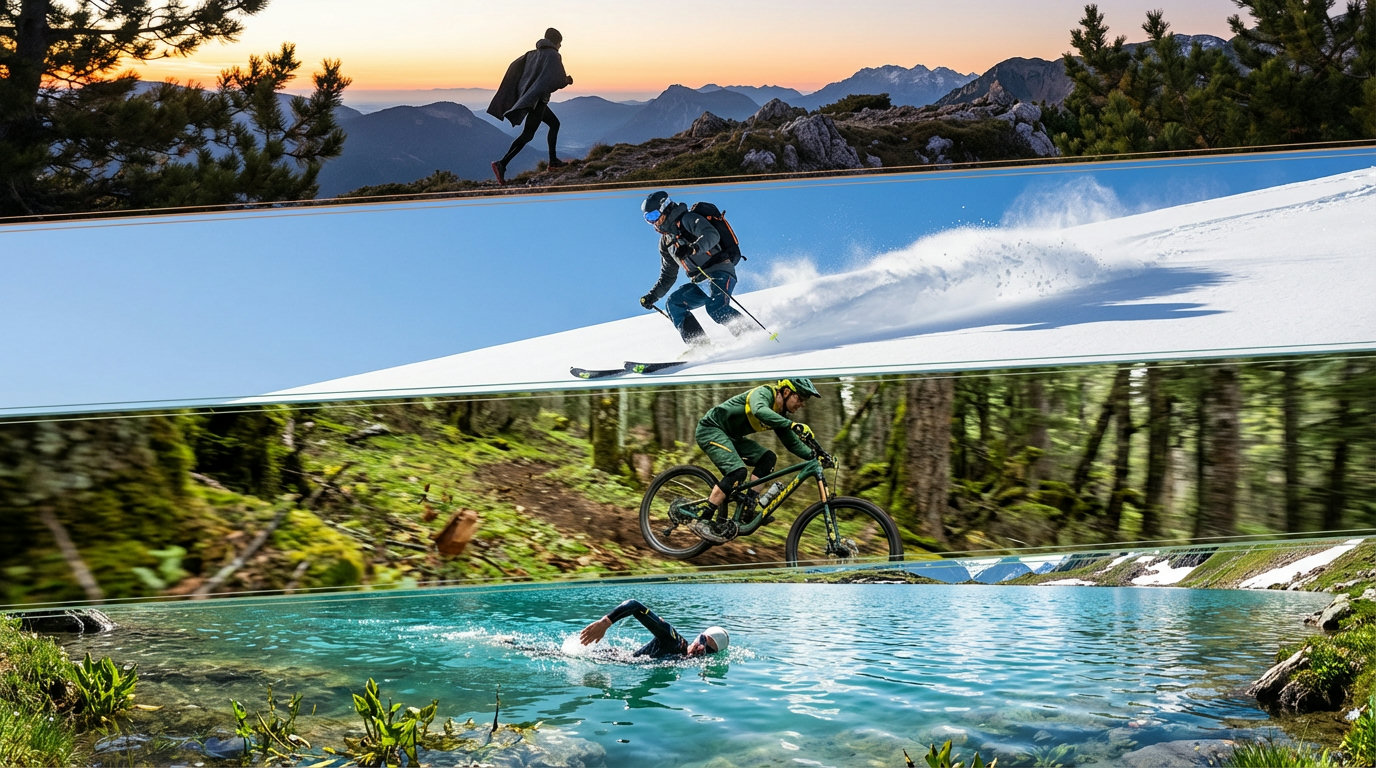
How many calories do you burn hiking, cycling or ski touring? A comparison of popular outdoor sports with reference values and the factors behind them.
Key points at a glance
- 01
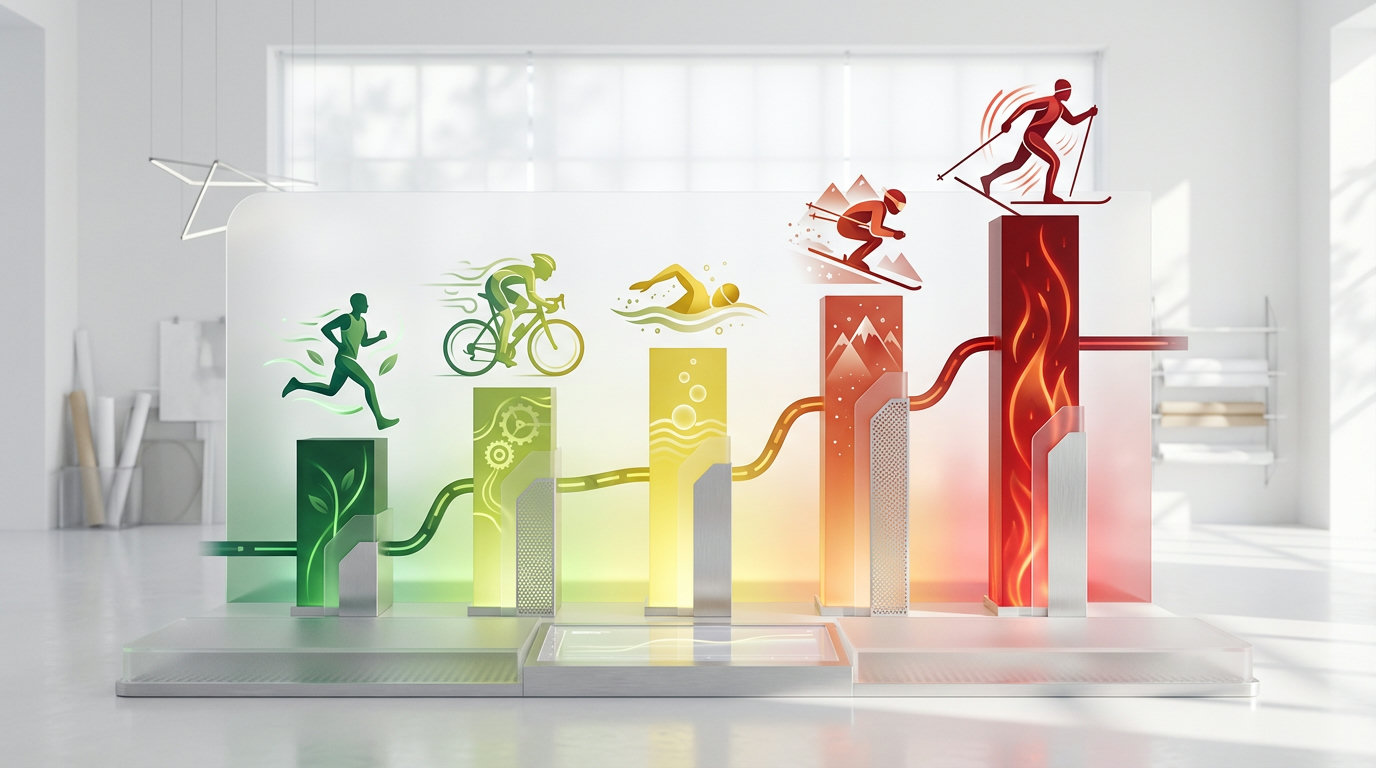
Cross-country skiing burns 500–1,120 kcal/h, making it the most calorie-intensive outdoor sport, followed by ski touring (400–700 kcal/h on the ascent) and trail running (600–1,000 kcal/h)
- 02
The 2024 Compendium of Physical Activities lists MET values for 1,114 activities. It is the key scientific basis for calculating energy use
- 03
Elevation gain, cold, pack weight and terrain can raise your burn by up to 55%, which is often overlooked when planning a tour
- 04
After intense sessions, the afterburn effect (EPOC) adds another 50–190 kcal over several hours
- 05
Rule of thumb: kcal/h = MET value × body weight in kg. Good enough for a rough estimate on the go
The MET system: how calorie burn is measured
How do you actually measure whether cross-country skiing burns more calories than hiking? The answer is MET, the Metabolic Equivalent of Task. One MET equals your energy use at rest: roughly 1 kcal per kilogram of body weight per hour.
The formula is simple: kcal/h = MET × body weight (kg). If you weigh 80 kg and do a sport rated at MET 8, you burn around 640 kcal an hour.
The most important source for MET values is the 2024 Compendium of Physical Activities, the third major update since 1993. The researchers screened more than 32,000 abstracts and extracted 2,356 energy expenditure values from 701 studies. The result: 1,114 activities, 912 of them with MET values measured by calorimetry. Compared with the 2011 update, 303 new activities were added, including, for the first time, separate values for hiking at different gradients and pack weights.
Comparing outdoor sports
Calories burned by sport (per hour)
| SportSource: 2024 Compendium | Intensity | MET | 70 kg | 80 kg | 90 kg |
|---|---|---|---|---|---|
Hiking | Flat terrain, easy | 3.5–5.3 | 245–371 | 280–424 | 315–477 |
Hiking | Cross-country, moderate | 6.0 | 420 | 480 | 540 |
Hiking | Steep uphill, heavy pack | 7.8–9.0 | 546–630 | 624–720 | 702–810 |
Trail running | Cross-country | 9.0 | 630 | 720 | 810 |
Trail running | Steep uphill | 10–12 | 700–840 | 800–960 | 900–1,080 |
Ski touring | Moderate ascent | 8–10 | 560–700 | 640–800 | 720–900 |
Cross-country skiing | Moderate (6–8 km/h) | 8.5 | 595 | 680 | 765 |
Cross-country skiing | Fast (8–13 km/h) | 11.3 | 791 | 904 | 1,017 |
Cross-country skiing | Racing, maximum effort | 15.5 | 1,085 | 1,240 | 1,395 |
Cycling | 15–20 km/h | 6.8–8.0 | 476–560 | 544–640 | 612–720 |
Mountain biking | Uphill, intense | 14.0 | 980 | 1,120 | 1,260 |
Climbing | Rock, moderate to hard | 7.3–8.0 | 511–560 | 584–640 | 657–720 |
Swimming | Front crawl, moderate | 8.0–9.8 | 560–686 | 640–784 | 720–882 |
Detailed analysis: what makes each sport different
Hiking: the underestimated calorie burner
In pure kcal per hour, hiking sits mid-table. On steep climbs with a heavy pack, though, it can match many high-intensity sports. The 2024 Compendium breaks it down in detail for the first time: flat terrain with a light daypack comes in at 3.5 MET, moderate cross-country hiking at 6.0 MET and mountain hiking with a pack of 10 kg or more at 7.8 MET. Steep climbs (11–20% gradient) reach 8.8 MET.
As a rule of thumb, climbing adds another 100–150 kcal per 100 metres of ascent to a base of 350 kcal/h. A hut hike with 1,000 metres of ascent can easily burn 800+ kcal, comparable to an hour of jogging.
Cross-country skiing: the calorie machine
Cross-country skiing is one of the most calorie-intensive sports of all, and for good reason: your arms and legs work at the same time. A comparative study by Scheiber et al. found that it takes about 2.5 hours of alpine skiing to use as much energy as a single hour of cross-country skiing.
At a moderate pace (6–8 km/h), you burn 595–680 kcal/h at 70–80 kg. Master the skating technique and push the pace, and you reach MET 13.3, comfortably above 1,000 kcal/h. In race mode (MET 15.5–16.5), peak values of more than 1,300 kcal/h have been documented.
Ski touring: maximum burn on the ascent
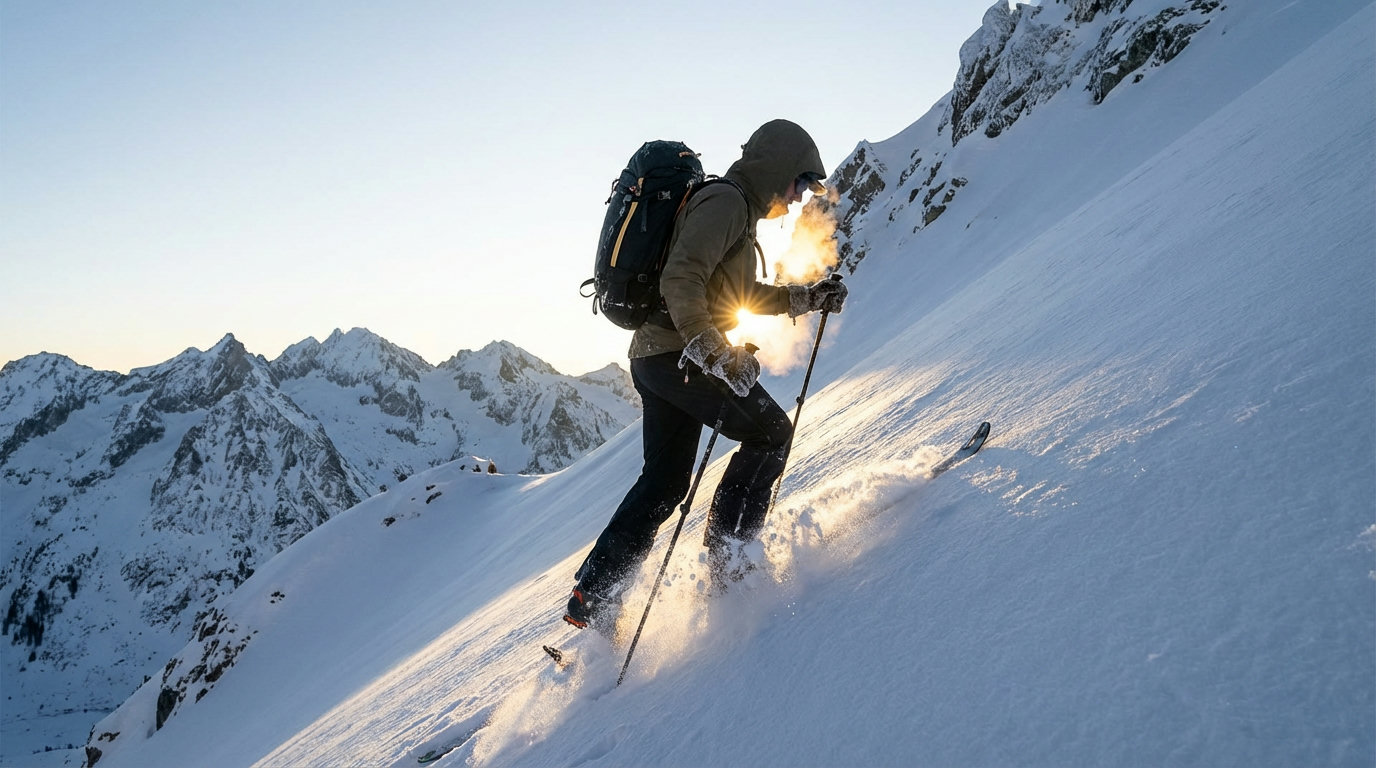
Ski touring is one of the most energy-intensive outdoor activities. The landmark study by Tosi, Leonardi and Schena gave the first quantitative description: at a self-selected speed on a 21% gradient, energy cost is 10.6 J/kg/m, higher than walking or snowshoeing.
A moderate ascent burns 400–700 kcal/h. On intense climbs through deep snow and steep terrain, more than 1,000 kcal/h is realistic. Speed matters too: burn rises in proportion, so going 10% faster costs roughly 3.2% more energy.
The five biggest influencing factors
A sport's MET value only tells half the story. Five factors can push your actual burn up by as much as 55%, or leave it noticeably lower than expected when conditions are kind.
Elevation gain +100–350 kcal
Every 300 metres of ascent adds 80–350 kcal, depending on gradient. Descending uses 30–40% less, but the eccentric muscle work makes it harder than walking on the flat.
Cold +34%
According to one study, hiking at –5 to –9 °C burns 34% more calories than at 12 °C. Thermogenesis, shivering and activated brown fat are the main drivers.
Pack weight +10–55%
A 5 kg pack adds 10–12% to your burn, 15 kg adds 27–33% and 23 kg or more adds 45–55%. Each per cent of extra load relative to body weight raises energy demand by about 1.7%.
Terrain type ×1.0–3.5
The Pandolf equation uses a terrain factor: tarmac = 1.0, gravel = 1.2, light terrain = 1.5, heavy sand = 2.0, bog = 3.5. Rough ground can easily double your burn.
Altitude from 1,500 m
From around 1,500–2,000 m, your burn rises as heart rate and breathing speed up in the thinner air. VO₂max drops by 20–30% at 3,300 m, so your body works relatively harder.
The afterburn effect: burning calories after exercise
Your body does not simply stop burning calories after hard training. EPOC (Excess Post-Exercise Oxygen Consumption) describes the raised oxygen consumption after exercise, while your body restores its ATP and creatine phosphate stores, clears lactate and regulates body temperature.
Research shows a clear link to intensity. An easy 30-minute session adds 15–33 kcal. An intense 60-minute session at 70–75% VO₂max adds 76–165 kcal over up to 7.5 hours. The peak: after a 45-minute intense cycling session, participants burned an extra 190 kcal over 14 hours.
For outdoor athletes, that means a ski tour with repeated steep climbs, essentially natural interval training, produces a much bigger afterburn than a moderate walk of the same length.
| Intensity and duration | Additional kcal | EPOC duration |
|---|---|---|
Easy, 30 min (60% VO₂max) | 15–33 | ~2 h |
Moderate, 45 min (70% VO₂max) | 49–74 | ~3.5 h |
Intense, 60 min (70–75% VO₂max) | 76–165 | ~7.5 h |
Very intense, 80 min | 130–162 | up to 24 h |
HIIT / intervals | up to 190 | up to 14 h |
Worked example: calculating a ski tour
How much energy does a long ski tour really take? Let's work it out:
Set the base MET
Moderate ski touring ascent = MET 10.0. At 80 kg: 800 kcal/h.
Add the pack weight
15 kg on 80 kg = 18.75% extra load. Factor: 1.71 × 18.75% = +32%. New base: 1,056 kcal/h.
Add a cold supplement
At –5 °C, a conservative +15% for thermogenesis. That gives 1,214 kcal/h.
Multiply by ascent time
4 hours × 1,214 kcal/h = 4,856 kcal for the ascent alone.
Add the descent and breaks
1.5 h descent (420 kcal/h) + 0.5 h breaks (100 kcal/h) = 680 kcal.
Add EPOC and resting metabolism
~250 kcal afterburn + ~1,900 kcal resting metabolism = total for the day: around 7,700 kcal.
Which sport suits your goal?
- 1
If you want to burn the most calories per hour
choose cross-country skating or intense ski touring; both exceed 1,000 kcal/h
- 2
If you want joint-friendly training
swimming or cycling are ideal: high energy use without impact
- 3
If you want to be outdoors without much equipment
hiking with elevation gain is surprisingly effective: 800+ kcal/h on a steep ascent
- 4
If you want to maximise the afterburn effect
use changing intensities: trail running with climbs or interval training on varied terrain
- 5
If you want to track your burn precisely
combine a GPS watch (elevation and pace) with the MET formula; it is more accurate than most watch algorithms
Calculate heart-rate zones
Your training zones determine how much energy you use at each intensity.
Open the heart-rate zone calculator ↗FAQ: common questions about calories burned
Frequently asked questions
How accurate are the calorie figures on GPS watches?
On average, GPS watches overestimate calorie burn by 15–30%, because their algorithms are often simplified. The MET method with your exact body weight is usually more accurate. Most precise of all: a heart-rate-based calculation with an individually calibrated VO₂max.
Do you burn calories on the descent too?
Yes. Descending uses 30–40% less energy than climbing, but it is far from free. The eccentric muscle work of braking takes energy and causes more muscle damage than the ascent.
Is it true that you burn more calories in the cold?
Yes, that is well documented. One study found 34% higher energy use at –5 to –9 °C than at 12 °C. The main drivers are thermogenesis and shivering. Good insulation reduces the effect: if you are dressed warmly, you burn less extra.
What burns more: an hour of running or an hour of cycling?
At the same intensity, running burns more because you carry your own body weight (MET 9–12 versus MET 6.8–10 for cycling). On the bike, though, you can keep going for longer, so your total burn per session may be higher.
How much do I need to eat to make up for a long tour?
Rule of thumb: a six-hour ski tour burns 5,000–6,000 kcal through activity alone, roughly three times a normal daily intake. Plan on 300–400 kcal of snacks per hour and eat a carbohydrate-rich meal afterwards.
Related articles and tools
Sources
- Herrmann et al.: 2024 Adult Compendium of Physical Activities – Journal of Sport and Health Science, 2024 ↗
- Tosi, Leonardi & Schena: The energy cost of ski mountaineering – J Sports Med Phys Fitness, 2009 ↗
- Scheiber et al.: Alpine vs. Cross-Country Skiing vs. Indoor Cycling – J Sports Sci Med, 2016 ↗
- Compendium of Physical Activities – Official Online Database ↗
- Harvard Health: Calories burned in 30 minutes by activity ↗
- Techniker Krankenkasse: Energieverbrauch beim Sport ↗
- NASM: Exploring Excess Post-Exercise Oxygen Consumption (EPOC) ↗
- Minetti et al.: Energy cost of walking and running at extreme slopes ↗
Inspiration, knowledge and gear for people who want more from the outdoors.