 AI-generated
Trail running season 2026: events, preparation and equipment
The key trail events in the DACH region, the right training build-up and the equipment you really need
AI-generatedTrail running season 2026: events, preparation and equipment
The key trail events in the DACH region, the right training build-up and the equipment you really need
An overview of the 2026 trail running seasonContents
The 2026 trail running season starts early and offers more choice than ever before. The first winter trail runs are already in the calendar from March, followed by classic mountain races from April and the core alpine season from May through to late summer.
The DACH event calendar is packed: from local 15 km mountain races to 100-mile ultras, there is a race for every level. Particularly exciting in 2026: the Zugspitz Ultratrail has joined the UTMB World Series, making it an official qualifying race. mozart 100 by UTMB has also found a new home in Fuschl am See, bringing international attention to the Salzburg mountains.
The line between trail running and fast mountain hiking is becoming increasingly blurred. Speed hiking, a related trend, appeals to many newcomers looking to take their first step onto technical terrain. If you choose the trail in 2026, you will be spoilt for choice.
2026 event highlights in the DACH regionContents
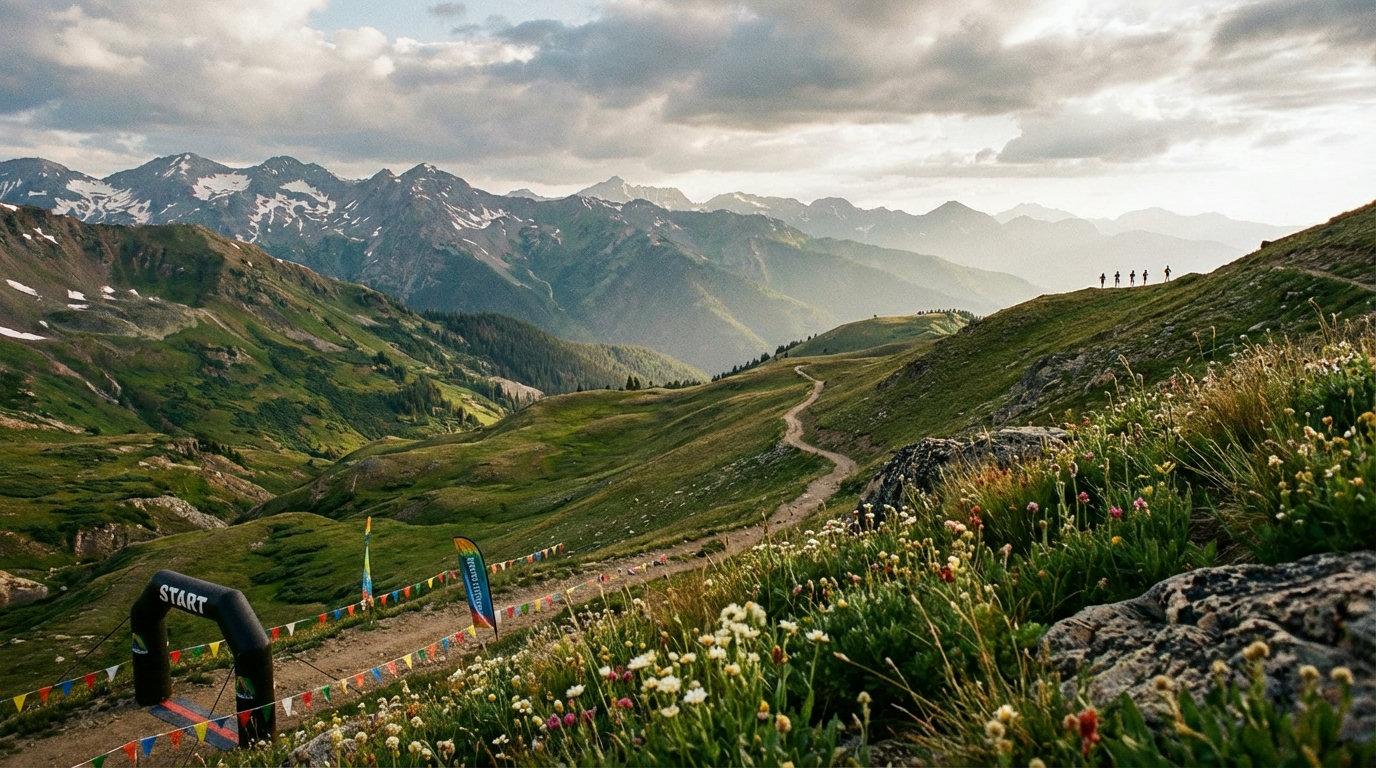
The 2026 trail calendar includes dozens of events in Germany, Austria and Switzerland alone. Platforms such as trailrunning.de list dates ranging from local mountain races to international UTMB qualifying events. The range extends from snowy winter trails in March and technical mountain routes in early summer to multi-day stage festivals at the height of summer.
We have compiled the most relevant events by country. Important: always check the official organiser websites for final dates, registration deadlines and mandatory equipment. Dates may change at short notice.
 AI-generated
GermanyContents
| Event | Date | Location | Highlight |
|---|---|---|---|
| Freudenstadt Spring Ultra | 21.03.2026 | Freudenstadt (Black Forest) | 50 km Black Forest ultra, season opener |
| Kyffhäuser Mountain Marathon | 18.04.2026 | Bad Frankenhausen | Traditional mountain marathon |
| LOWA Ultratrail Franconian Switzerland | 25 April 2026 | Franconian Switzerland | Franconian highlight, technical trails |
| MOUNTAINMAN Nesselwang | 8–9 May 2026 | Nesselwang (Allgäu) | German ultratrail championships, 70 km |
| Black Forest Trailrun Masters | June 2026 | Elzach (Black Forest) | Black Forest classic, multiple distances |
| Zugspitz Ultratrail by UTMB | 18–20 June 2026 | Garmisch-Partenkirchen | NEW to the UTMB World Series, ultratrail + basetrail |
| Terra Raetica Trails | 30 June–4 July 2026 | Nauders/Samnaun/Reschen | Multi-stage trail festival across Austria, Italy and Switzerland |
| Chiemgau Trail Run | Summer 2026 | Chiemgau (Bavaria) | Mountain-view trails, multiple distances |
AustriaContents
| Event | Date | Location | Highlight |
|---|---|---|---|
| Achensee Xtreme | 7–8 March 2026 | Eben am Achensee | Winter trail run, 6–18 km, season opener |
| Innsbruck Alpine Trailrun Festival | 29 April–2 May 2026 | Innsbruck | The Alps’ largest trail festival, 7–110 km |
| Stuiben Trailrun | 14–16 May 2026 | Umhausen (Ötztal) | Multi-day event at Tyrol’s largest waterfall |
| mozart 100 by UTMB | 6 June 2026 | Fuschl am See (Salzburg) | UTMB World Series, new home in Fuschl |
| Karwendelmarsch | Summer 2026 | Scharnitz–Pertisau | Iconic 52 km route, places sell out quickly |
| Pitz Alpine Glacier Trail | Summer 2026 | Pitztal | Glacier trail at 2,000–3,440 m |
| Gletscher Trailrun Gurgl | 16–19 July 2026 | Gurgl (Ötztal) | Trails at 2,000–3,000 m, 14–62 km |
| Großglockner Ultra-Trail | Summer 2026 | Kaprun/Zell am See | High-alpine ultra-trail on Austria’s highest mountain |
SwitzerlandContents
| Event | Date | Location | Highlight |
|---|---|---|---|
| Swiss Canyon Trail | 29–31 May 2026 | Couvet (Neuchâtel) | Trail running weekend in the Jura |
| Bernina Ultraks | 3–4 July 2026 | Pontresina | High-alpine event, 6.5–42 km |
| Eiger Ultra-Trail by UTMB | 16–18 July 2026 | Grindelwald | UTMB qualification, distances from short courses to 101 km |
| Davos X-Trails | August 2026 | Davos | Multiple distances, panoramic trails |
| Swiss Alps 100 | August 2026 | Aletsch Arena | 100 miles through the Swiss Alps |
| Matterhorn Ultraks | August 2026 | Zermatt | Iconic Matterhorn backdrop, up to 50 km |
| Churfirsten Trail Run | 28–30 August 2026 | Toggenburg | Spectacular Churfirsten backdrop |
Grippy soles, secure support and the right match for the terrain: find the trail shoe for your season.
Season planning and training structureContents
You do not run a trail event without preparation. If you are planning a race, whether 15 km or 100 km, you need a structured training plan. Depending on your target distance, begin systematic preparation 3 to 6 months before your main event.
The principle is simple: progress through clearly defined phases, from building aerobic endurance and terrain-specific training to race preparation. Each phase has its own focus and builds on the previous one.
The phases vary according to your target distance. For a 20 km trail, 8 to 10 weeks of focused training can be enough if you already have a solid running base. For alpine races over 50 km or ultra distances, you need at least 4 to 5 months. The key is progressively building volume: no more than a 10–15% increase per week.
If you increase your training too sharply, you risk overload. This is a common mistake, particularly among ambitious runners moving over from the road. Uneven ground, elevation gain and technical sections make trail running significantly more demanding than running on tarmac.
- 1
Base phase (8–12 weeks before the event)
Focus on aerobic endurance on gently undulating terrain. Run 2–3 times per week, supplemented by cycling or swimming. Increase volume and duration gradually, keeping long runs deliberately below race pace.
- 2
Build phase (4–8 weeks before the event)
Add targeted elevation gain: hill runs, uphill intervals and your first technical trails. Strength and stability training twice per week. Sessions become more specific, ideally on terrain similar to your target race.
- 3
Race-specific phase (2–4 weeks before the event)
Longer trail runs on the target terrain or comparable ground. Test your race kit and nutrition strategy in training. Recce the route where possible.
- 4
Tapering (1–2 weeks before the event)
Reduce volume by 30–50% while maintaining intensity. Do not introduce new training stimuli; prioritise recovery. Mental preparation: study the route profile and set your pacing strategy.
The most important training elementsContents
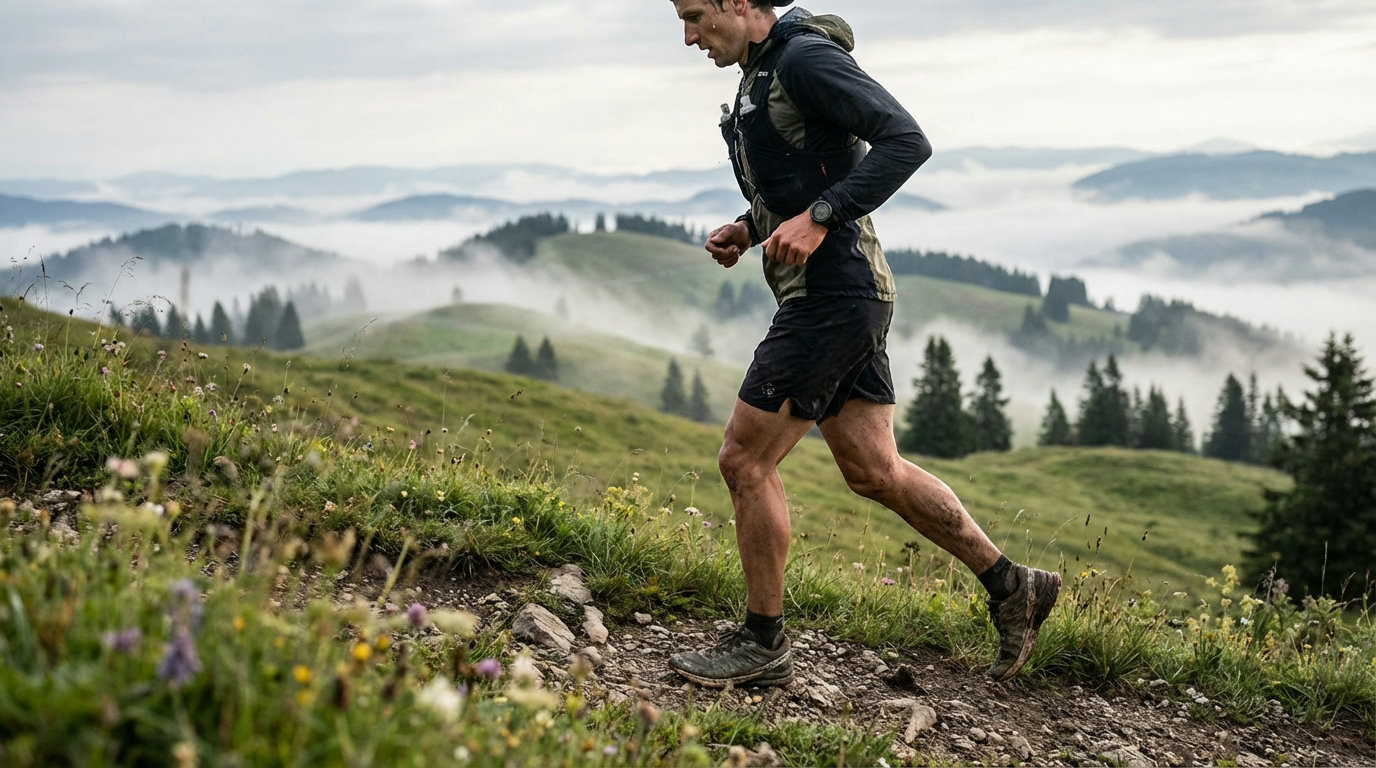
Trail running places different demands on your body than road running. Running economy on trails is made up of several elements that you need to train deliberately. If you only run on the flat and hope your legs will carry you uphill, you will be disappointed.
Sports science and specialist running magazines agree on the core elements: uphill power, downhill technique, core stability and terrain-specific speed endurance form the foundation. These four areas complement one another, and neglecting one will catch up with you by race day at the latest.
Below, you will find the four key training elements in detail. The good news is that you do not need a performance lab. Hills, stairs, forest paths and a few basic exercises are enough to get started.
 AI-generated
Pace, elevation gain, heart rate: the right watch helps you manage your training.
Must-have trail running kitContents
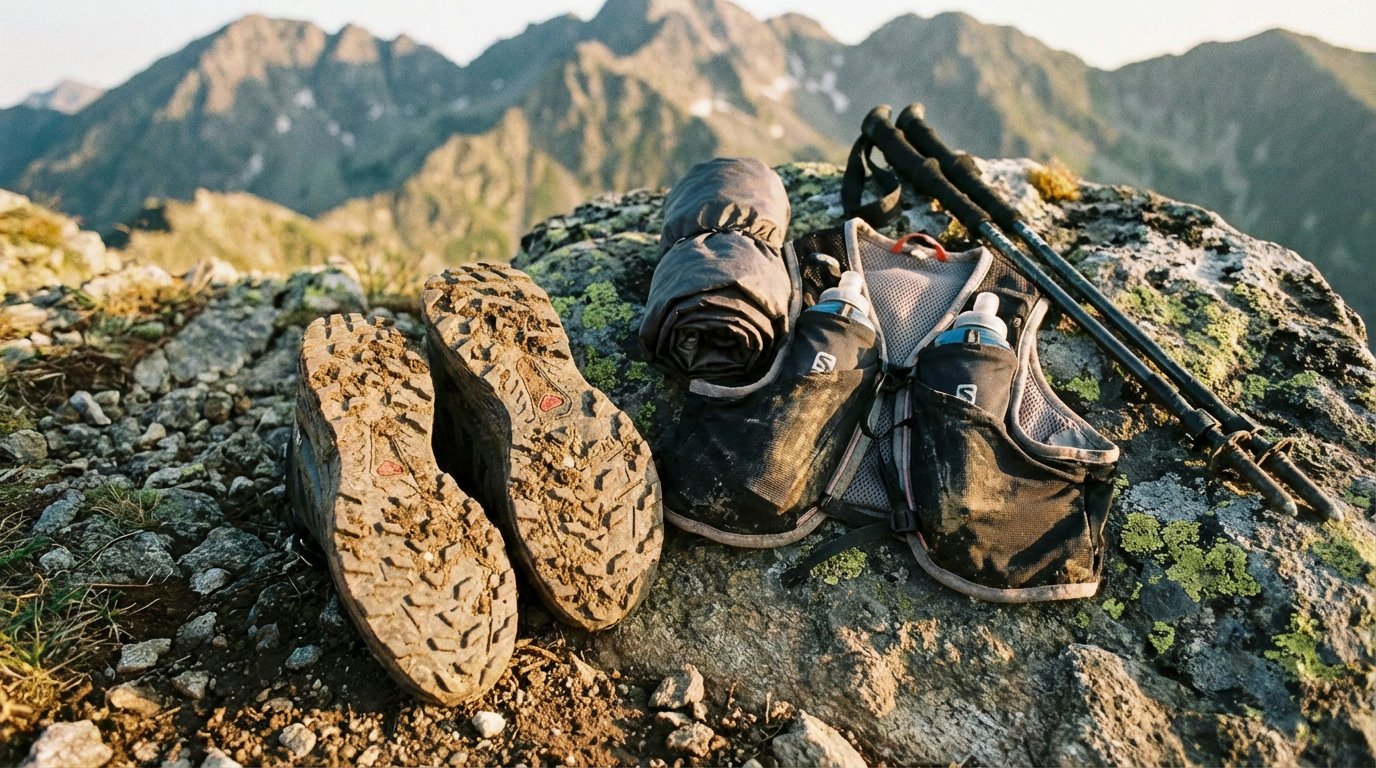
The right kit does not have to be expensive, but it must suit its intended use. The most important item is the trail running shoe: a trail-specific outsole with a good tread pattern and sufficient grip is non-negotiable. Standard road running shoes quickly reach their limits on wet rocks, roots and mud. At best, you lose time; at worst, you lose your balance.
Your equipment can be divided into three areas: shoes, clothing and hydration/nutrition. With shoes, the terrain decides: deep lugs grip in mud and soft ground, while shallower tread patterns roll more smoothly over rock and hard-packed paths. Try different models in store, paying attention to fit and room around the toes. You need space at the front, especially on descents.
For clothing, follow the layering principle: a technical shirt as a base layer, a light mid-layer when needed, plus a wind- and water-repellent jacket. Complete your setup with a running pack or hydration vest with soft flasks and suitable nutrition: gels, bars and salt tablets for longer sessions.
Important: there is no single shoe for every type of terrain. If you run exclusively on forest paths, you need a different tread pattern from someone tackling rocky alpine trails. For getting started, a model with a medium tread pattern and good cushioning that works on mixed terrain is recommended. As you gain experience, a second, more specialised pair can be worthwhile.
What to look for when buying trail shoesContents
Trail shoes are your most important piece of kit, and also the most individual. What fits one runner perfectly may give another blisters after five kilometres. Rather than blindly following a hyped-up model, choose according to these criteria:
Tread and grip — Your terrain is what matters. For forest and gravel paths, a shallower tread pattern with 4–5 mm lugs is enough. In alpine terrain, on rock and in mud, you need deeper 5–7 mm lugs and a softer rubber compound.
Cushioning vs ground feel — Highly cushioned shoes are more forgiving over long distances, but give you less feedback from the ground. More minimal models offer better control on technical trails, but demand more from your feet and joints.
Heel-to-toe drop — Most trail shoes have a drop of between 4 and 8 mm. A lower drop encourages midfoot striking, while a higher drop puts less strain on the Achilles tendon. Do not switch abruptly; adjust to a different drop gradually.
Fit and toe box — Feet swell over long distances. A sufficiently wide toe box helps prevent black toenails. Try on shoes in the afternoon, when your feet are at their largest.
The current trend is towards supercritical EVA for lighter, more responsive cushioning and carbon plates moving from road running into trail running. However, this remains controversial because the benefits are lower on technical terrain than on tarmac.
 AI-generated
Essential vs extended gear
| Equipment | Essential setup | Extended (alpine/ultra) |
|---|---|---|
| Shoes | Trail shoes with grippy soles | Specialised models for rock, mud or waterproof protection |
| Clothing | Technical shirt + shorts | Layering system with midlayer + windproof jacket |
| Rain protection | Lightweight windproof jacket | Waterproof running jacket, often mandatory |
| Hydration system | Handheld bottle | Running pack with soft flasks or hydration bladder |
| Navigation | Smartphone with GPS | GPS watch + maps |
| Nutrition | Bars + gels for 1–2 h | Gels, bars, salt tablets, personalised plan |
| Safety | Nein | Head torch, emergency blanket, whistle, first aid kit |
| Poles | Nein | Foldable trail running poles |
8 Einträge in der Vergleichstabelle
Shoes, clothing, packs and accessories: everything for your next trail.
Safety gear for alpine trailsContents
As distances increase, terrain becomes alpine and routes include night sections, additional safety gear becomes mandatory. Many alpine races publish mandatory equipment lists, which are checked when you collect your race number. If you do not have everything with you, you cannot start.
The key safety items at a glance:
- Trail running poles: Take the strain off on long climbs and provide stability on technical descents. Foldable models fit in your pack.
- Head torch: Mandatory for ultra and night races. At least 200 lumens; bring spare batteries.
- Mobile phone in a waterproof case with a charged battery and emergency number.
- Whistle: Small, light and potentially lifesaving in an emergency. Many running packs have one built in.
- First aid kit: At minimum, blister plasters, tape and sterile dressings.
- Emergency blanket: Weighs under 50 g and protects against hypothermia if you are forced to stop.
- Maps or a GPS device: Essential, especially on self-supported trails without route markings.
From compact hydration vests to 15-litre packs for ultra distances.
Which setup is right for you?Contents
The right choice depends on your terrain and goal
Ideal for
Experienced runners planning their first or next trail season
Not ideal for
Road runners with no interest in off-road running