Background
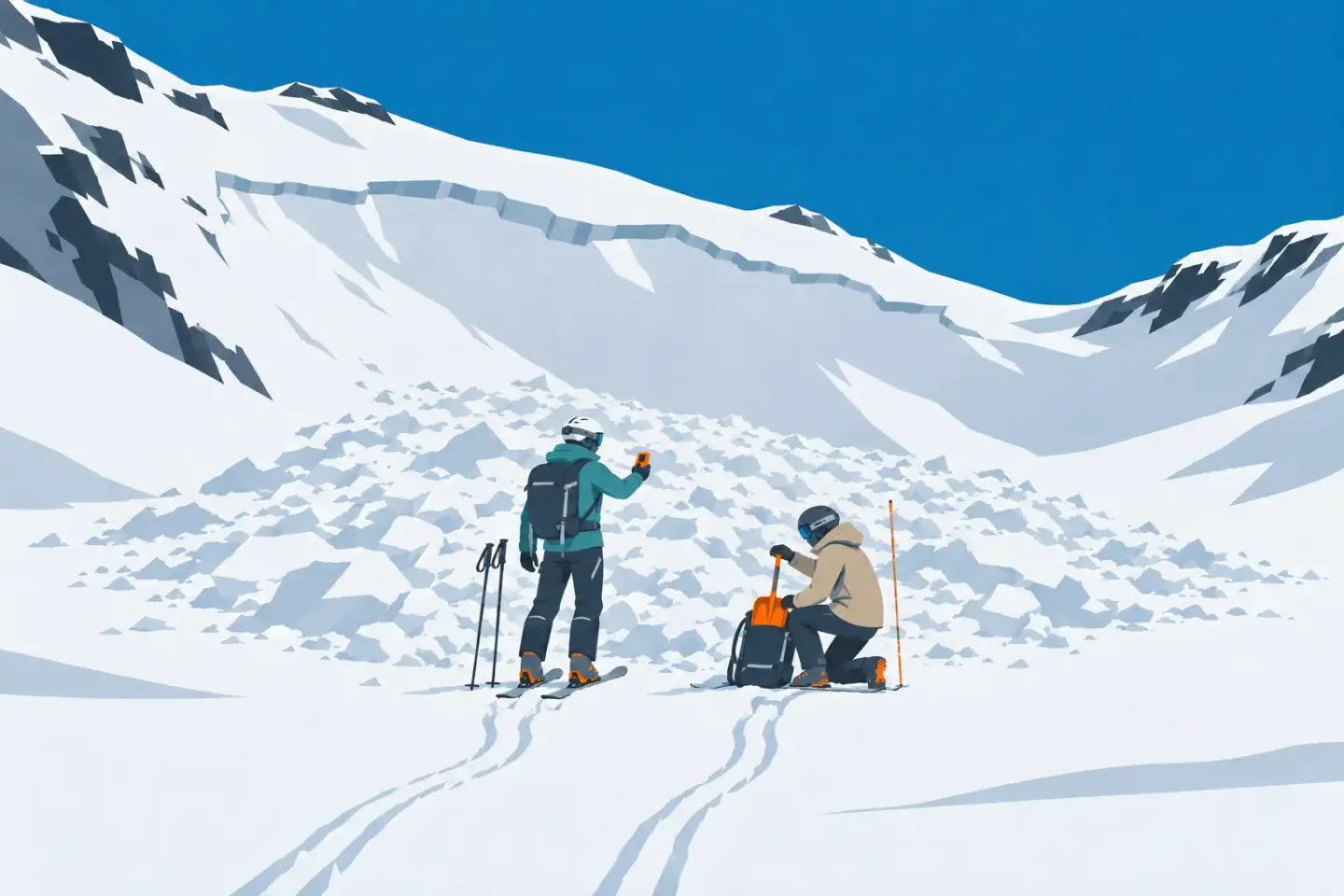 Illustration: SportFits
Avalanche emergency
The first 15 minutes
Anyone buried needs the people who were travelling alongside them. This is how the rescue works, from the avalanche to recovery.
Scroll through the nine stations
Survived when recovered within the first 15 minutes
91%
But the curve already drops steeply from the tenth minute. After 30 minutes, barely one in three people survives.
Median minutes until their own group digs out a buried person
10min
Rescue services take a median of 90 minutes, because they have to get there first. People rescued by their own group survive about three times as often.
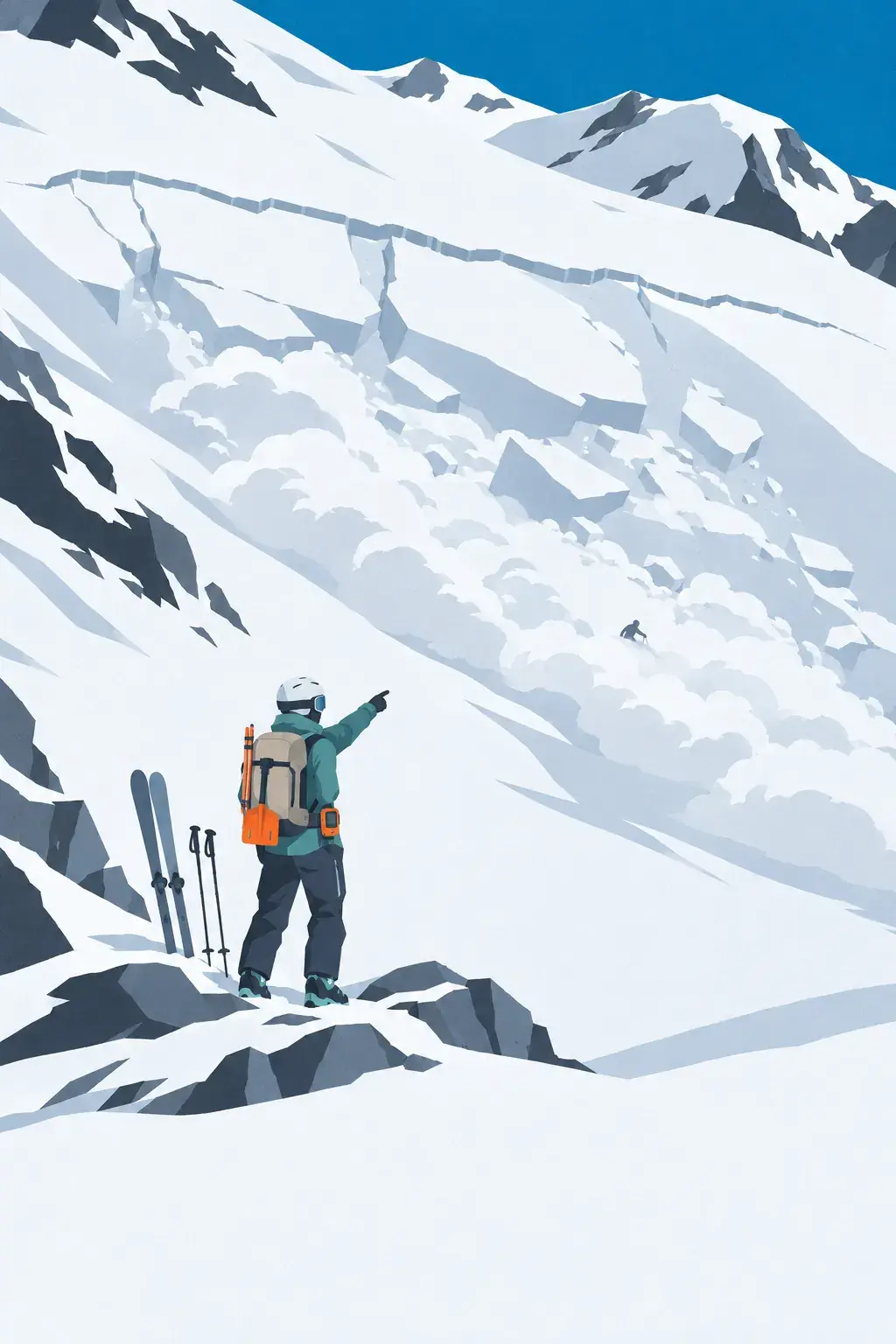 Illustration: SportFits
1 · The avalanche releases
Remember the point where they disappeared
Follow the person swept away with your eyes for as long as you can see them. The point where they disappear is the starting point for your search.
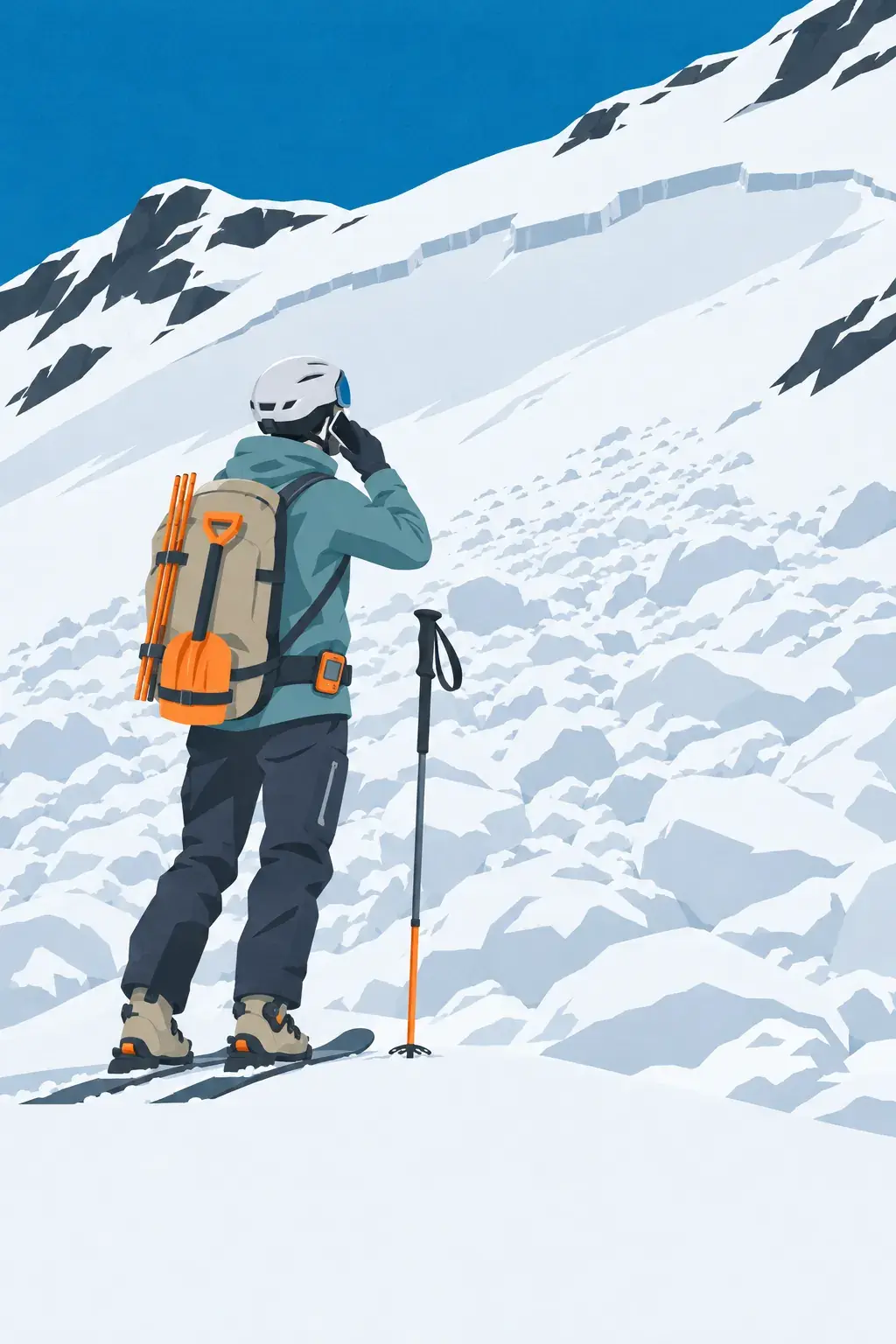 Illustration: SportFits
2 · Overview and emergency call
Look first, then call
Check whether more snow could come down from the slope above, then switch your device to search mode. If there are several of you, one person makes the emergency call, 112 or 140 in Austria, 1414 in Switzerland, while everyone else starts searching immediately.
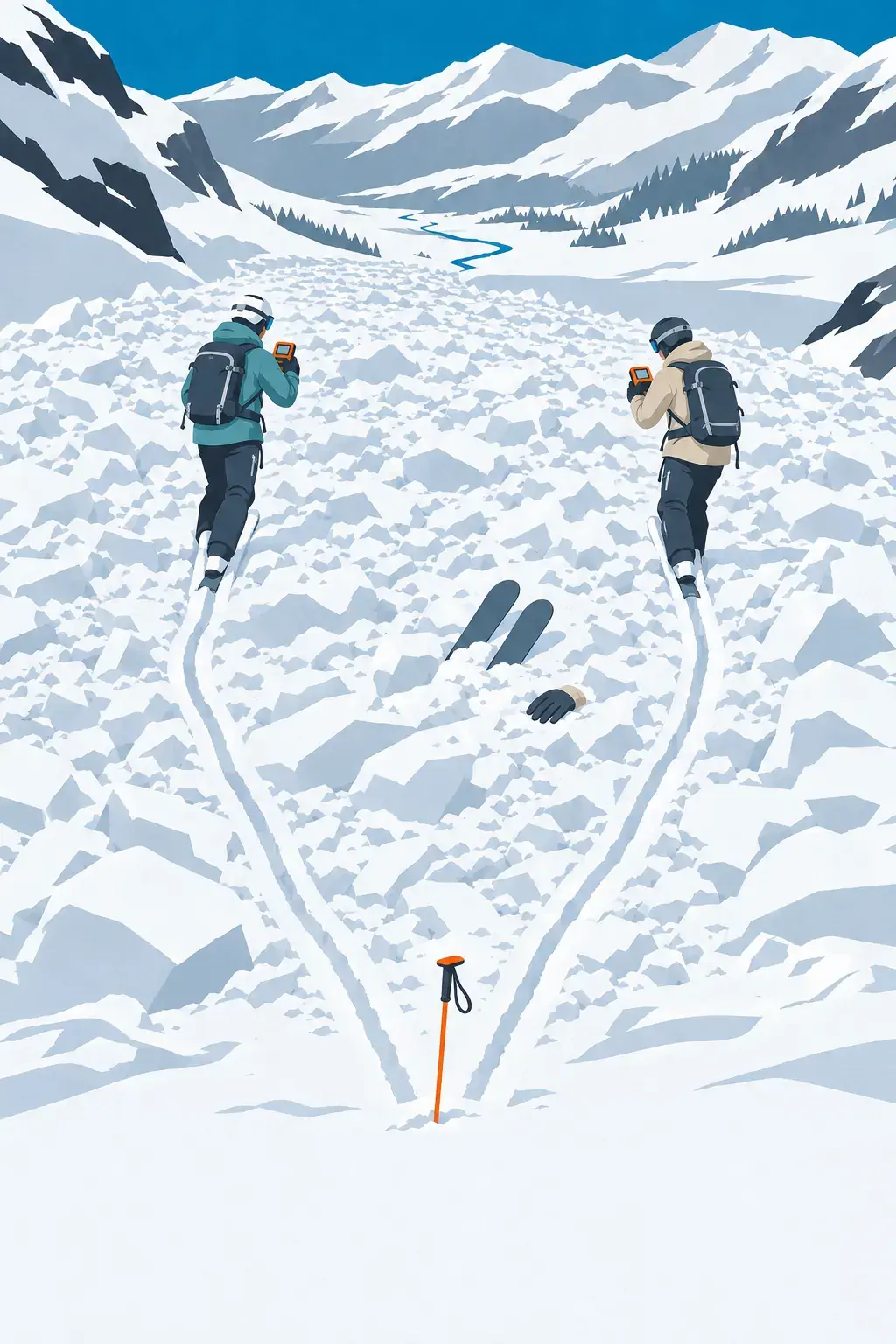 Illustration: SportFits
3 · Signal search
Move quickly, using your eyes and ears
Move from the point where the person disappeared in the direction the avalanche flowed, briskly and with the device held horizontally in front of you. Look at the debris cone rather than the display, because a ski, a glove or a call can save minutes.
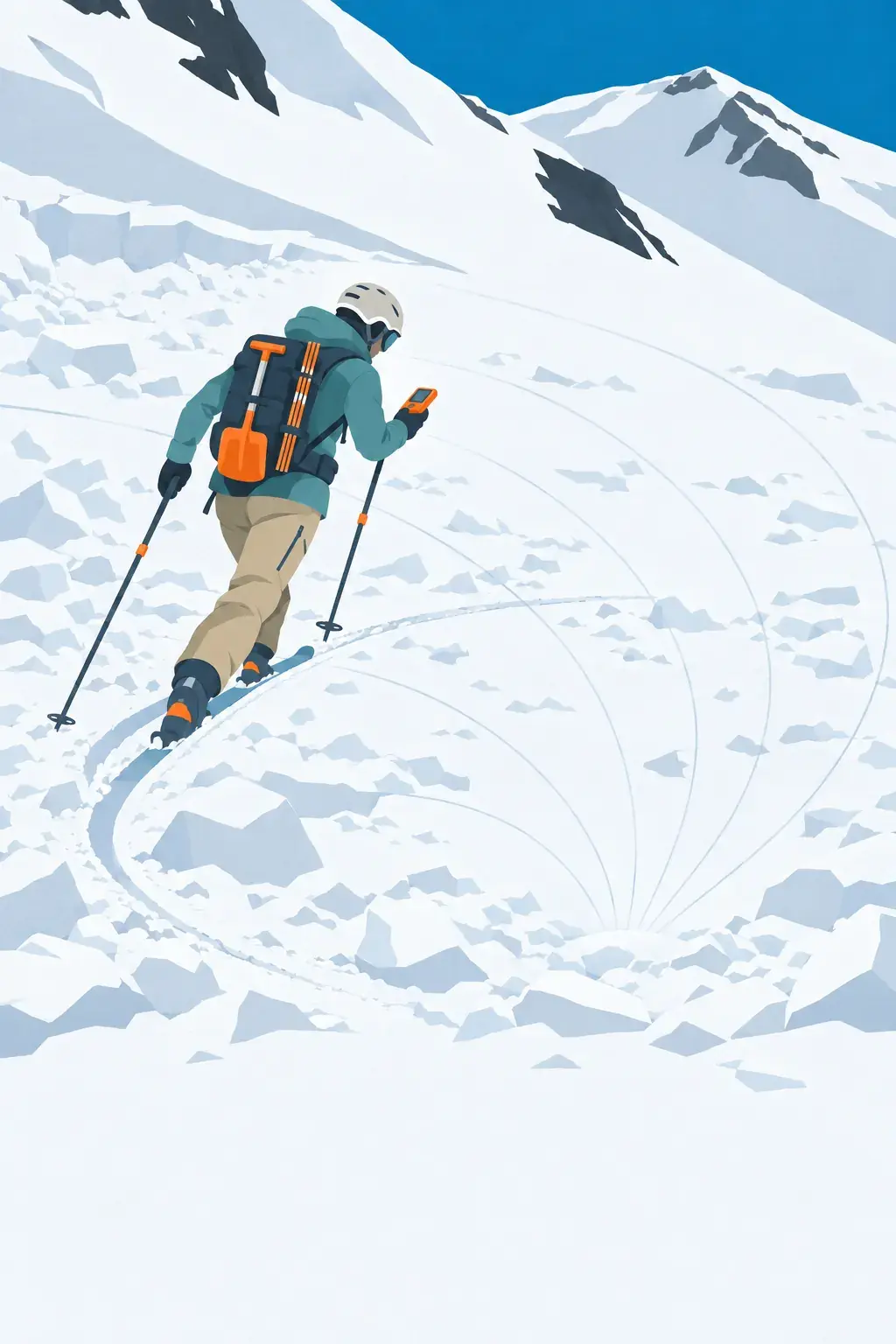 Illustration: SportFits
4 · Coarse search
Follow the arrow, even around a curve
Once the device has a stable signal, follow the arrow and turn around as soon as the values increase. The arrow follows the field line and guides you in an arc; from about ten metres away, slow down.
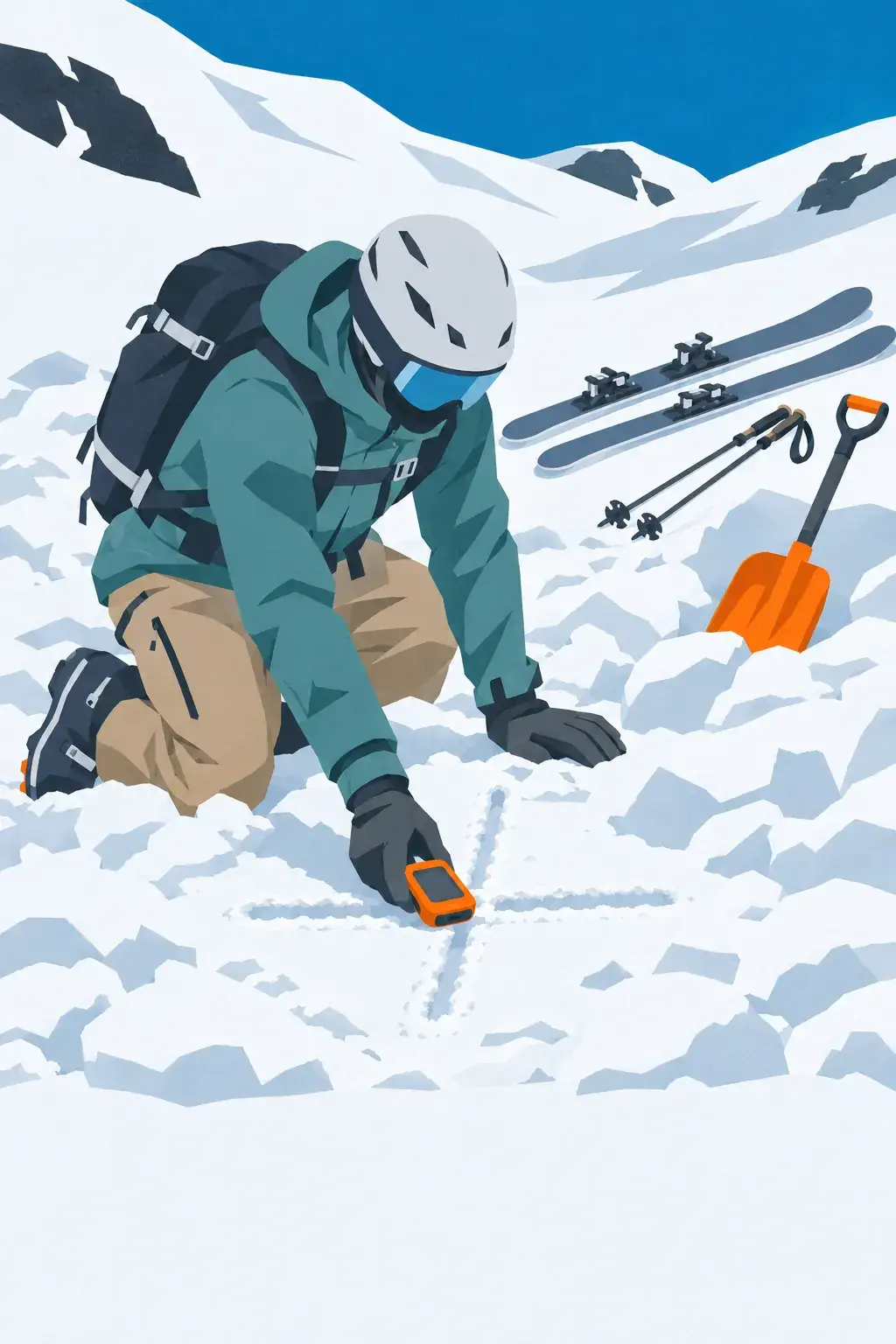 Illustration: SportFits
5 · Fine search
Slow down
Below three metres, the arrow disappears on many devices, so guide the device close over the snow while kneeling. Cross the area along two perpendicular lines until you find the lowest value.
6 · Pinpoint search · the average burial depth
80cm
Mark the point with the lowest value, for example with a glove. The display there roughly corresponds to the depth; the probe finds the exact point.
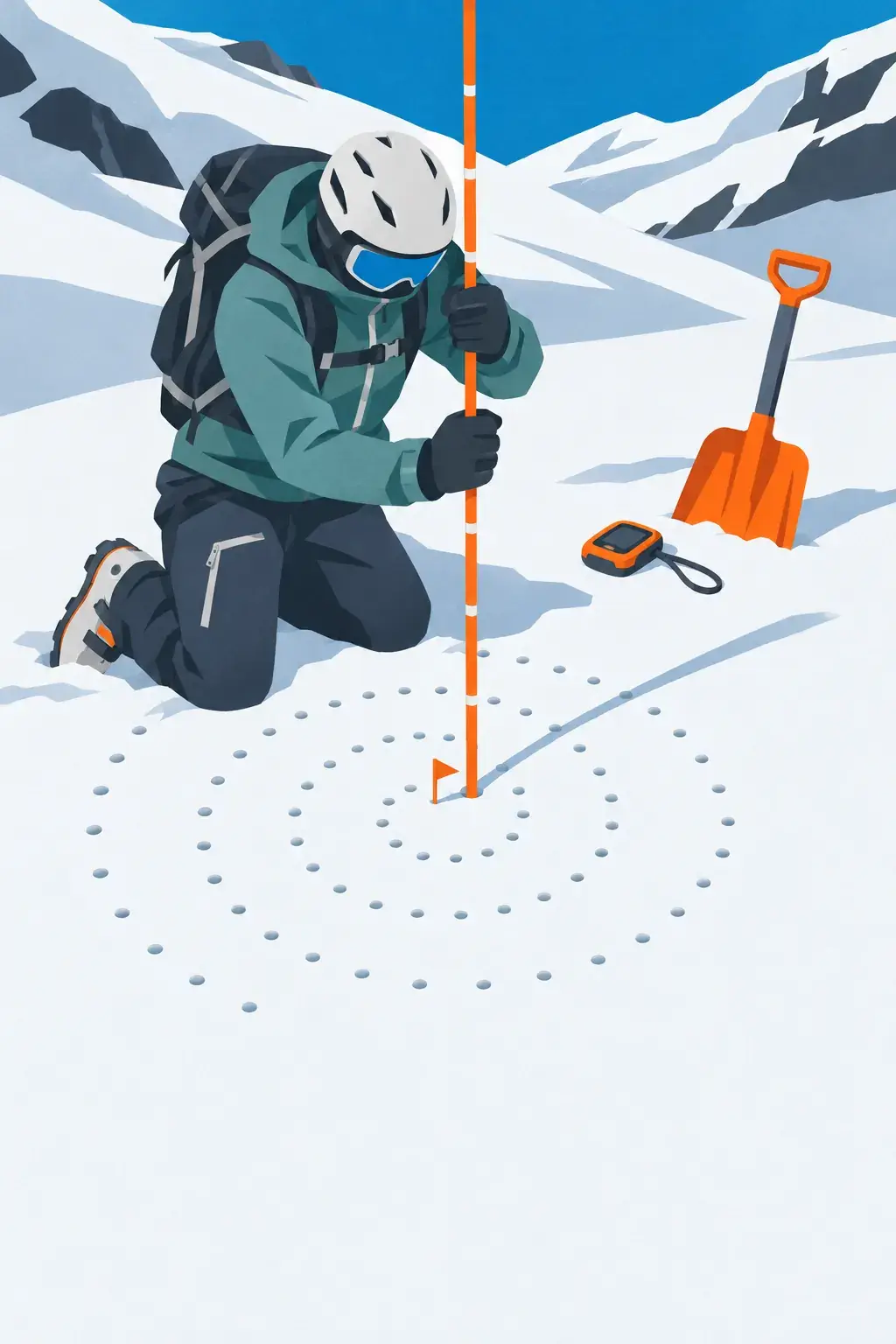 Illustration: SportFits
7 · Probing
In a spiral
Starting at the marked point, probe outwards in a spiral, about every 20 centimetres and always at right angles to the snow surface. If it feels soft and springy, leave the probe in place.
Guide figures from the Ortovox Safety Academy for trained users
Digging takes the longest
- Transceiver search2–3 min
- Probing0,5–1 min
- Digging out4–5 minoften longer at a depth of one metre
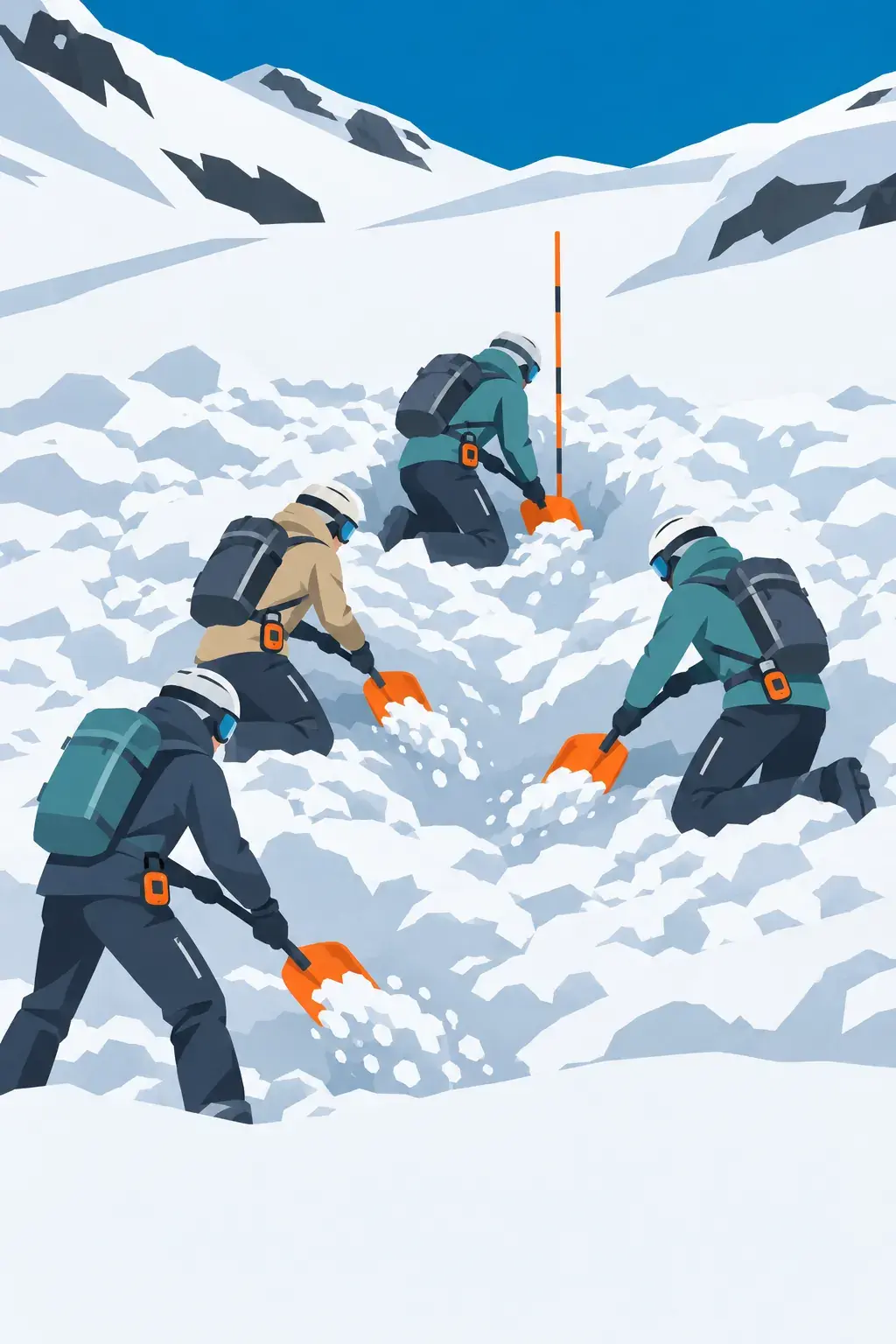 Illustration: SportFits
8 · Shovelling
In a V, like a conveyor belt
Start downhill from the probe, about twice as far away as the person is buried deep on flat terrain, and about the same distance on steep terrain. If there are several of you, form a V, with one person at the probe and the others paddling the snow backwards, changing places every few minutes.
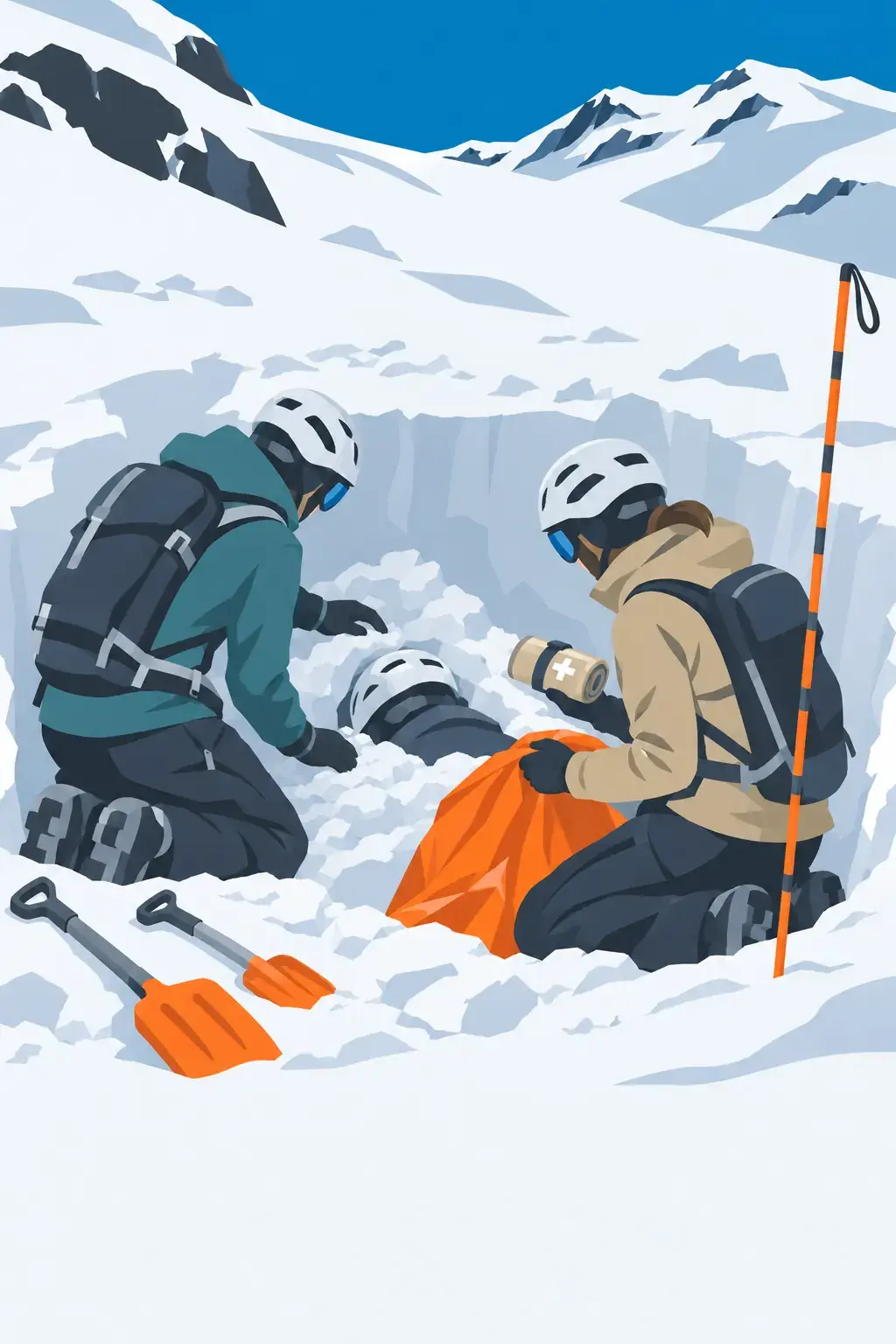 Illustration: SportFits
9 · First aid
Head and chest first
First uncover the head and chest and check whether the mouth and nose are clear and whether there was an air pocket in front of the face. If the person is not breathing, begin with five rescue breaths and continue resuscitation until the rescue service takes over.
Next
Practise before it matters
Listen: the first 15 minutes
The companion-rescue process in just under four minutes, narrated by an AI voice.
Practise the search yourself now
Someone is buried under the snow and you have the avalanche transceiver in your hand. The browser exercise guides you through signal search, coarse search, fine search and probing. It does not replace a course in the field.
Go to the transceiver exercise ↗For a long time, a simple rule applied: more than 90 per cent of buried people survive the first 15 minutes. It comes from an analysis of 422 completely buried people in Switzerland, published by the team around Markus Falk and Hermann Brugger in the journal Nature in 1994. The rule is not wrong. The curve simply drops earlier today.
A team led by emergency physician Simon Rauch, which also included Brugger and Falk, analysed Swiss data from 40 winters in 2024: 1,643 people whose heads and chests were under the snow. After ten minutes under the snow, the probability of survival was 91 per cent, after 15 minutes 76 per cent and after 30 minutes 31 per cent. The bend in the curve therefore comes after just ten minutes, not only after 15. The reason has not been established with certainty. The authors consider earlier suffocation more likely than an increase in injuries.
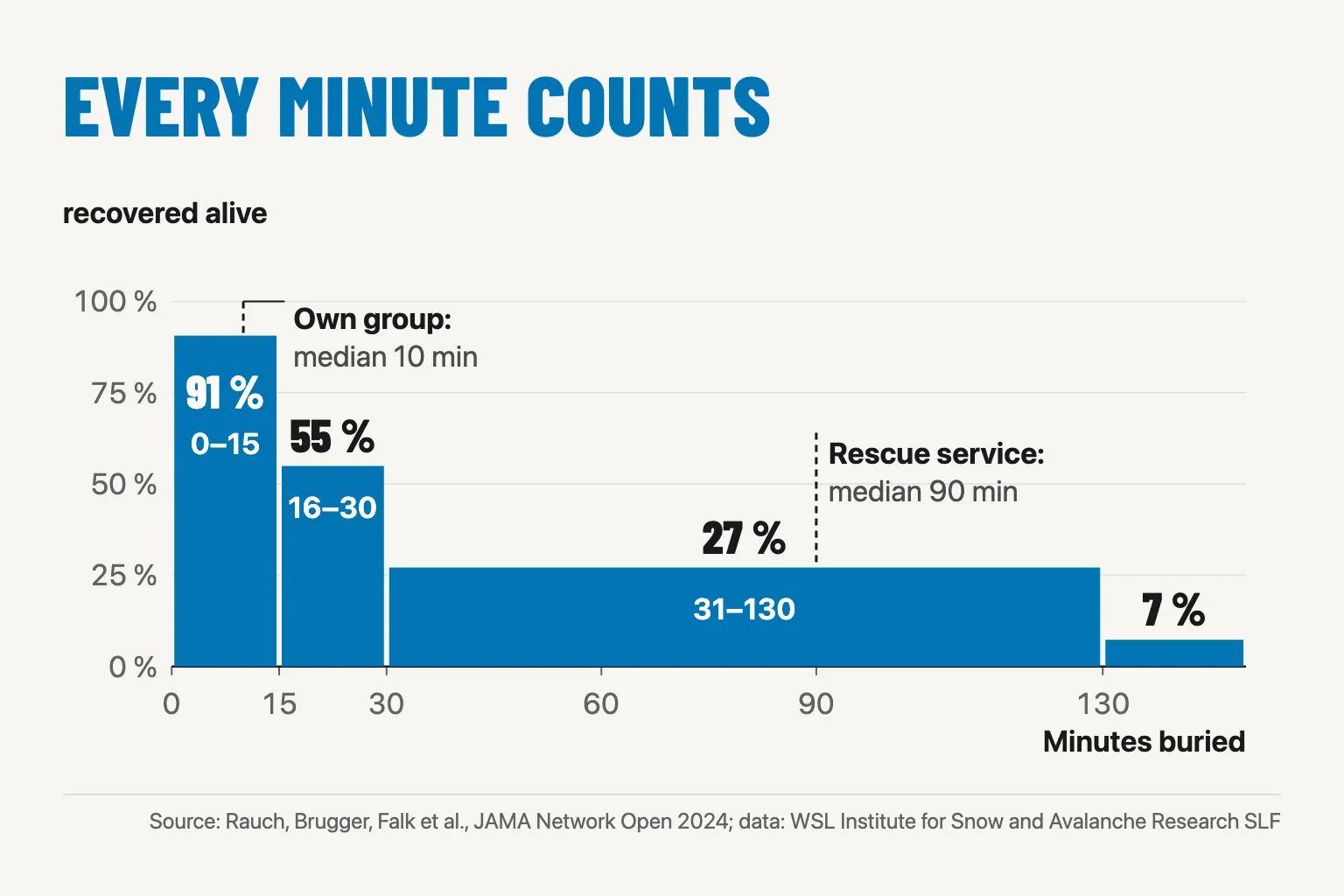
An overview by the International Commission for Alpine Rescue of 120 studies shows what buried people die from: most suffocate, in 65 to 100 per cent of cases depending on the study. Injuries follow at 5 to 29 per cent, while hypothermia is rarely the cause, at zero to four per cent. That is why the people already there matter. If the group digs, the person is free after an average of ten minutes. The rescue service takes an average of 90 because it first has to be alerted and travel to the site. Those rescued by their own group survived about three times as often.
Depth also matters. An analysis from Austria and Switzerland in 2016 shows that the duration and depth of burial act independently of each other, and that an air pocket in front of the face improves the chances, especially after 15 minutes. In Switzerland, buried people were at an average depth of 80 centimetres.
Searching with an avalanche transceiver, or LVS for short, has four phases. The Ortovox Safety Academy compares them with an aircraft’s landing approach: the closer you get to the target, the slower and more precise you become.
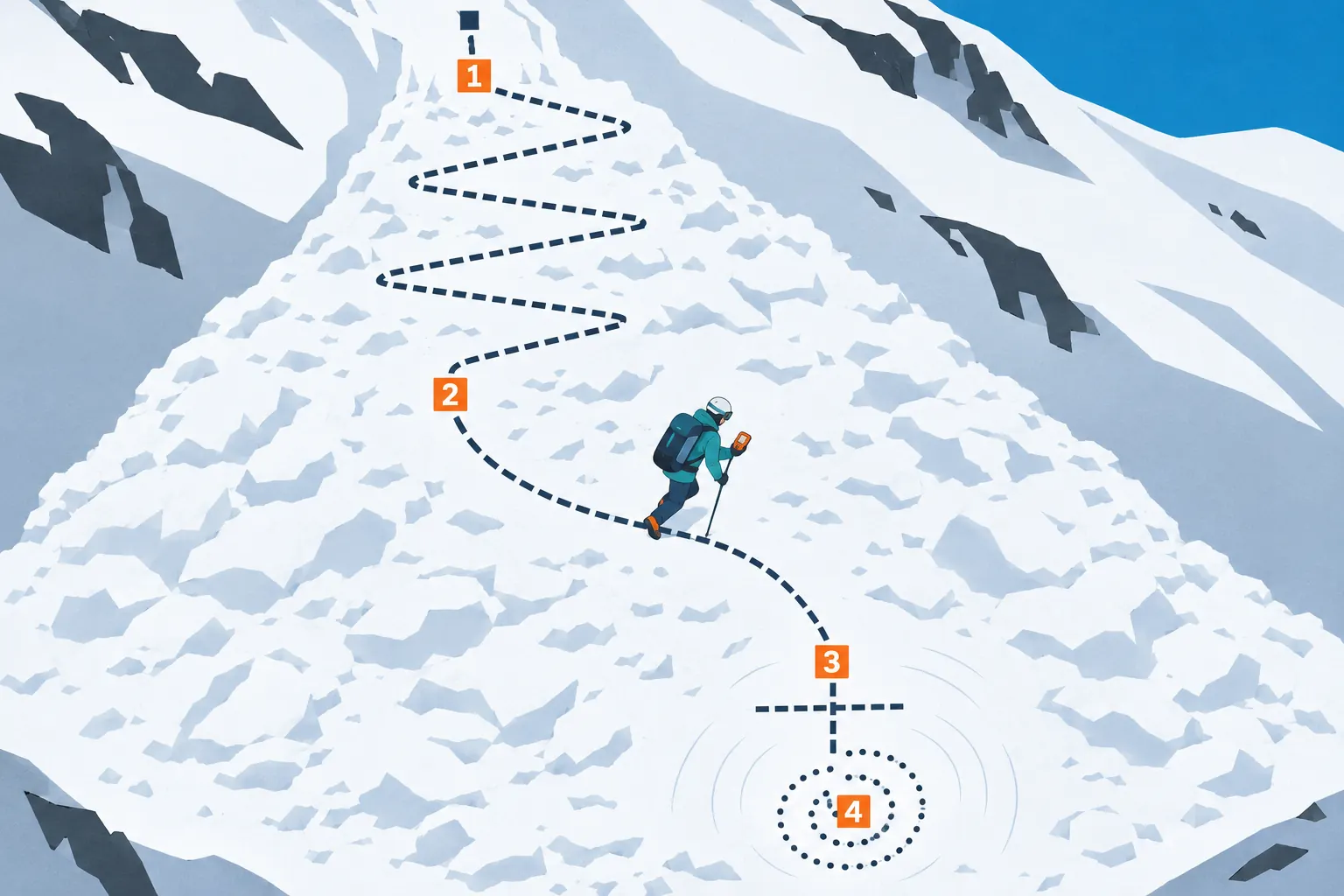
Signal search: until the device receives something.
Everyone searching switches their device to search mode; anyone not searching switches theirs off. Then move from the point where the person disappeared in the direction the avalanche flowed, as quickly as the snow allows, with the device held horizontally in front of you. How far apart the search lanes may be depends on the device. The DAV teaches 20 metres between lanes and 10 metres from the edge, while Ortovox specifies a search-strip width of 80 metres for the Focus Voice. Look at the debris cone rather than the display: a ski or a glove on the snow can shorten the route.
Coarse search: follow the arrow.
Once the signal is stable, follow the arrow. If the values rise, turn around. The arrow follows the sender’s field line and therefore usually guides you in an arc. From about ten metres away, slow down because the device needs time to calculate and you would otherwise walk past the signal.
Fine search: kneeling and slowly.
From about five metres away, or three metres according to Swiss training, hold the device close over the snow and stop rotating it. On many devices, the arrow disappears below three metres. Cross the area along one line until you reach the lowest value, then cross it again at right angles.
Pinpoint search: with the probe.
Mark the lowest value with a glove or hat. It roughly corresponds to the depth, but is not exact. The probe finds the exact spot faster than the device.
The probe tells you exactly where the person is and how deep. Start at the marked point and probe outwards in a spiral, about every 20 centimetres. The angle is important: at right angles to the snow surface, so on a slope not vertically downwards, and the same for every probe. If the angle changes, gaps remain at depth.
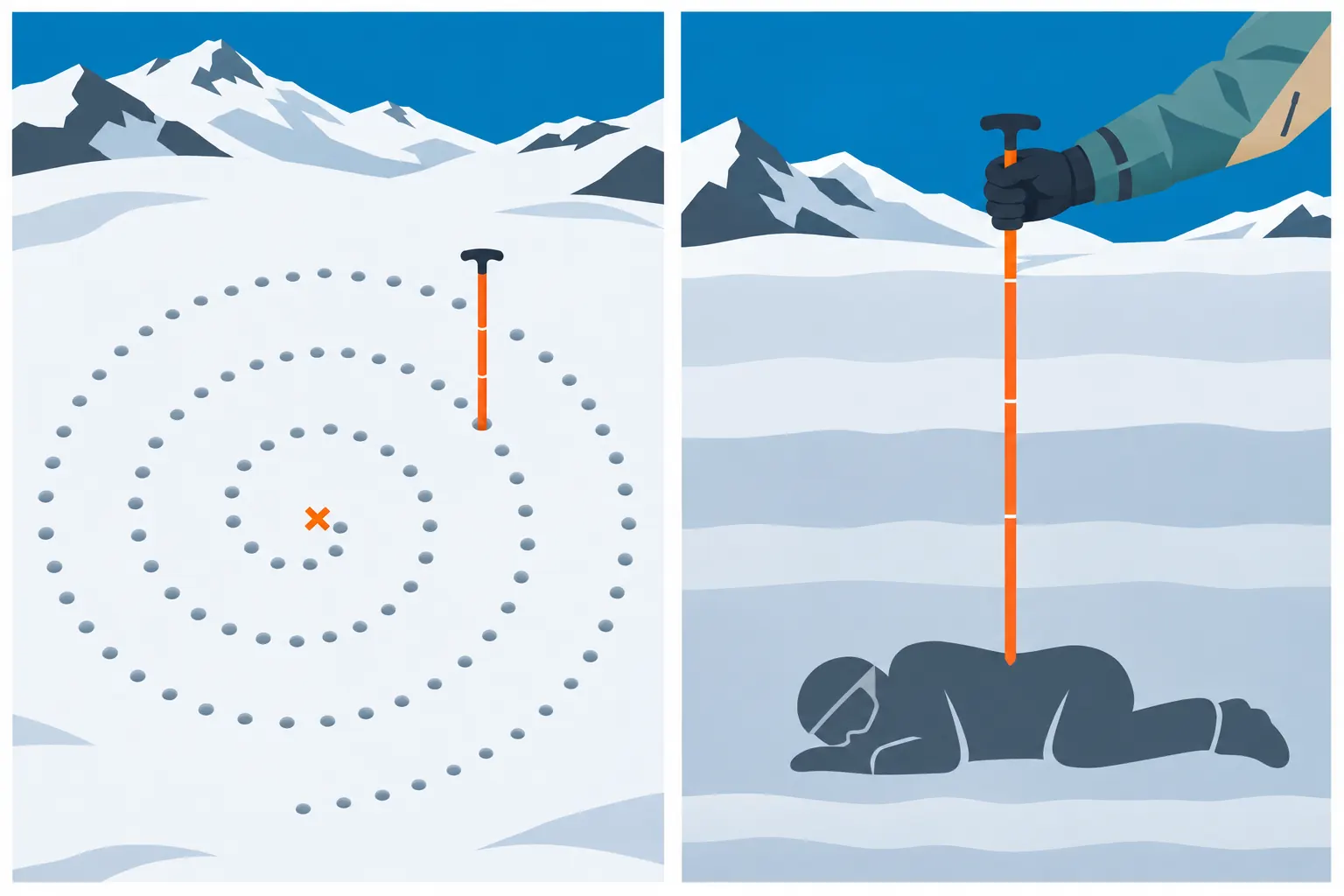
Probe to at least one and a half times the depth last shown by the device. A body feels soft and springy, a stone hard. If you hit something, leave the probe in place; it shows the way when digging. Do not step on the snow around the probe, otherwise you may compress an air pocket. The probe must also be long enough: the Swiss avalanche-prevention training team requires at least 240 centimetres.
Digging out takes by far the most time. If everyone simply starts digging, they get in each other’s way. Manuel Genswein and Ragnhild Eide therefore described and tested the V-shaped snow conveyor belt in field trials. Groups without this system took 42 per cent longer at a depth of one metre and more than twice as long at two metres.
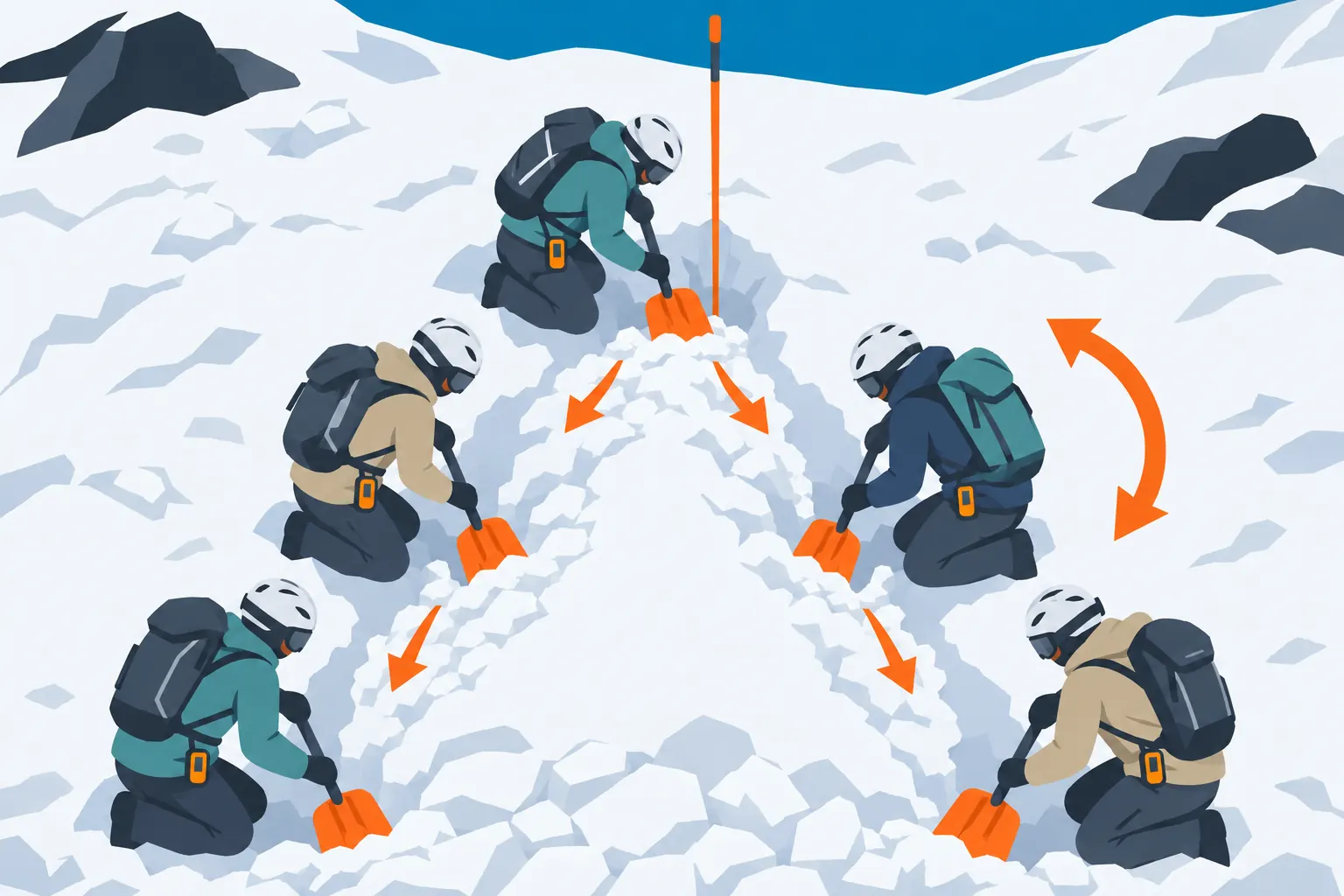
How the conveyor belt works
on flat terrain, about twice as far away as the person is buried deep; on steep terrain, about the same distance
at a depth of two metres on flat terrain, this means five people
the person at the front digs towards the probe, while everyone else paddles the snow backwards instead of lifting it
and push it away backwards
clockwise, after four minutes at the latest or at the first sign of fatigue
once the person is visible, stop changing positions; two people work at the front while kneeling
If you are alone, you also start downhill of the probe. The DAV recommends starting about one to one and a half times as far away as the probe is deep.
As soon as the face is clear, the key question is whether the person can breathe. The recommendations of the International Commission for Alpine Rescue (ICAR MedCom, as of 2023) are as follows:
Clear the head and chest.
Clear snow from the mouth and nose, checking whether there was an air pocket in front of the face and whether the airways are clear. Note the time.
Buried for up to 60 minutes: assume suffocation.
Check for signs of life for no more than ten seconds. If there are none, give five rescue breaths and then begin CPR until the rescue service takes over.
Buried for more than 60 minutes: consider hypothermia.
Check for signs of life for up to one minute. If the airways are clear or this is unclear, begin CPR in either case.
Move carefully and keep warm.
If the person is breathing, move them carefully, protect them from further cooling, for example with a bivy bag, and consider possible injuries.
If there are several of you, one person calls and at least one starts searching immediately. The person on the phone should stay at least 25 metres away from the searchers so that the mobile phone does not interfere with the avalanche transceivers. If you are alone or have no signal, search comes first. There is no fixed rule on whether someone alone should call or search first. We do it this way: search first, then make the emergency call as soon as it is possible without losing time.
| Country | Number | Note |
|---|---|---|
Germany | 112 | also for the mountain rescue service |
Austria | 140 | alpine emergency number; 144 in Vorarlberg, 112 works everywhere |
Switzerland | 1414 | Rega; 144 in Valais, 112 uses all networks |
Italy, France | 112 | European emergency number |
Five details help on the phone: what happened, where it happened, preferably with coordinates, how many people are buried, who is calling and when it happened.
A transceiver, probe and shovel belong together. A device without a probe finds the person, but not quickly enough. A probe without a shovel shows where they are, but not how to get them out. All three only help if everyone carries them. Anyone travelling as the only person without a device can neither search for anyone nor be found themselves. Keep the probe and shovel in your backpack, within easy reach; the backpack guide helps you find one that fits.
An avalanche airbag acts one step earlier: it can prevent you from being completely buried in the first place. An analysis of accidents from seven countries found that mortality fell from 22 to 11 per cent when an airbag was deployed. However, one in five airbags was not deployed, usually because of an operating error. Anyone who is buried despite using one needs the same search as everyone else.
What suits you
- 1
If you are buying an avalanche transceiver for the first time
choose a three-antenna device with a marking function and practise with it before you need it in the field
- 2
If you struggle to focus on a display in stressful situations
voice guidance such as that on the Focus Voice or Diract Voice can help, but it does not replace learning the search technique
- 3
If you often travel in steep freeride terrain
an airbag can reduce your risk; it supplements a transceiver, probe and shovel and never replaces them
- 4
If you focus on every gram
a shorter, lighter probe is tempting, but below 240 centimetres it becomes marginal for a deep burial
Right for you if …
Ski touring, freeriding and snowshoeing away from secured pistes
Probably not for you if …
Piste skiing in a secured ski area
The search itself is quick to learn. It becomes difficult under stress, with cold hands and someone you know somewhere under the snow. That is why professionals practise regularly, and not just with the device. The DAV advises practising probing and digging just as intensively as the transceiver search. Every tour should also start with a group check: every device transmits and every device receives. And before you set off, check the regional avalanche bulletin and the snow and wind on the weather radar.
No article or screen exercise replaces a course in the field. The Ortovox Safety Academy offers avalanche courses with certified mountain schools in small groups, as well as the free LAB Snow learning platform with a dedicated chapter on companion rescue. Courses are also available from the German Alpine Club, the Austrian Alpine Club and the Swiss Alpine Club.
Next, see Transceiver, probe, shovel and the finder Which avalanche transceiver suits you?. Everything from Ortovox in our range is in Experience Ortovox.
Frequently asked questions
How long can someone survive under an avalanche?
According to the latest Swiss data, 91 per cent of buried people survive the first ten minutes, while after 30 minutes barely one third are still alive. An air pocket in front of the face improves the chances, and even after more than two hours, 7 per cent were recovered alive. You cannot rely on this.
How deep is a buried person usually?
Completely buried people in Switzerland were at an average depth of 80 centimetres. That sounds shallow. Even so, digging them out usually takes longer than the entire search.
Does an avalanche airbag replace an avalanche transceiver?
No. An airbag reduces the likelihood of being completely buried. If you are buried despite using one, the group can only find you with a transceiver, probe and shovel.
How often should I practise with my avalanche transceiver?
Regularly, and not just the search: the DAV advises practising probing and digging with similar intensity. Before every tour, check as a group that every device transmits and receives.
What should I do if I am alone?
Search first and make the emergency call as soon as it is possible without losing time. If there is no signal, search always comes first. If you are alone, dig your way towards the probe from downhill.
Sources (16)
- Rauch S, Brugger H, Falk M et al.: Avalanche Survival Rates in Switzerland, 1981–2020. JAMA Network Open 2024;7(9):e2435253 ↗
- Brugger H, Durrer B, Adler-Kastner L et al.: Field management of avalanche victims. Resuscitation 2001;51:7–15 ↗
- Procter E, Strapazzon G, Dal Cappello T et al.: Burial duration, depth and air pocket explain avalanche survival patterns in Austria and Switzerland. Resuscitation 2016;105:173–176 ↗
- Pasquier M, Strapazzon G, Kottmann A et al.: On-site treatment of avalanche victims, ICAR MedCom 2023. Resuscitation 2023;184:109708 ↗
- ICAR MedCom: Avalanche Victim Resuscitation Checklist, revised 2023 ↗
- Haegeli P, Falk M, Procter E et al.: The effectiveness of avalanche airbags. Resuscitation 2014;85:1197–1203 ↗
- Genswein M, Eide R: The V-Shaped Snow Conveyor-Belt. International Snow Science Workshop, Whistler 2008 ↗
- Swiss avalanche training team (KAT): Avalanche accident fact sheet, 2020, via WSL Institute for Snow and Avalanche Research SLF (German) ↗
- German Alpine Club (DAV): Searching with an avalanche transceiver (German) ↗
- German Alpine Club (DAV): Probing and digging out buried people (German) ↗
- German Alpine Club (DAV): Emergency calls and rescue in the Alps (German) ↗
- Austrian Mountain Rescue: Making an emergency call (German) ↗
- Rega: Emergency number 1414 ↗
- Ortovox Safety Academy: LAB Snow, companion rescue chapter ↗
- Ortovox: Focus Voice and Focus Pro user manual ↗
- Ortovox Safety Academy: Avalanche courses ↗
SportFits
outdoors looks good on you