Wissen
Chiemgau-Arena: Ruhpolding’s races in the forest
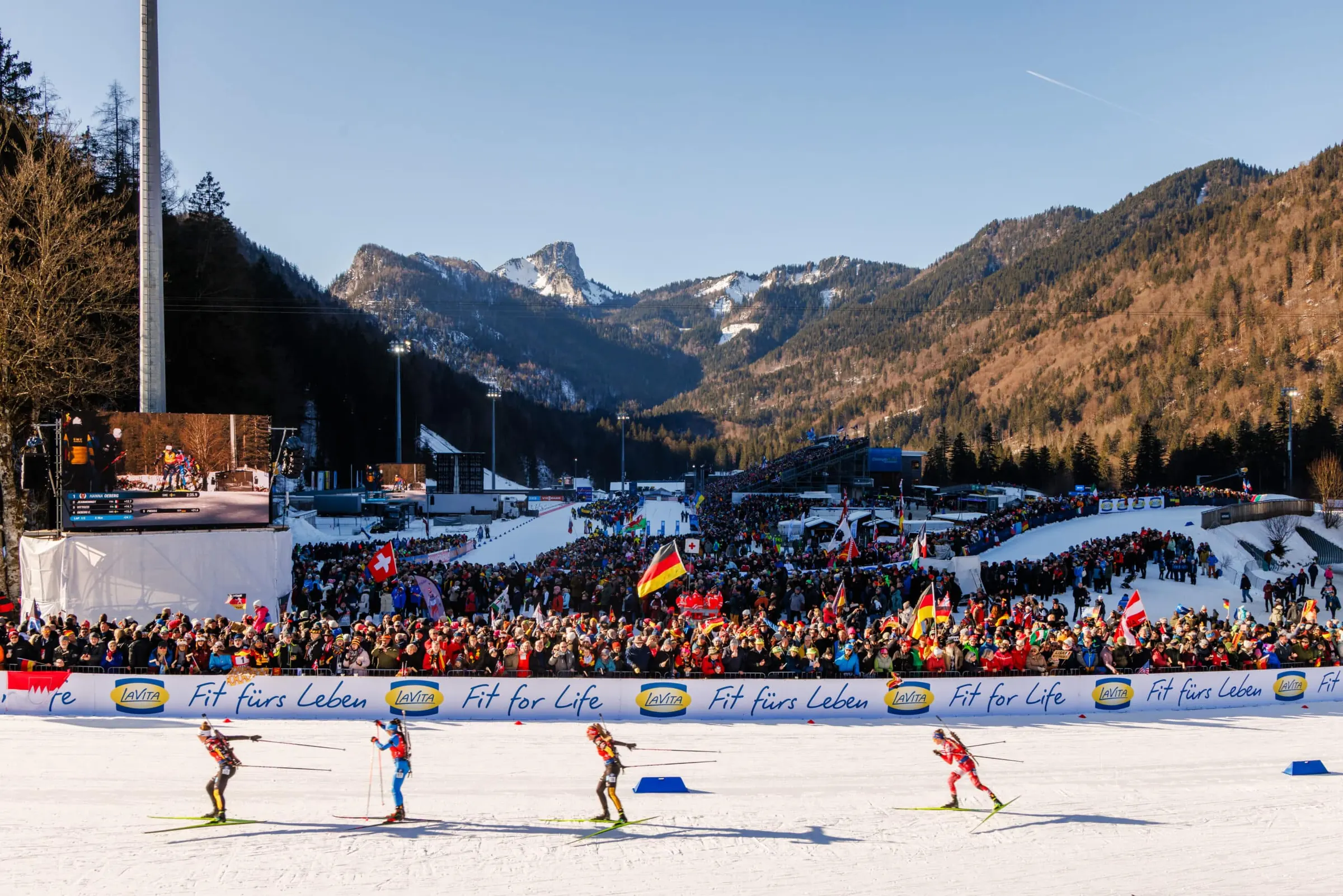
Four biathlon World Championships since 1979, loops through the forest: Chiemgau-Arena in Ruhpolding and how to watch the action there.
Chiemgau-Arena lies south of Ruhpolding between Unternberg and Zirmberg. Forest surrounds the running loops, while the stadium brings together the start, shooting range and finish. This makes it a sports venue in its own right, outside the town centre. Getting there requires different planning from walking from the station to a grandstand in town.
Biathlon here is all about changing perspectives. Along the course, you can see the effort involved in skiing; in the stadium, you can follow the transitions to shooting. Before choosing a ticket, one simple decision is worthwhile: would you like to follow one section up close or see how the race comes together in the stadium? For a first visit, we recommend an officially designated stadium area.
The separate loop maps also help with choosing where to stand. Find a section that is actually used in the competition you have chosen, then identify the permitted spectator route to get there. An interesting point on another loop is of little use on that day. Only the right map turns a general forest setting into a specific place to watch the race.
Running loops in the official course overview
- 01
Published loop: 2.0 kilometres.
- 02
Published loop: 2.5 kilometres.
- 03
Published loop: 3.3 kilometres.
- 04
Four biathlon World Championships: 1979, 1985, 1996 and 2012.
The loop is shorter than the race
The tourist information office provides various course maps. Their lengths refer to loops that may be completed several times in a competition. The total distance of a race is a different figure. Confusing the two either means underestimating the repetitions or expecting one large loop through the forest.
Biathlon combines cross-country skiing and shooting. After a section of the course, the athletes return to the stadium for the relevant shooting bout. For orientation, look on the map for the approach to the shooting range and the exit back to the ski track. This is where the parts of the race that otherwise seem far apart come together.
We recommend deliberately following one of these transition points. How does the pace change before shooting? How does an athlete get back into their stride afterwards? You do not need your own cross-country skiing experience to notice the differences. Returning repeatedly to the same place also makes the sport accessible for a first visit to the stadium.
Grandstand or forest course
The official stadium overview distinguishes between the grandstands at the shooting range, the sunny grandstand and the course area. These names represent different viewing directions. A ticket for the course area does not automatically mean a place in a grandstand. Before buying, check which paths and areas your category actually gives you access to.
Along the course, it is worth watching body position and line choice. In the stadium, you can link the shooting bouts directly to what happens next in the race. Both perspectives can make a visit worthwhile. You should not expect any single spot to give you a complete view of every part of the course. The forest is part of the character of the venue, but it also limits visibility.
The organiser points out that weather can affect spectator routes. This applies both to the actual route to your section and to the way back. We therefore recommend choosing a place that your whole group can reach reliably. A particularly interesting climb is of little use if access is too difficult for some of your companions.
Four World Championships on Zirmberg
The first biathlon World Championships in the new stadium took place in 1979. Further editions followed in 1985 and 1996, then in 2012. The organiser traces this development in its history. The venue has been expanded and rebuilt several times. This explains why Ruhpolding has both a long tradition and changed spectator areas.
The local editorial team, which verified the information, describes the expansion for 2012 as another major step. An old race photograph can therefore illustrate the history well without replacing the current site map. For your visit, the current visitor routing matters. Clarify the correct entrance using the current ticket category rather than relying on familiar television images.
For us, the appeal of this history lies in the venue’s continuous sporting use. The arena is a training and competition venue, not a freely available network of cross-country ski tracks for every holiday day. If you want to ski yourself, choose a published public loop and check whether it is open for use. Wanting to follow the same track as the professionals is not yet a suitable day plan.
By train to Ruhpolding, then on to the arena
The organiser recommends travelling by train via Traunstein to Ruhpolding. From there, the available shuttle services form part of your planning. There is no regular access road or parking for visitors directly at the arena. On race day, this information matters more than the journey time to the town shown on your navigation map.
An official footpath follows the Traun from the town centre to the arena. The organiser gives the distance as approximately seven kilometres and around one and a half hours. This is a route in its own right. For a short visit with plenty of time spent standing, we would check the available transfer and choose the long walk only if it is explicitly meant to be part of your day.
Start looking for accommodation by deciding what should be close: the daily route to the trailhead or to the viewing area? For an additional alpine skiing day, you can find destinations in the Höhenmeter ski area overview. Treat this trip as a separate day; the arena is not an entry point to an alpine ski area.
Sources
- Stadium overview and lap lengths of 2.0, 2.5 and 3.3 kilometres, Ruhpolding Tourismus, accessed 22 October 2026 ↗
- History and four World Championships, Biathlon Ruhpolding, accessed 22 October 2026 ↗
- Travel, shuttle, parking regulations and walking route, Biathlon Ruhpolding, accessed 22 October 2026 ↗
- FAQ, visitor routes and weather conditions, Biathlon Ruhpolding, accessed 22 October 2026 ↗
Inspiration, knowledge and gear for people who want more from the outdoors.