
Training & Health
Rigid tape vs. kinesiology tape: stability or mobility?
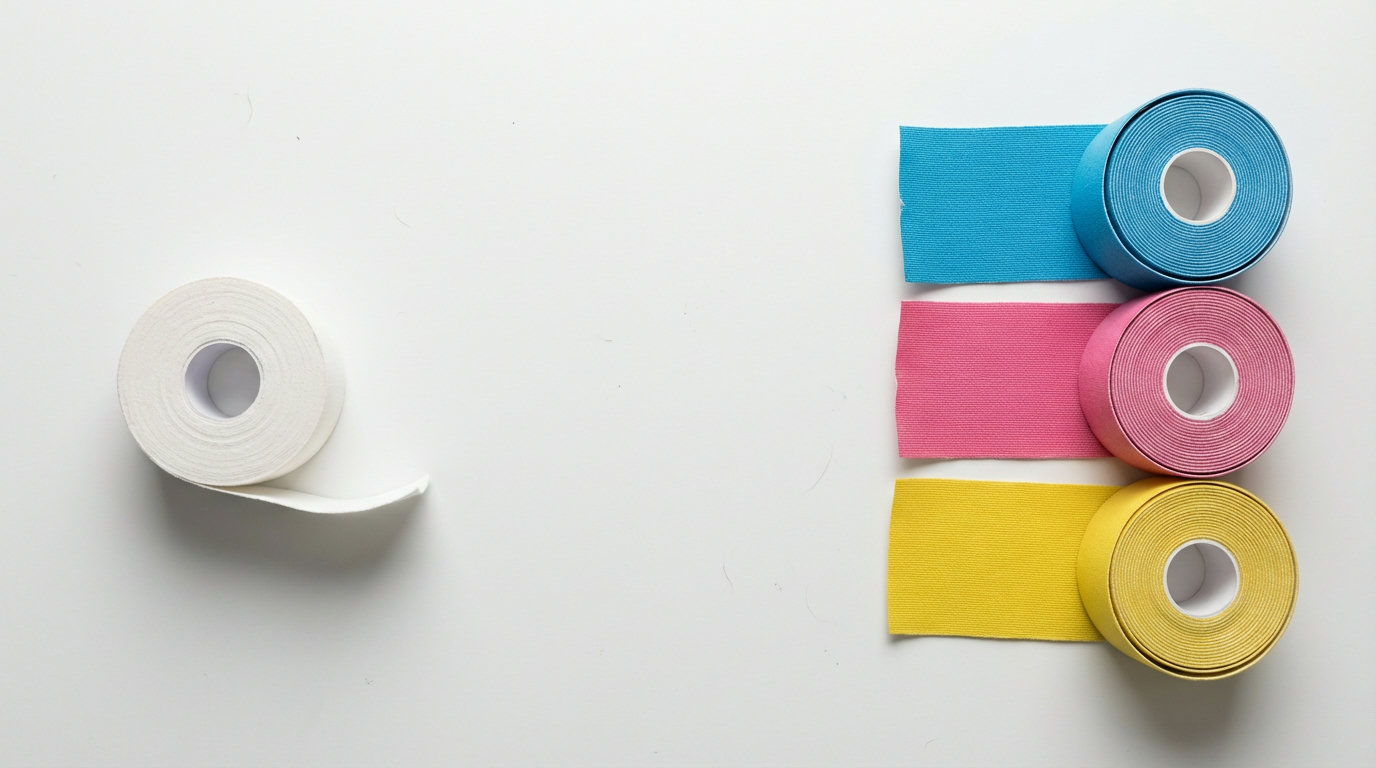
Classic sports tape fixes a joint in place, kinesiology tape supports movement. Here is when you need which, with a comparison table, a study check and clear recommendations.
Key points
- 01
Classic sports tape is rigid and stabilises joints mechanically, which makes it ideal after injuries and for unstable joints.
- 02
Kinesiology tape is elastic (it stretches up to 180%) and supports natural movement instead of restricting it.
- 03
For preventing ankle injuries, rigid tape is well supported by evidence, with injuries reduced by more than 60%.
- 04
The evidence for kinesiology tape is mixed. As an add-on to physiotherapy, it is still considered useful and safe.
- 05
You don't have to pick just one. With chronic instability, combining both can make sense.
What is taping, and what is the difference?
Taping has been a standard tool in sports medicine for decades. Whether after a sprained ankle or as prevention before a competition, a tape bandage is often the first thing applied on the pitch.
Today, though, there are two fundamentally different approaches: classic sports tape (also called athletic tape) and kinesiology tape. Both stick to your skin, both are meant to help. Yet their philosophies could hardly be further apart.
Classic tape immobilises. Kinesiology tape mobilises. Which approach is right depends on your situation, and that is what this comparison is about.
Classic sports tape: the stable bandage
Classic sports tape, such as the widely used Leukotape Classic, is an inelastic, rigid tape made of sturdy cotton or synthetic fabric with a strong zinc oxide adhesive. Team sports have used it for decades, and it is the standard for acute injuries.
The principle is simple. The tape is usually wrapped around a joint and deliberately limits its range of motion. Injured ligaments, tendons or unstable joints get mechanical protection, much like a temporary bandage, only firmer and more precise.
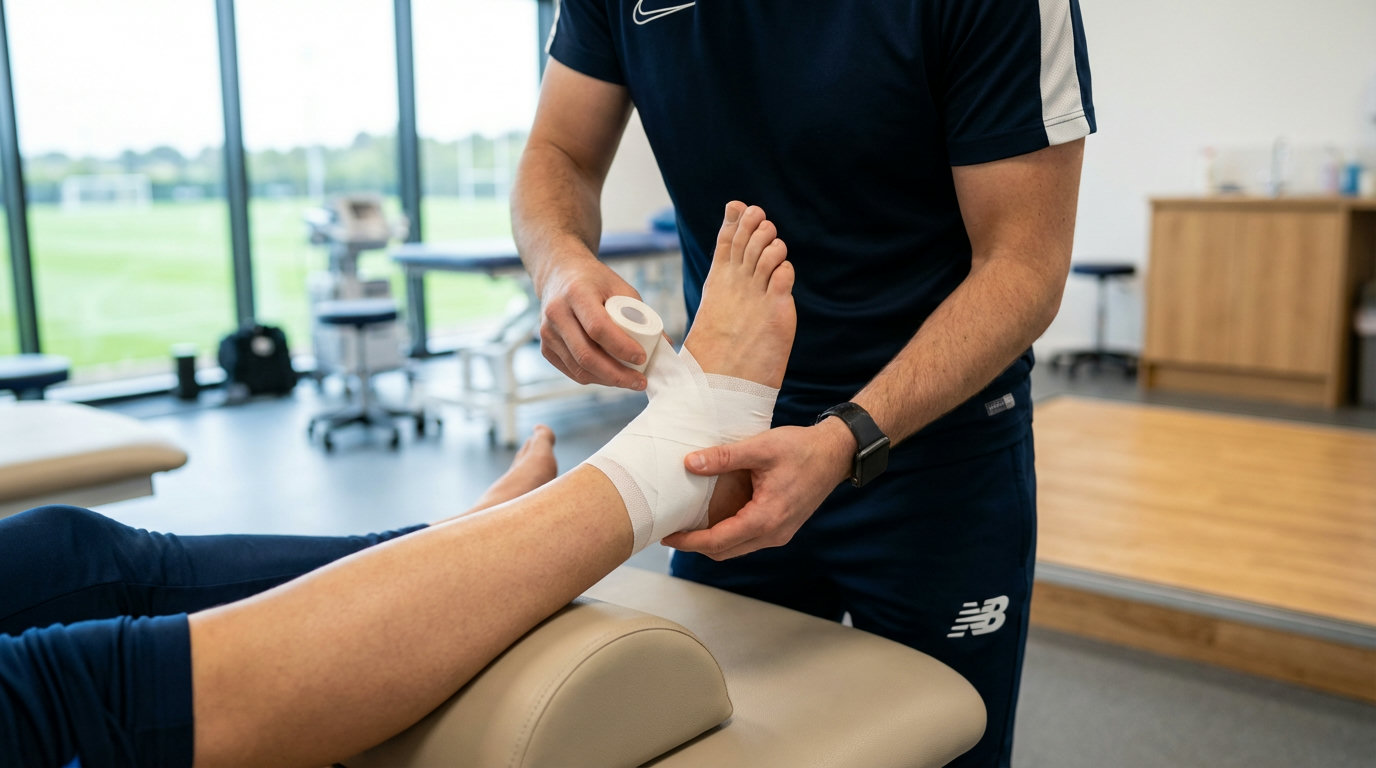
Rigid tape is especially common in football, basketball and handball. If you have ever watched a professional football match, you will know the white tape around the players' ankles.
Kinesiology tape: mobility instead of immobilisation
Kinesiology tape was developed in 1973 by the Japanese chiropractor Dr Kenzo Kase (†2023), together with the company Nitto Denko. Kase was unhappy with the limits of traditional taping and took a radically different approach. Instead of immobilising joints, the tape was meant to support natural movement.
The result is a highly elastic tape made of cotton and elastane. It stretches to 180% of its original length and is roughly as thick as human skin. The pressure-sensitive, medical-grade acrylic adhesive holds for 3 to 7 days, even in the shower or the pool.
Kinesiology tape had its global breakthrough at the 2008 Olympic Games in Beijing, when colourful strips on athletes' shoulders and knees suddenly appeared on every screen. Coloured tape has been part of sport ever since.
Comparison at a glance
Classic tape vs. kinesiology tape
| Feature | Classic sports tape | Kinesiology tape |
|---|---|---|
Elasticity | Not elastic (rigid) | Stretches up to 180% |
Material | Sturdy cotton or synthetic fabric | Elastic cotton and elastane |
Function | Mechanical stabilisation | Movement support |
Wearing time | A few hours, up to 3 days | 3–7 days, waterproof |
Freedom of movement | Heavily restricted | Almost completely preserved |
Application method | Wrapped around joints | Along muscles or joints |
How it works | Mechanical fixation | Sensory stimulation |
Blood flow | Can be restricted | Encouraged by lifting the skin |
Who applies it | Ideally a qualified professional | You can apply it yourself |
Evidence | Well supported for ankles | Mixed, but useful as an add-on |
How the two types of tape work
Classic tape works purely mechanically. It holds a joint in a set position and blocks movement in painful or risky directions. It also takes load off the affected tissue and improves proprioception, your sense of where the joint is. In practice it acts like a temporary bandage: firmer, stickier and far more restrictive than kinesiology tape.
Kinesiology tape takes a sensory approach. It works by stimulating the mechanoreceptors between skin and muscle. The elastic tension lifts the skin very slightly, which is meant to improve blood flow and lymphatic drainage, reduce swelling and ease pain. It may also regulate muscle tone and give proprioceptive feedback that reminds the muscle of its correct working position.
Which tape when? Uses in sport
Use classic tape for:
- Acute injuries: after torn ligaments, sprains and joint instability
- Returning from injury: when a joint cannot yet take full load
- Hypermobile joints: with congenital or acquired hypermobility
- Prevention after previous injury: for athletes with a history of ankle injuries, systematic reviews show that external supports reduce ankle injuries by at least 60%
- Sports with a high risk of rolling your ankle: football, basketball, handball, volleyball
Use kinesiology tape for:
- Running: plantar fasciitis, Achilles tendinitis, IT band syndrome, shin splints
- Tennis and padel: tennis elbow (epicondylitis), shoulder and wrist pain
- Swimming: swimmer's shoulder, back pain, breaststroker's knee
- Cycling: knee pain, Achilles tendon problems, neck problems
- CrossFit and strength training: muscle strains, joint pain, wrist problems
- General: muscle tension, tendinitis, posture correction, lymphatic drainage after surgery, and as prevention during competitions
Which tape is right for you?
- 1
If you have an acute sprain or ligament injury
use classic sports tape for maximum stability
- 2
If you want to treat muscle tension or tendon problems
kinesiology tape is the better choice
- 3
If you need full freedom of movement in competition
kinesiology tape supports you without limiting performance
- 4
If you want to encourage lymphatic drainage after surgery
kinesiology tape suits you thanks to its skin-lifting effect
- 5
If you have chronic ankle problems
a combination of both types can make sense
- 6
If you tape to protect a known weak ankle
rigid tape is the better-evidenced option
Right for you if …
Athletes with acute or chronic complaints who want to choose deliberately between stabilisation and mobility
Probably not for you if …
Serious injuries, fractures or open wounds: professional medical care comes first
Pros and cons at a glance
Classic sports tape
What speaks for it
Maximum stability and protection for injured joints
Well-proven for preventing ankle injuries (60%+ reduction)
Reliably prevents unwanted movements
Firmer and stickier than kinesiology tape
What to weigh up
Clearly restricts freedom of movement
Can reduce blood flow if applied too tightly
Usually only wearable for a few hours, so it has to be reapplied for every session
Needs experience to apply, ideally by a qualified professional
Can irritate the skin if worn for long periods
Kinesiology tape
What speaks for it
You keep full freedom of movement
Can be worn for 3–7 days, even in the shower or pool
Encourages blood flow and lymphatic drainage
Few side effects, inexpensive and drug-free
You can apply it yourself (with instructions)
What to weigh up
Scientific evidence is mixed, and a placebo effect is likely
Does not give enough stability for serious injuries
Applied wrongly (too much or too little stretch), it may not work or may cause blisters
Not suitable as the only treatment, only as an add-on to physiotherapy

What does the research say?
The evidence differs considerably between the two types of tape.
Classic tape rests on a solid evidence base, especially for preventing ankle injuries. A comprehensive summary of systematic reviews (SAGE Journals, 2021) shows that external supports such as tape and braces reduce ankle injuries by at least 60%. Eight overlapping reviews confirm this. Meta-analyses also show clear benefits for pain relief in knee osteoarthritis.
Kinesiology tape has been studied a lot, with almost 1,000 PubMed entries, but mostly with small groups of participants or low levels of evidence. The German sports medicine journal Sportärztezeitung puts it neatly: does kinesiology taping help? Answer: maybe. A meta-analysis by Csapo et al. (2015) covering 530 comparisons found no significant effect on muscle strength. Only 2 of 15 studies show an effect on athletic performance.
Recent studies (2024/2025) suggest that after muscle fatigue, kinesiology tape may improve strength and proprioception more than other types of tape. Classic tape remains better for static postural control.
Prof. Tobias Renkawitz (Heidelberg University Hospital) sums it up: science alone has not established a clearly provable benefit, and placebo effects are likely. At the same time, kinesiology tape is considered safe, inexpensive and low in side effects, so it can make sense alongside exercises and physiotherapy.
Contraindications and safety advice
Don't use either type of tape with:
- Open wounds or active skin infections
- A known allergy to tape adhesive
- Injured or badly irritated skin
Also avoid kinesiology tape with:
- Deep vein thrombosis
- Cancer
- Pregnancy (on the abdomen and lower back)
- Fractures (it does not give enough stability)
- Reduced sensation or peripheral neuropathy
With classic tape, take particular care:
- Don't wear it too long. The risk of dermatitis rises after 3 days
- Use underwrap to reduce skin irritation
- Check circulation: tingling, numbness or discolouration mean the tape is too tight
If your skin reacts (redness, itching, burning), remove the tape straight away, clean the skin and don't tape again. Before using tape for the first time, try a small skin test on the inside of your forearm.
Stability or mobility? Our verdict
It is not an either/or. Each type of tape has clearly defined uses, and they complement each other.
Classic sports tape is the first choice for mechanical stability: after acute injuries, with unstable joints or to protect a known weak ankle. The evidence is strong and the mechanism is clear.
Kinesiology tape suits you if you want to keep your freedom of movement while easing problems such as muscle tension, tendinitis or swelling. The research is more cautious here, but as an add-on to physiotherapy it is considered safe and potentially helpful.
One thing matters most: no tape replaces a proper diagnosis, targeted exercises or professional treatment. Tape is one building block of therapy. Only one.
Frequently asked questions
Can kinesiology tape replace classic sports tape?
No. The two types of tape do different jobs. Kinesiology tape does not provide the mechanical stability of classic tape. For acute injuries and severe joint instability, rigid tape remains the better choice.
How long can I wear kinesiology tape?
Kinesiology tape usually lasts 3 to 7 days, even in the shower or pool. Remove classic tape after a few hours, or 3 days at most, because the risk of dermatitis rises.
Is kinesiology tape scientifically proven?
The evidence is mixed. There are signs of positive effects on proprioception and pain relief, but also strong signs of placebo effects. As an add-on to physiotherapy, it is still considered safe and low in side effects.
Can I tape myself?
With some instruction, you can apply kinesiology tape yourself. Classic tape needs more experience and is best applied by a professional, such as a physiotherapist or sports doctor.
Does the colour of kinesiology tape matter?
Not according to the science. The colour of the tape has no proven influence on its effect. In kinesiology, colours are given meanings (red = activating, blue = cooling), but this is not evidence-based.
More on the topic
Related articles and tools
Sources
- Sportärztezeitung: kinesiology taping, evidence and use (German) ↗
- SAGE Journals: Comprehensive Summary of Systematic Reviews on Sports Injury Prevention (2021) ↗
- sportsandmedicine.com: kinesiology tape, an overview of the evidence (German) ↗
- PubMed Central: Kinesiology Tape - Muscle Strength and Proprioception (2024) ↗
- BR Fernsehen / Prof. Renkawitz: kinesiology tape, effective or placebo? (German) ↗
- PubMed Central: Effects of Tape and Kinesiotape on Ankle after Running Fatigue (2025) ↗
- Akademie Sport Gesundheit: kinesiology tape vs. sports tape (German) ↗
- Physiopedia: Taping Advice Sheet ↗
Inspiration, knowledge and gear for people who want more from the outdoors.