
 AI-generated
She called it Instagram. I called it prevention.
A doctor’s appointment, a list, a remark, and the question of why medicine and informed patients cannot find a shared conversation.
AI-generatedShe called it Instagram. I called it prevention.
A doctor’s appointment, a list, a remark, and the question of why medicine and informed patients cannot find a shared conversation.
A scene that stays with youContents
I had prepared. Made notes, organised my questions. Not as self-diagnosis, not as a list of demands, but as a framework for a conversation I considered important.
The background: I eat a pescetarian diet, train regularly with weights with a focus on building muscle, and for some time I have been feeling a fatigue that does not match my training load. My sleep is less restorative than it should be. No drama, no emergency, but exactly the kind of signal you want properly investigated before something diffuse settles into something chronic.
Blood was taken. Then I waited for the conversation with the doctor. It did not begin with questions about symptoms, training or nutrition.
It began with a boundary being drawn.
In essence, she said that she did not need to engage with any Instagram nonsense. Immediately afterwards: she alone decided which values would be tested. And: she was not the right doctor for me. The conversation was over before it had begun. No look at my notes. No brief prioritisation. No ‘We’ll do this, but not that.’ No ‘Let’s start with basic diagnostics and take it from there.’
This was my list. Not a screenshot from a podcast, not an influencer’s recommendation sheet, but a lab test request organised by category, with clinical-history context, dosage details for my supplements and a clear note: cost-effective, common causes first.
| Category | Parameters | Covered by health insurance? |
|---|---|---|
| Basic tests + organ screening | Full blood count, CRP, liver values (ALT, AST, GGT), kidney values (creatinine, eGFR), electrolytes | Yes (check-up) |
| Micronutrients | Full iron status (ferritin, transferrin saturation), holo-TC (active B12), 25-OH vitamin D | Partly IGeL |
| Metabolism & cardiovascular health | HbA1c, lipid profile (LDL, HDL, triglycerides), ApoB, Lp(a) | Partly IGeL |
| Thyroid | TSH, fT4 (fT3 if needed) | Yes (curative care) |
| Basic hormone check | Total testosterone, SHBG, albumin (morning) | IGeL |
Alongside it, I included a note with my key details: a pescatarian diet, strength training, current supplements (creatine 4 g/day, magnesium glycinate, vitamin D3/K2 with exact dosage and duration of use). No diagnosis. No ultimatum. A basis for a conversation that never happened.
The problem is not the listContents
I am not writing this to attack one individual. I am writing it because this situation exposes a dilemma that is becoming more common, and one that extends far beyond my personal experience.
What happens when someone with specific goals such as prevention, performance or healthy ageing encounters a system not designed for this kind of conversation? And how quickly does an ordinary concern become a breach of trust when “doing your own research” is automatically read as “following a trend”?
At the same time, the reality in medical practices is different: time pressure, budget constraints, guidelines, liability. Doctors encounter genuine misinformation from social media every day. Under these conditions, a defensive reflex is understandable: “I decide.” “That is from the internet.” “I am not getting into that.”
The problem is that when this reflex becomes the standard response, we lose precisely what prevention and longevity actually need: co-operation.
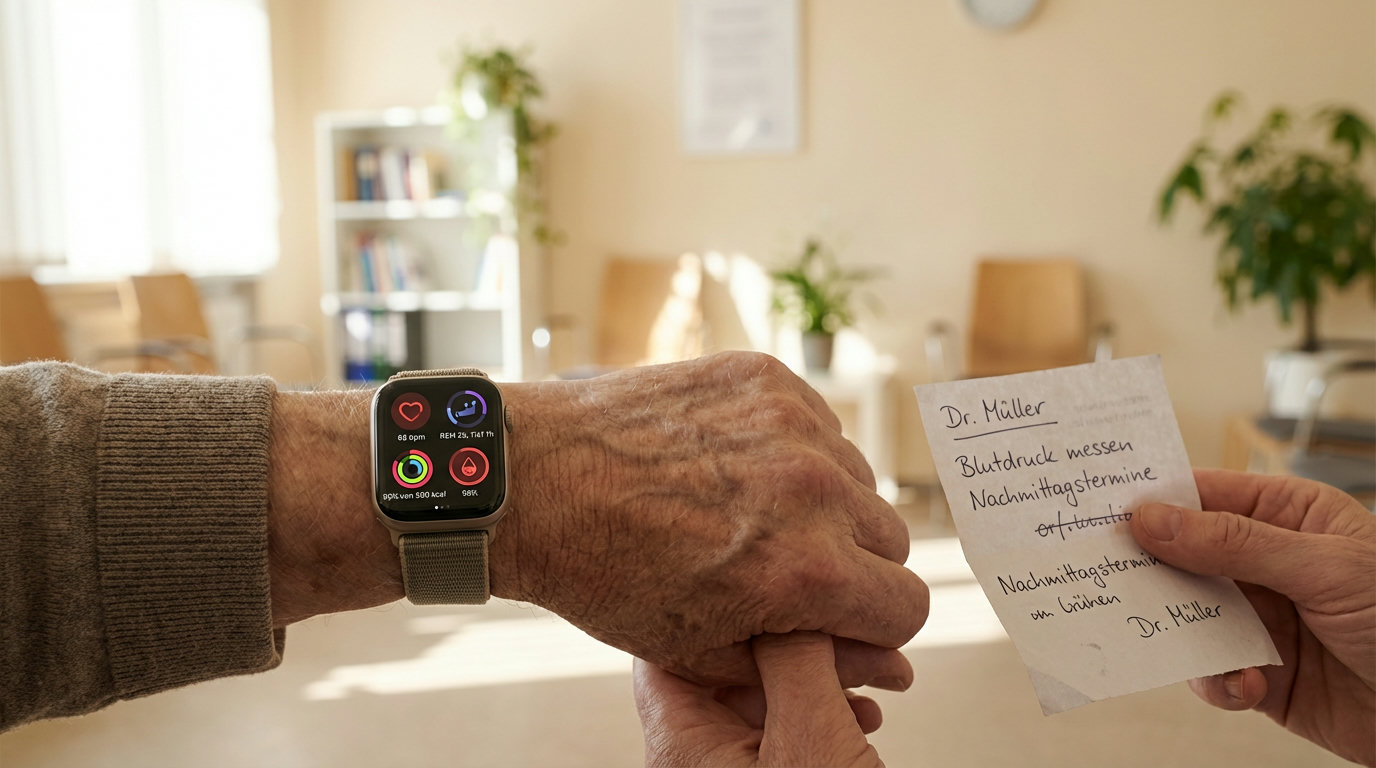 AI-generated
Two legitimate perspectivesContents
The misunderstanding often begins with the word “values”.
From a practice perspective, measuring “values” can quickly become a bottomless pit. Every additional parameter costs money, time and follow-up work. Many values vary widely, depend on the time of day or training, and generate further questions. There is also a real issue: social media and influencer marketing have, in part, turned lab values into lifestyle accessories. Anyone who sees people arrive at the practice every day with diagnoses based on screenshots develops protective mechanisms.
From an informed patient’s perspective, measuring “values” is often the opposite of lifestyle. It is an attempt to reduce uncertainty. Fatigue is vague. Sleep problems are vague. You can live with them for months and tell yourself it is stress, age or winter. Or you can say: I want to check systematically whether there are treatable causes, such as iron status, thyroid function, inflammatory markers, B12 or vitamin D. Not as self-diagnosis, but as a basis for a conversation.
Both perspectives are valid. And that is precisely why the conflict is so frustrating: It is not about knowledge. It is about roles.
In the old world, the division of roles was clear. Doctors were gatekeepers: they decided what was measured, what mattered and what did not. Patients brought symptoms and received decisions.
In the new world, that is shifting. Knowledge is available. Studies can be found. Wearables provide daily streams of data that once existed only in clinics. People no longer arrive with symptoms alone, but with goals: “I want to perform well.” “I want to age healthily.” “I want to understand what is happening in my body.”
The problem is not the question. The problem is that we do not have a good interface for discussing it.
Three principles for a better conversationContents
- 1
Establish two-stage diagnostics as the standard
Level 1 follows guidelines closely and is optimised for the specific issue. For fatigue and poor sleep: full blood count, inflammatory markers, iron status, thyroid function and metabolic parameters. This is not biohacking, it is sound medicine. Level 2 is optional, goal-oriented and transparent. It comes into play if Level 1 shows abnormalities or if someone deliberately wants to discuss prevention. Then you can say openly: this is not necessarily medically required, but it may be relevant to your goals. Self-funded, costs X, benefit is Y. This creates not an Instagram accusation, but an agreement.
- 2
Shared decision-making, not as a buzzword but as a process
Shared decision-making does not mean that patients decide everything. It means the doctor brings medical guardrails and risk assessment. The patient brings goals, preferences and context. Together, they create a decision that is medically justifiable and personally appropriate. This is especially important in prevention and longevity, because there is rarely one correct decision. There are trade-offs: how much diagnostic testing is useful without creating overdiagnosis? Which values are stable and guide action, and which are more noise?
- 3
Find a new language beyond Instagram
Instagram has become a catch-all term for everything that does not come from conventional medicine. Understandably so, but it is also a rhetorical conversation-stopper. What we need is a clear distinction: “I have a diagnosis from social media” is fundamentally different from “I have a symptom and want to rule out common causes.” And that is different again from “I have a prevention goal and am prepared to spend money on it consciously.” These distinctions can be clarified in three minutes, if there is a willingness to clarify them.
AI is changing the rules of the gameContents
AI will not replace doctors. But it is changing the nature of the conversation, whether we want it to or not.
It gives patients prior knowledge. It can summarise the research, prioritise markers and explain the difference between correlation and causation. It can help turn a list into a question, enabling exactly the kind of preparation that a good doctor’s appointment actually needs.
That is the real opportunity: The practice no longer has to be the gatekeeper of knowledge. It can be the guide. And patients do not have to make demands, they can ask goal-oriented questions.
 AI-generated
What is at stakeContents
If this new model succeeds, both sides benefit. The patient gains clarity and feels taken seriously. The practice gains structure and reduces conflict. And the system gains something it has lacked until now: a practical culture of prevention.
If it does not succeed, people will look elsewhere: to self-funded laboratories, private performance diagnostics and AI-supported self-interpretation. Not because they want to distrust doctors, but because otherwise they feel left alone. That would be the worst of all worlds: more data, less medical guidance and more uncertainty despite greater measurability.
The crossroads
In the end, my experience at the practice was a signal. Not in the sense of: I now have to do everything on my own. Rather: I need treatment where collaboration is possible. Where people do not respond defensively by reflex, but prioritise in a structured way. Where the reality of modern information is not seen as an attack, but as a starting point for better decisions.
Perhaps that is the essence of longevity in 2026: not the perfect list of blood markers, but a new relationship between medicine, data and trust.