Ski resorts and the climate check: where winter sport and climate protection fit together
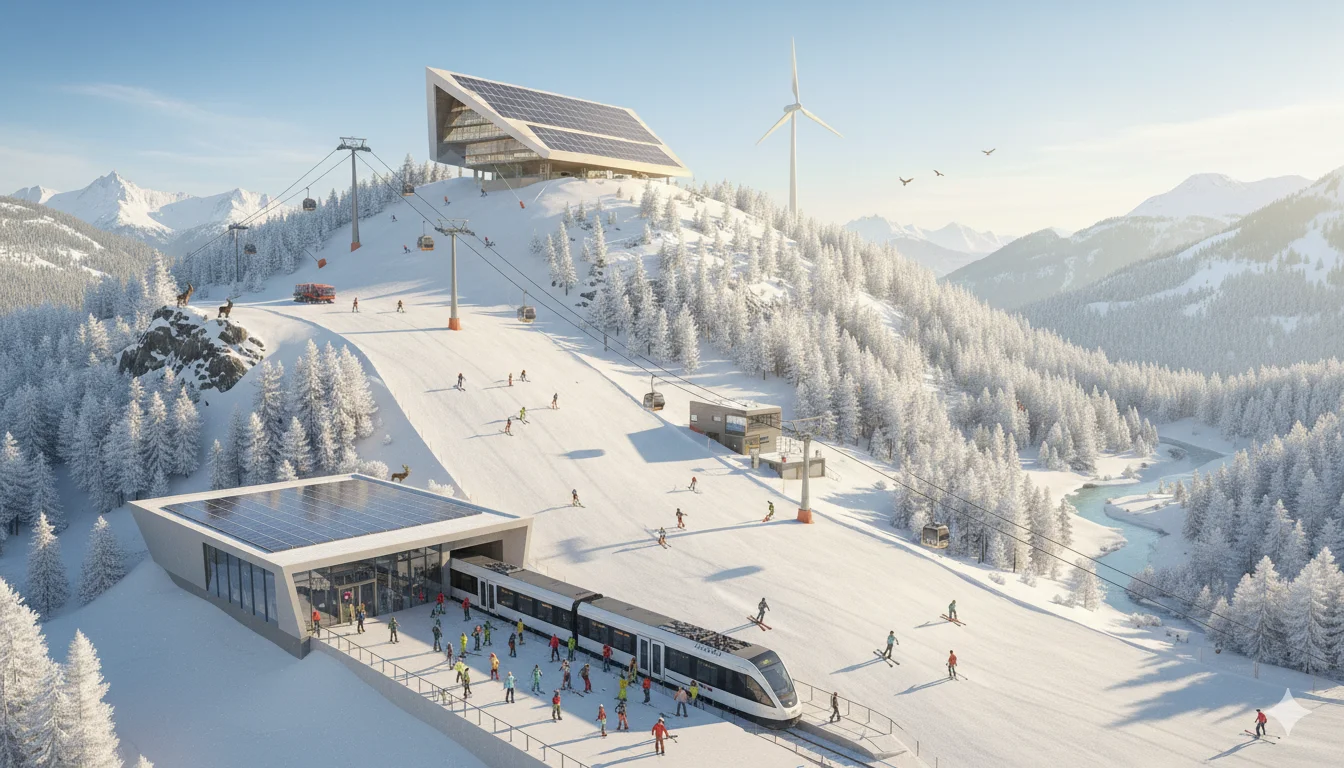
Green electricity, hydrogen snow groomers, car-free villages: how realistic are the sustainability promises of ski resorts?
Ski resorts and the climate check: where winter sport and climate protection fit together
Green electricity, hydrogen snow groomers, car-free villages: how realistic are the sustainability promises of ski resorts?
The starting point: do skiing and the climate fit together?Contents
Skiing depends on intact nature. At the same time it puts pressure on exactly that, through energy use, sealed surfaces and above all the journey to the resort. According to the FIS Sustainability Guide, a single day on the slopes accounts for almost 49 kg of CO2 per person. Roughly half of that comes from driving there.
The pressure is growing. Current studies put 53 % of all European ski resorts at very high risk for snow reliability if global warming reaches +2 degrees Celsius. The industry is responding, sometimes ambitiously, sometimes cosmetically. So let's look in detail at what actually sits behind those sustainability promises.
Switzerland: innovation out in frontContents
Switzerland has come furthest on sustainability in winter sport. Several resorts have gone beyond green electricity to entirely new energy concepts.
Engelberg/Brunni is so far the only certified climate-neutral ski resort in Switzerland. All the mountain railways run on 100 % hydropower and the snow groomers are fuelled with biofuel. Since 2016, a solar installation on the Ristis top station has generated electricity for the LED piste lighting.
Flims Laax Falera, aiming to be the first self-sufficient alpine destination worldwide, has arguably the most ambitious vision in the Alps. A seven-point plan foresees covering all 280 GWh per year from 100 % local renewable energy. The Crap Sogn Gion top station is meant to turn from pure energy consumer into energy producer, and the building facades already carry solar panels.
Zermatt has been car-free since it was founded. Only electric vehicles and traditional horse-drawn carriages move through the village. More than 690 solar modules have produced around 212,000 kWh per year since 2009, saving roughly 30 tonnes of CO2 annually. Combined with the direct rail link, Zermatt is one of the most consistent overall concepts for genuine sustainability.
Arosa-Lenzerheide is modernising systematically. New cableways with direct drive use around 10 % less energy, top stations are getting photovoltaic modules, and the oil heating systems have been replaced by heat pumps running on 100 % green electricity.
Austria: broad commitment, varying depthContents
In Austria, a lot has happened in Tyrol and Salzburg in particular.
The SkiWelt Wilder Kaiser - Brixental has run its 284 kilometres of pistes and 90 lifts on 100 % green electricity from hydropower for over 20 years. It is also home to the world's first solar-powered ski lift, a project that drew international attention.
Ischgl received the climate-neutral certificate from ClimatePartner in 2019 as the largest ski resort in the Alps to do so. Since 2021 the entire operation has run on TÜV-certified green electricity from 100 % hydropower. Solar and heat recovery systems save around 80,000 litres of heating oil a year. Unavoidable emissions are offset through reforestation projects in the Paznaun valley and in Peru.
Snow Space Salzburg (Flachau) has set itself the goal of becoming climate-neutral by the 2025/2026 season. Because around half of its emissions come from piste grooming, the resort is currently testing two interesting approaches: synthetic fuels with a 90 % CO2 reduction, and the hydrogen snow groomer LEITWOLF h2MOTION, which was already in service at the 2022 Flachau World Cup.
St. Anton am Arlberg has been energy self-sufficient since 2006 thanks to its own storage power plant at Kartellsee, which generates around 33 million kWh per year. Add to that a biomass heating plant, solar installations and chemical-free artificial snow made purely from drinking water and air. St. Anton is also a KLAR! model region for climate change adaptation.
Germany and France: 2030 targets and strong labelsContents
In Germany, Winterberg (Sauerland) stands out: 100 % green electricity, snow groomers running on biodiesel (90 % less CO2) and modern snowmaking systems that use 50 % less energy than their predecessors. The goal is climate neutrality by 2030, and the resort has invested around 2 million euros to get there.
The Zugspitze area near Garmisch-Partenkirchen relies on natural snow and does without snow cannons, which its altitude makes possible. Snow groomers run on GTL fuel, and GPS snow depth measurement means existing snow is moved precisely where it is needed rather than groomed across the board. The Schneefernerhaus environmental research station also studies climate and the environment on site.
In France, 21 ski resorts carry the Flocon Vert label, a strict sustainability certificate. Les Arcs was the first ski resort in Europe with international B Corp certification and uses low-carbon snow groomers.
Avoriaz is, alongside Zermatt, one of the few car-free ski resorts in the Alps and also holds ISO 14001 certification. Serre Chevalier uses a hybrid energy mix of hydropower, more than 1,400 solar panels and micro wind turbines, with the aim of cutting CO2 emissions by 50 % by 2030.
Ski resorts compared on sustainabilityContents
| Ski resort | Country | Electricity | What stands out | Certification |
|---|---|---|---|---|
| Engelberg/Brunni | Switzerland | 100 % hydropower | Certified climate-neutral, biofuel groomers | Climate-neutral |
| Flims Laax Falera | Switzerland | 100 % renewable | Vision: first self-sufficient alpine destination | Greenstyle |
| Zermatt | Switzerland | 100 % renewable | Car-free since it was founded, 690 solar modules | Nein |
| SkiWelt Wilder Kaiser | Austria | 100 % hydropower | World's first solar-powered ski lift | Nein |
| Ischgl | Austria | 100 % hydropower | Largest climate-neutral ski resort in the Alps | ClimatePartner |
| St. Anton am Arlberg | Austria | Own power plant | Energy self-sufficient since 2006, KLAR! region | KLAR! |
| Winterberg | Germany | 100 % green electricity | 2 million euro sustainability investment | Nein |
| Zugspitze/Garmisch | Germany | Green electricity + solar | No snow cannons, natural snow | Nein |
| Les Arcs | France | Renewable | First B Corp ski resort in Europe | B Corp + Flocon Vert |
| Avoriaz | France | Renewable | Car-free, ISO 14001 | ISO 14001 + Flocon Vert |
10 Einträge in der Vergleichstabelle
The three biggest levers, and what you can do yourselfContents
Not everything is down to the resorts. FIS data attributes around 57 % of all emissions from a ski holiday to the journey. Taking the train instead of the car cuts your carbon footprint dramatically. Some regions actively encourage it: 4 Vallées and Portes du Soleil in Switzerland offer discounted Snow'n'Rail tickets, for example. Zermatt and St. Anton are reachable directly by train, and in St. Anton you step off at the station practically straight into the mountain railway.
The second big lever is snow groomers, which cause up to 94 % of a resort's direct emissions. A lot is moving here as a result. Sustainable fuels cut pollutant output by up to 90 %. With the Prinoth Husky eMotions there is already a fully electric groomer that runs emission-free in operation, although it is still in the test phase.
Third, snowmaking makes a difference. Modern systems use around 50 % less energy than older models. Snow farming, meaning storing and reusing meltwater, further reduces the demand for fresh water.
Global Sustainability Ski Alliance: the industry organises itselfContents
An important step for sustainable ski tourism came in 2025 at the Interalpin trade fair in Innsbruck. Eight leading resort operators from Europe and New Zealand joined forces to form the Global Sustainability Ski Alliance, the first alliance of its kind in the ski industry. Together the members run more than 800 ski lifts and count around 25 million skier days per year.
Members include Flims Laax Falera (Switzerland), Compagnie des Alpes (France), Kitz Ski (Austria), Kronplatz (Italy), SkiStar (Scandinavia), Levi (Finland), NZSki (New Zealand) and the Oberstdorf Kleinwalsertal Bergbahnen (Germany). The aim: shared standards for environmental data, knowledge exchange on innovations, and measurable performance indicators that make progress comparable.
The alliance is betting on electrification, maximum energy efficiency and a complete switch to renewable energy. Social responsibility is on the agenda too. Fair wages and stronger local economic cycles in mountain regions have to be secured if sustainable tourism is to work in the long run.
How much of this will translate into measurable impact remains to be seen. But the simple fact that eight major operators want to agree on shared measurement standards is progress. Until now, every resort did its own thing on sustainability.
An honest assessment: what sounds good and what really countsContents
Certificates and labels at a glanceContents
| Certificate | Where it is used | Focus |
|---|---|---|
| Flocon Vert | 21 resorts (France) | Comprehensive sustainability audit |
| B Corp | Les Arcs (France) | Social and environmental standards |
| ClimatePartner | Ischgl (Austria) | Carbon footprint plus offsetting |
| ISO 14001 | Various (global) | Environmental management system |
| Sustainable Slopes | 200 resorts (USA) | Voluntary commitment by the US ski industry |
| Swisstainable | Swiss destinations | Tourism sustainability in Switzerland |
Nobody is perfect, but every step countsContents
Skiing is and remains a resource-intensive sport, which makes it all the more important that more and more resorts are actively pushing back. The biggest lever, though, is in your own hands. Travel by train instead of car, rent equipment rather than buying new every season, support local hosts, treat mountain regions and the people who live there with respect, and deliberately choose resorts with a real climate commitment. None of it takes much effort. It adds up when enough people join in.
Frequently asked questionsContents
Read onContents
At snow-online.de you will find up-to-date information on ski resorts, snow conditions and lift systems (in German), a useful starting point if you want to plan your next trip more consciously.
Sources
- FIS Sustainability Guide for Ski Resorts 2024
- FIS Sustainability Guide, full version (PDF)
- LifeVERDE: skiing and snowboarding more sustainably (in German)
- SnowTrex: climate-friendly ski resorts in Europe (in German)
- HolidayCheck: sustainable ski holidays in Europe (in German)
- Snow Space Salzburg: climate-neutral by 2025/2026 (in German)
- Ischgl: climate-neutral ski resort (official site)
- snow-online.de: new alliance for a sustainable future of winter sport (in German)