
Training & Health
Compression in sport: what the research says

Compression clothing promises faster recovery and better performance. We looked at what the studies actually back up and what is just marketing.
Key takeaways
- 01
Compression has moderate but consistent effects on recovery (effect size g=0.38–0.49)
- 02
The strongest evidence: delayed-onset muscle soreness (DOMS) drops by 15–20%
- 03
The ideal pressure is 15–25 mmHg. More is not automatically better
- 04
Expectation (placebo) effects boost the response, which counts as a bonus
- 05
Best use: put it on straight after hard exercise and wear it for 2–12 hours
Compression clothing is everywhere, from professional athletes to ambitious hobby runners. The promises are big: faster recovery, better performance, less muscle soreness. How much of that survives scientific scrutiny?
We analysed the current evidence: meta-analyses, randomised controlled trials and systematic reviews. The picture is more nuanced than the marketing, and also more positive than some sceptics claim.
What the science really shows
The good news first: compression works. The effects are statistically significant and reproducible across dozens of studies. The less exciting news? They are moderate, not dramatic.
A meta-analysis by Hill et al. (2014), covering 12 studies and more than 200 participants, found this effect size of g=0.38 for the recovery of muscle strength. What does that mean in practice?
On average, athletes wearing compression recover measurably faster. We are not talking about a 50% improvement, though. The differences are subtler: roughly a 10–15% faster return to full strength in the first 24–48 hours.
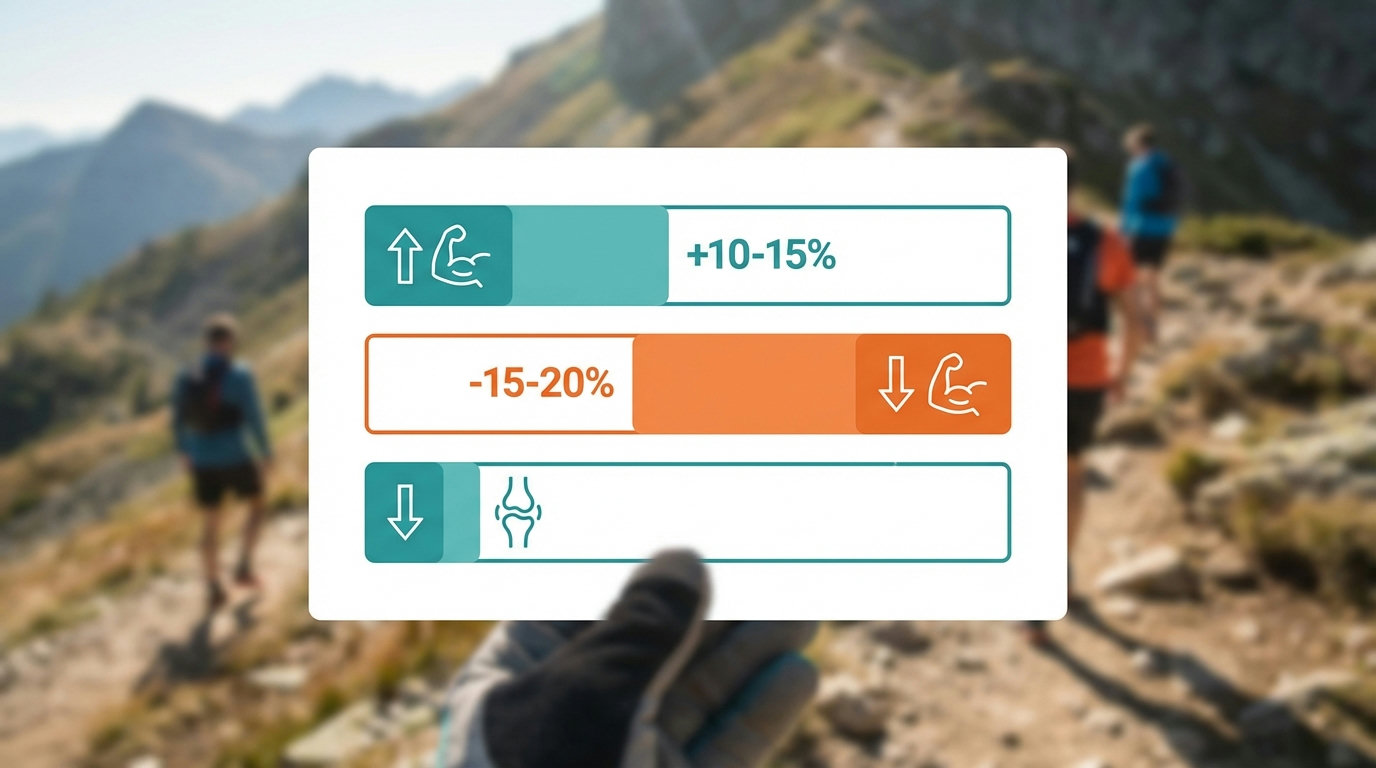
Strength recovery
Small to moderate improvement in muscle-strength recovery after 24–72 hours
Muscle soreness (DOMS)
Less perceived pain in the first 48 hours
Swelling
Measurably less oedema thanks to better lymphatic drainage
The physiology: how compression works in the body
The physiological mechanisms behind compression clothing are well understood and have been documented in the medical literature for decades. Graduated compression, meaning pressure that decreases from distal (farther from the heart) to proximal (closer to the heart), draws on basic principles of vascular physiology.
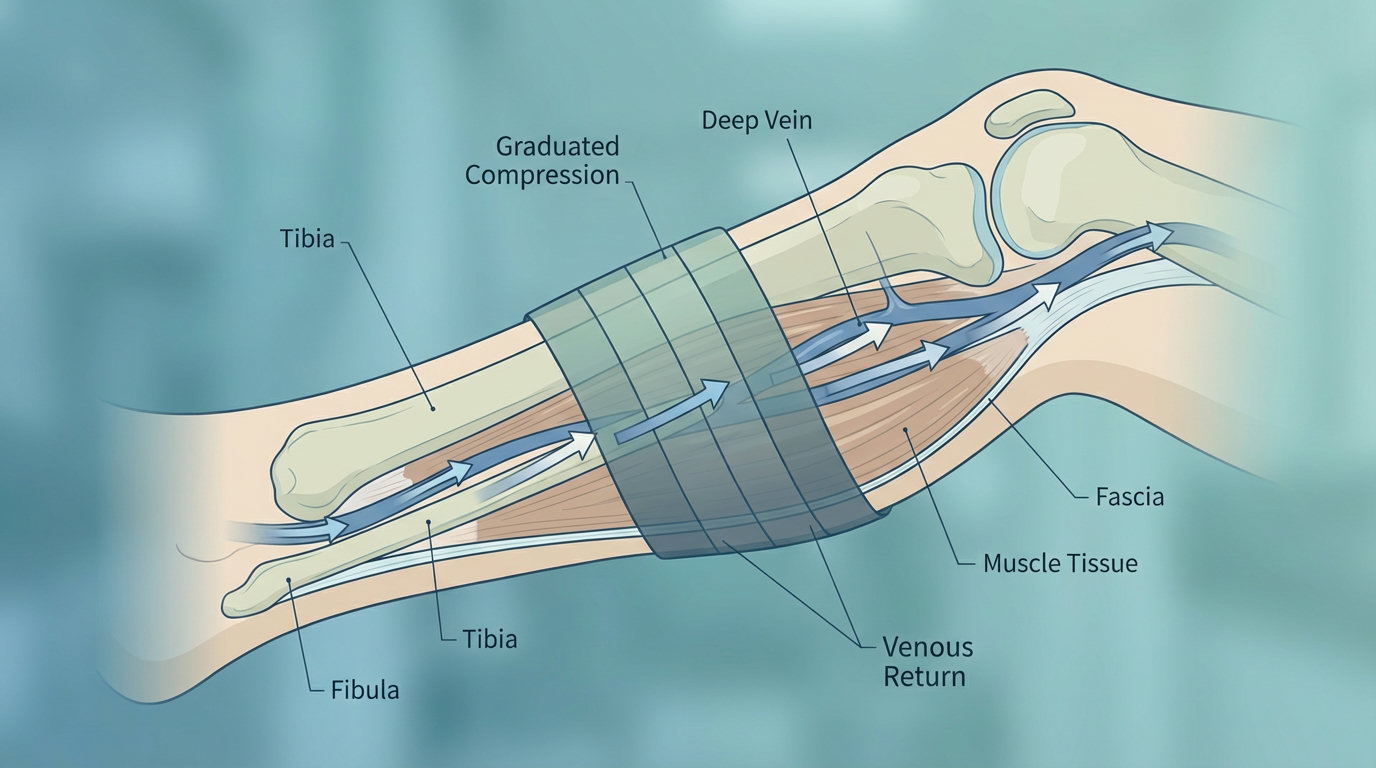
The four main mechanisms
Improved venous return
Reduced swelling (oedema prevention)
Less muscle oscillation
Proprioceptive feedback
The placebo debate: is it all in your head?

A common argument against compression goes: "It's just placebo." That criticism deserves a closer look.
Yes, expectation plays a role. Studies show that athletes who believe in the effect experience stronger benefits. Brophy-Williams et al. (2017) recorded participants' expectations, and higher expectations did correlate with stronger perceived recovery.
Here is the key point, though:
How recovered and ready you feel is a performance factor of its own. If an athlete feels more recovered after a session in compression, that shapes training quality the next day, whether the cause is purely physiological or partly psychological.
On top of that, measurable physiological differences remain even after controlling statistically for placebo effects. The placebo share simply adds to the real effects.
Objective vs subjective measures in studies
| Measure | Type | Typical effect | Strength of evidence |
|---|---|---|---|
Maximal strength | Objective | 5–10% faster recovery | Moderate |
Blood lactate clearance | Objective | Accelerated by 10–15% | Moderate |
Perceived fatigue | Subjective | Clearly reduced | Strong |
Soreness intensity | Subjective | 15–20% lower | Strong |
Range of motion | Objective | Faster normalisation | Moderate |
Sleep quality | Subjective | Improved when worn overnight | Low to moderate |
When should you wear it, and for how long?
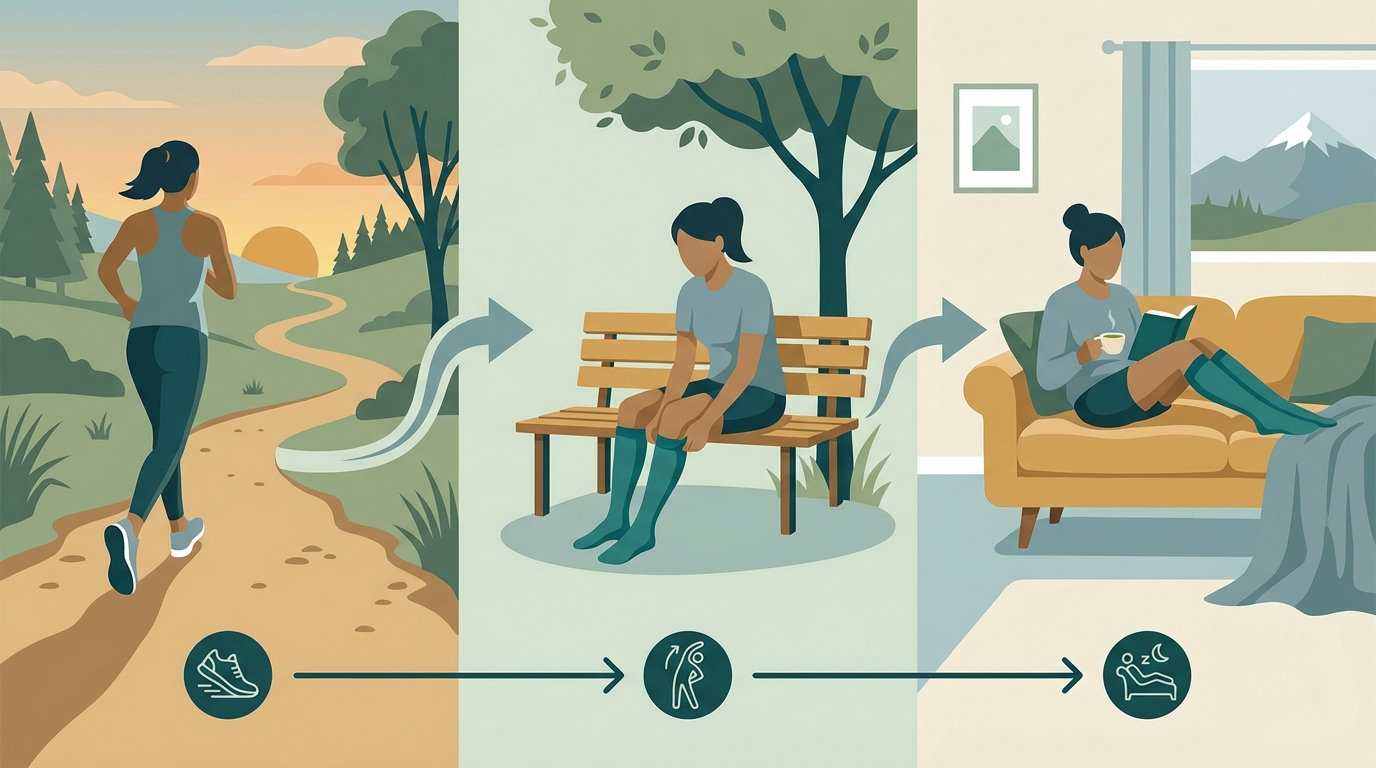
The evidence on timing is clear: the sooner you put on compression after exercise, the better.
The critical recovery phase starts the moment training ends. In the first hours, inflammation sets in, fluid starts to collect and muscle repair gets going. Wear compression at this stage and you step into these processes early.
Timing recommendations based on the evidence
| Time window | Priority | Recommended duration | Evidence |
|---|---|---|---|
0–2 h after training | Highest | At least 2 hours | Strong |
2–6 h after training | High | For as long as practical | Strong |
Overnight | Medium | 6–8 hours | Moderate |
During training | Low to medium | Entire session | Mixed |
Before competition | Situational | 1–2 hours | Weak |
Who benefits from compression?
Compression is no miracle cure. It is an evidence-based tool for specific situations and athlete profiles.
High training frequency
If you train five or more times a week, every recovery aid helps. With short recovery windows between sessions, small effects add up.
Intense sessions
After races, interval sessions, long runs or hard strength workouts, whenever the load was above average.
Travel and competitions
Especially on flights and before important competitions. Compression reduces travel-related swelling and supports recovery on the move.
Prone to DOMS
If you are prone to heavy muscle soreness or have just added new training stimuli, you will often notice the clearest relief.
Casual athlete with two or three easy sessions a week? Probably not decisive, as natural recovery is enough. Ambitious athlete who wants every bit of recovery you can get? Then it definitely belongs in your toolkit.
The limits of compression
However positive the evidence on recovery, there are areas where compression is less convincing:
Compression: when is it worth it?
- 1
You train hard five or more times a week
A noticeable recovery benefit thanks to shorter recovery time
- 2
You want an instant performance boost during training
Barely measurable effects. The main benefit is recovery
- 3
You are very prone to soreness after new training stimuli
The clearest relief: 15–20% fewer DOMS symptoms
- 4
You train easily two or three times a week
Natural recovery is usually enough. Compression is optional
Right for you if …
Ambitious athletes who train often, people prone to DOMS and athletes who travel
Probably not for you if …
Casual athletes with two or three easy sessions a week, for whom natural recovery is enough
Compression does not replace other recovery measures. It works best as part of a wider approach:
- Enough sleep (7–9 hours)
- Good nutrition with sufficient protein
- Smart training management
- Active recovery when needed
Conclusion: moderate effects that add up
Compression clothing won't transform your recovery overnight. What it offers is an evidence-based tool with consistent, moderate effects, especially for easing muscle soreness and speeding up strength recovery.
If you train hard on a regular basis, the investment makes sense. Each effect may be small. Over weeks and months, though, they add up to better training quality and fewer missed sessions.
Scientific sources
- Hill J et al. (2014): Compression garments and recovery from exercise-induced muscle damage: a meta-analysis ↗
- Born DP et al. (2013): Bringing light into the dark: effects of compression clothing on performance and recovery ↗
- Kraemer WJ et al. (2001): Influence of compression therapy on symptoms following soft tissue injury ↗
- MacRae BA et al. (2011): Compression garments and exercise: garment considerations, physiology and performance ↗
- Brophy-Williams N et al. (2017): Wearing compression garments during recovery ↗
- Engel FA et al. (2016): Is there evidence that runners can benefit from wearing compression clothing? ↗
Inspiration, knowledge and gear for people who want more from the outdoors.