
Stories
Viking: Winter boots, rubber boots and footwear technologies explained
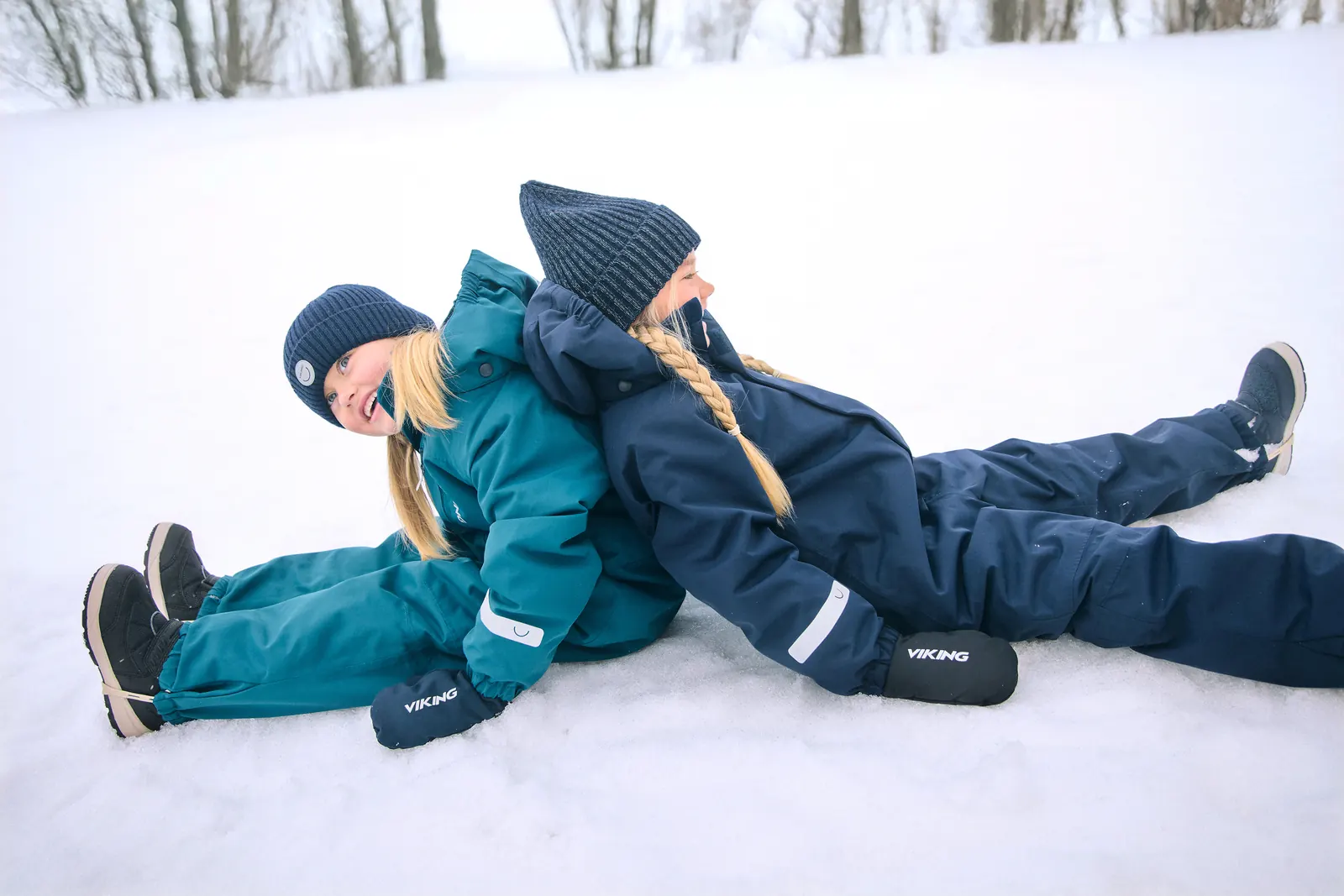
Founded in Norway in 1920, Viking builds footwear for rain, slush and sub-zero frost. Learn what codes like GTX, WP, SC, 1V, 2V and BOA mean, when an Elastopan thermo boot beats a GORE-TEX winter boot, and how much growth room kids' feet need.
The essentials at a glance
- 01
Businessman Peter Mathias Røwde founded the rubber factory on 17 January 1920 in Askim, Norway; today Viking Outdoor Footwear AS directs product development from Oslo.
- 02
Partnering with GORE-TEX in 1992 made Viking one of the world's earliest footwear brands to bring waterproof, breathable membranes into kids', hiking and hunting boots.
- 03
Model suffixes follow a logical code: GTX means GORE-TEX, WP marks Watershield, SC stands for Solarcore aerogel insulation, 1V/2V counts Velcro straps, SL indicates Speed Lace and BOA denotes dial closure.
- 04
For growing children's feet, Viking advises adding 1.0 cm of extra length in summer shoes and 1.5 cm in insulated winter boots; once toe room drops below 5 mm, size up.
Curbside slush exposes weak winter boots faster than powder snow ever will. Crisp morning frost turns into ankle-deep grey meltwater outside schools and kindergartens by noon. Building footwear for that wet, freezing swing has been Viking's core craft in Norway for more than a century.
Browse the current range and you will spot dense model names like Jack Warm GTX 1V, Constrictor Warm SC WP 1V SL or Stride Mid Spike Warm BOA WP. Behind those letters sits a straightforward modular grid of membrane, insulation, last width and closure hardware.
Viking began on 17 January 1920, when businessman and consul general Peter Mathias Røwde opened a rubber factory in Askim in southeastern Norway. His goal was practical: reduce Norway's reliance on imports and shield everyday leather shoes from mud and wet snow using waterproof rubber galoshes. Røwde hired specialist rubber chemists early on to keep compounds supple in Nordic cold.
In 1934 the Askim plant burned to the ground. Rebuilt as a modernized factory employing around 1,100 workers, it soon turned out 10,000 pairs of galoshes and 1,200 pairs of shoes per day, making it one of Norway's largest industrial employers. Several enduring silhouettes arrived during the 1960s: the maritime sailing boots Kadett and Seilas, the 1966 Rocky mountain boot endorsed by routes inspectors from the Norwegian Trekking Association (DNT), and in 1969 the wool-lined Cherrox® winter boot.
A technical turning point followed in 1992, when Viking became one of the first shoe manufacturers worldwide to partner with GORE-TEX. By the mid-1990s, waterproof-breathable laminates appeared across kids' winter boots and the Crosser hunting boot. Headquartered today in Oslo as Viking Outdoor Footwear AS, the brand pairs adult and children's footwear with insulated kids' winter outerwear.
Nearly every Viking model name tells you its technical build before you open the spec sheet. For membranes, GTX denotes GORE-TEX (including next-generation PFAS-free ePE laminates on newer styles, according to Viking), while WP identifies Watershield, Viking's own PFAS-free waterproof membrane. Warm signals cold-weather fleece, wool-blend or synthetic insulation, whereas SC marks Solarcore®: an ultra-thin sole insulation inspired by NASA space-suit aerogel that compresses underfoot to block ground chill without stiff bulk.
Closure codes sit right at the end of the product name:
- 1V and 2V: one or two hook-and-loop Velcro straps for quick adjustment in mittens.
- SL: elastic bungee Speed Lace, frequently paired with a single ankle strap (
1V SL). - BOA: micro-adjustable BOA® Fit System dial and lace reel.
- Zip: side zipper for fast step-in entry.
Kids' GORE-TEX and Watershield winter boots
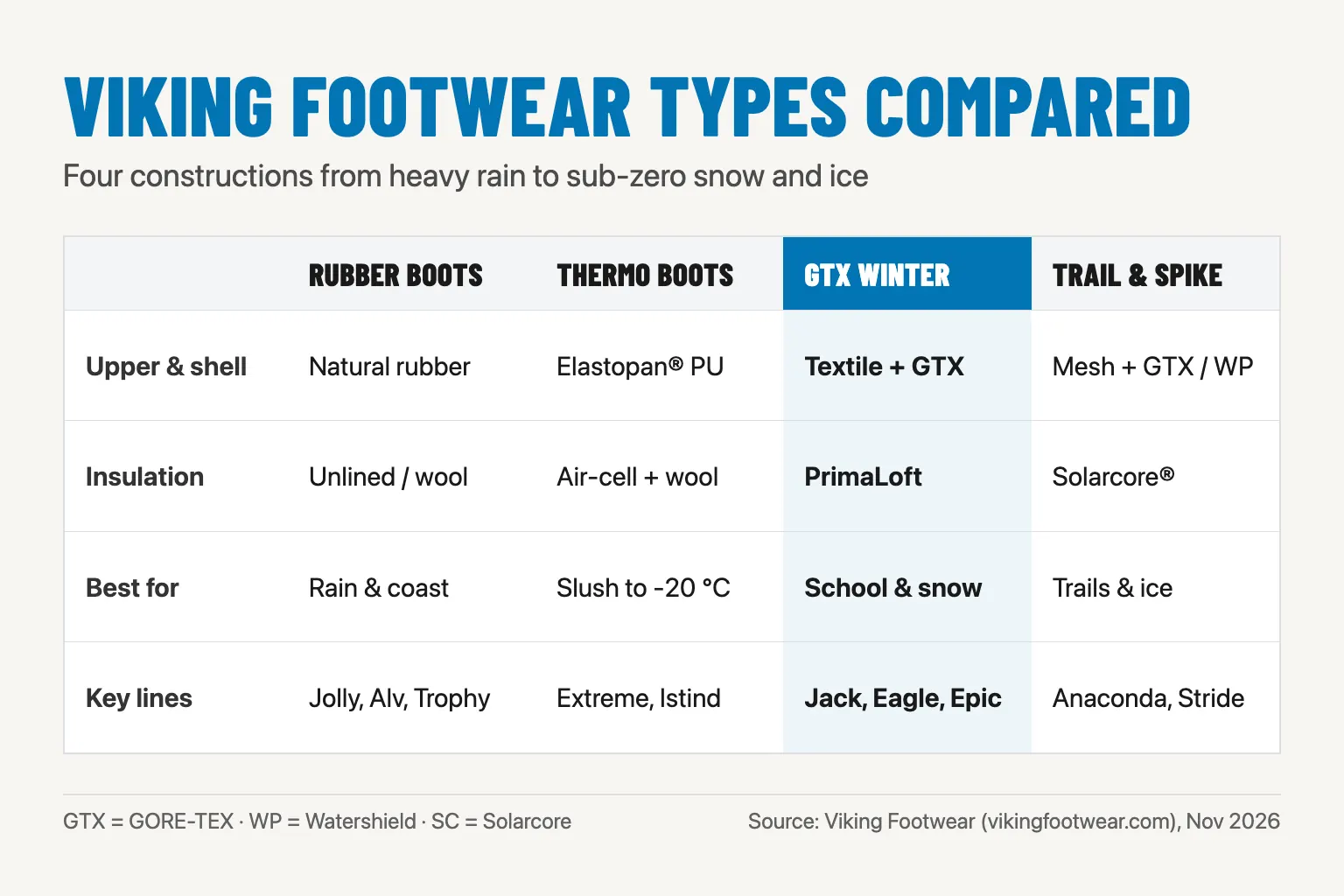
For full school and kindergarten days, breathable membrane winter boots top the range because sweat vapor can escape while children run outdoors or sit indoors. Built on a regular-width last, the mid-cut Viking Jack Warm GTX 1V combines faux-fur warm lining with elastic speed laces and a top strap, alongside the fleece-lined Viking Eagle Warm GTX 1V (EU 30 to 43). Kids who prefer traditional lacing and a leather-textile upper get a tailored fit in the Viking Epic Warm GTX with front and rear reflectors.
Broader forefeet and higher insteps call for Viking's wide-lasted series. Toddlers and younger children from EU 20 can fasten the Viking Play Reflex Warm GTX 2V independently via dual Velcro straps, while older kids up to EU 41 get the same wide fit with dial precision on the Viking Espo Reflex Warm GTX BOA. Deep sub-zero cold brings the Viking Expower Warm GTX 2V into play, pairing PrimaLoft Gold insulation with a cushioned EVA midsole.
In the Watershield WP lineup, the scuff-guarded Viking Equip Warm WP 2V (EU 22 to 33) covers everyday snow play, while the taller Viking Constrictor Warm SC WP 1V SL adds Solarcore underfoot thermal protection.
Seamless Elastopan PU thermo boots
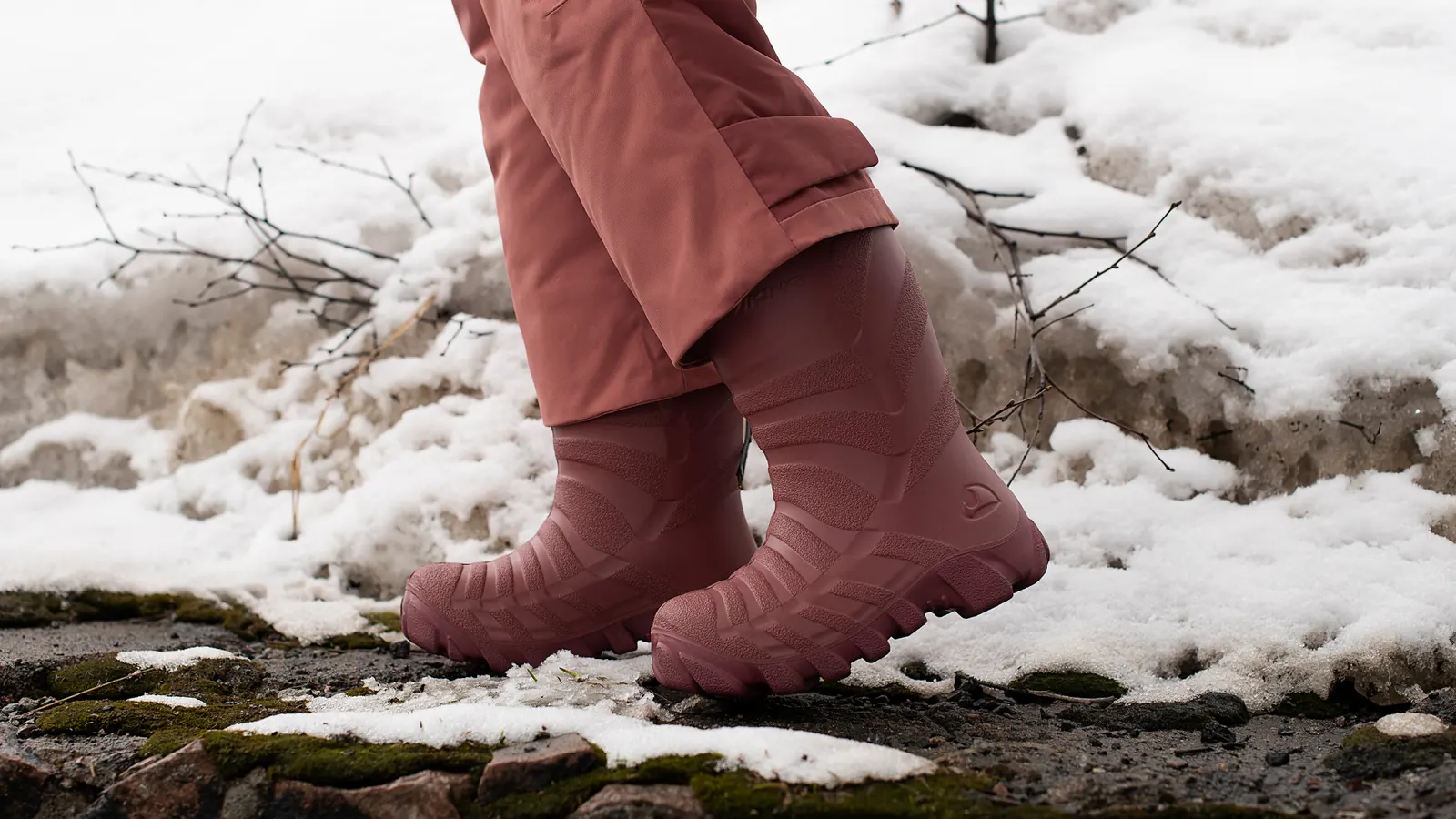
When heavy rain hits half-melted snow and kids stand ankle-deep in icy puddles for hours, textile uppers eventually wet out on the surface and cool down. Viking solves slush season with molded thermo boots made from Elastopan®, a BASF polyurethane compound that is 100% PVC-free according to Viking.
Millions of microscopic air cells trapped inside the PU matrix trap warmth while keeping weight substantially lower than solid rubber. Because upper and outsole are cast as one seamless shell, meltwater finds zero stitch holes to seep through. Both the kids' Viking Extreme Warm (EU 22 to 39) and the Viking Frost Fighter Warm, rated by Viking down to -20 °C, pair Elastopan shells with warm wool-polyester linings and drawcord snow cuffs. Adults get the same seamless PU warmth in the wide-fitting pull-on Viking Icefighter 2 Warm (EU 36 to 47) featuring deep mud lugs and a heel kick spur.
Handcrafted natural rubber boots
Natural rubber remains central to Viking's DNA. Workers assemble individual rubber pieces by hand over shoe lasts before vulcanizing them into a watertight boot; according to Viking, all natural rubber compounds are PVC-free. Among children's styles, the Viking Jolly pairs a reinforced toe cap with double-sealed seams, while the Viking Jolly Warm adds a wool-blend lining and non-marking sole for chilly autumn rain. For early walkers needing wide toe splay and zero drop, the Viking Alv Barefoot uses an extra-supple flat sole.
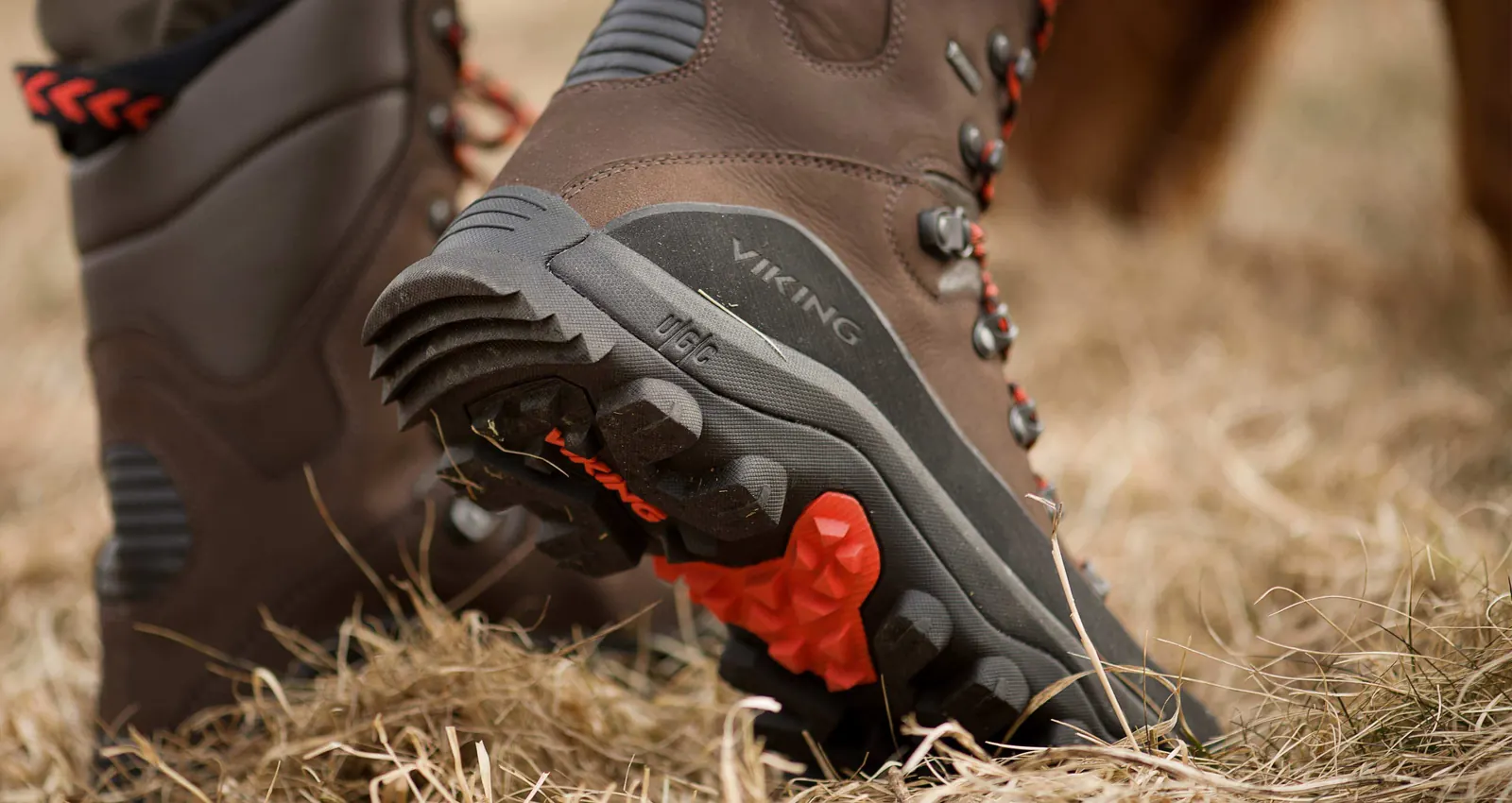
Adult rubber styles span from the nautical Viking Seilas Heritage with a calendered, non-marking deck outsole and the 20 cm mid-height urban boot Viking Bergen up to the backcountry-ready Viking Trophy Mid. Built with a 27.5 cm shaft, adjustable gusset strap and multi-directional UGC® outsole, Trophy Mid targets muddy forest tracks, wet pastures and long hours on uneven ground.
Adult cold-weather and hiking models combine ankle support with specialized winter traction. Built on a wide last from EU 36 to 47, the Viking Constrictor Warm SC GTX unites GORE-TEX waterproofing, Solarcore aerogel insulation and a Vibram MegaGrip outsole; the boot earned a 2024 ISPO Award and was selected by aerospace group Nåva Space for lunar-suit lab simulations at the European Space Agency (ESA). Hikers who want gloved dial tightening can step into the PrimaLoft-lined Viking Constrictor 3 High WP BOA with an aerogel insole.
Black ice and frozen gravel demand mechanical bite beyond rubber lugs. Viking molds fixed steel spikes directly into the rockered rubber outsoles of the women's Viking Stride Mid Spike Warm BOA WP W and men's Viking Stride Spikes Mid Warm GTX M. On ice-free mountain paths, the low-cut Viking Anaconda 4x4 Low GTX BOA grips wet roots with Viking's proprietary UGC® rubber outsole, while the high-cut Viking Villrein Pro High GTX BOA brings dual-zone BOA lacing and Vibram MegaGrip to boggy mountain terrain, winning a 2024 Scandinavian Outdoor Award.
Complementing its kids' footwear, Viking produces insulated children's outerwear built for snow play. Pieces such as the one-piece Viking Toasty Winter Thermal Overall with taped seams, articulated knees and replaceable foot straps or the PrimaLoft-insulated Viking Play Winter Jacket Thermal feature a fluorine-free BIONIC-FINISH® water-repellent treatment according to Viking.
Membrane winter boots, thermo boots and rubber boots compared
| Feature | GORE-TEX / Watershield winter bootsAll-rounder | Elastopan PU thermo boots | Natural rubber boots |
|---|---|---|---|
Weatherproofing & climate | Waterproof and breathable via membrane | 100% waterproof, seamless, non-breathable | 100% waterproof, hand-vulcanized |
Typical temperature window | Cool autumn through deep winter frost | Slush and wet cold down to approx. -20 °C | Spring to autumn (Warm styles: shoulder season) |
Weight & support | Lightweight, supportive sneaker-like chassis | Very light air-cell PU, roomy pull-on fit | Supple flex, slightly heavier rubber feel |
Care routine | Selected Velcro styles machine-washable at 30 °C | Rinse off mud with lukewarm water | Wipe clean + apply rubber conditioning spray |
Six core Viking picks from our range
From top-selling kids' GORE-TEX winter boots and Elastopan thermo boots to natural rubber classics and BOA trail shoes
 VikingJack Warm GTX 1VMid-cut kids' winter boot with GORE-TEX, faux-fur warm lining, speed lace plus Velcro strap and 30 °C washability.View product →
 VikingEquip Warm WP 2VInsulated kids' winter boot (EU 22 to 33) with Watershield membrane, abrasion guards and dual Velcro closures.View product →
 VikingExtreme WarmSeamless kids' Elastopan PU thermo boot with warm wool-polyester lining and drawcord snow gaiter.View product →
 VikingJolly WarmHandcrafted kids' natural rubber boot with insulating wool-blend lining, reinforced toe cap and reflectors.View product →
 VikingConstrictor Warm SC GTXWide-fit adult winter boot combining GORE-TEX, Solarcore aerogel underfoot insulation and Vibram MegaGrip traction.View product →
 VikingAnaconda 4x4 Low GTX BOAWaterproof low-cut hiking shoe featuring GORE-TEX protection, micro-adjustable BOA dial and high-grip UGC outsole.View product →
Prices from the shop, checked when this page loaded. The price shown in the shop applies.
Seamless Elastopan thermo boots like Extreme Warm and Icefighter 2 Warm excel in deep slush, yet solid polyurethane cannot vent sweat vapor. Worn all day inside heated classrooms or on fast, dry hikes, moisture builds up inside socks. For full school days or active walking, a breathable GORE-TEX or Watershield winter boot regulates foot climate far better.
Molded metal spikes on Stride Spike boots require similar discipline. Steel pins bite confidently into sheet ice, but click loudly on bare pavement, wear down faster on dry asphalt and scratch hardwood, parquet or tiled shop floors. Treat spiked models as dedicated ice-walking tools rather than indoor-outdoor commuter shoes.
Matching the right Viking boot to your conditions
- 1
If your child needs one boot for walking to school, playground snow and heated classrooms
choose a breathable GORE-TEX model like Jack Warm GTX 1V or Expower Warm GTX 2V over a closed PU thermo boot.
- 2
If kids spend hours jumping in freezing slush puddles around 0 °C
pick a seamless Elastopan thermo boot such as Extreme Warm so outer fabrics never soak through.
- 3
If your child has wide feet or a high instep
look to wide-lasted ranges like Play Reflex, Espo, Expower or Alv Barefoot rather than standard-width styles.
- 4
If your winter walks mix snowy sidewalks with shops and trains
opt for Vibram MegaGrip lugged boots like Constrictor Warm SC GTX instead of fixed steel spikes.
Right for you if …
Families, winter commuters and hikers needing dependable protection across rain, slush, snow and icy paths
Probably not for you if …
Wearing non-breathable PU thermo boots all day indoors or walking across delicate indoor flooring in fixed steel spikes
Measuring kids' feet and growth allowance
Children's feet grow in spurts, up to 5 mm in a single month according to Viking (roughly 20 mm per year at ages 1 to 2, 15 mm at ages 2 to 3, and 10 mm per year from ages 3 to 11). Measure both feet standing against a flat wall without skirting boards in the afternoon, using the longer foot as your baseline.
Add the appropriate allowance to that measured foot length:
- 1.0 cm of growth and roll-off room for summer, mid-season and unlined footwear.
- 1.5 cm of extra space in warm-lined winter and thermo boots, since plush linings and wool socks take up interior volume.
- Once less than 5 mm remains ahead of the toes, replace the shoe so toes do not jam on descents. Every SportFits product page lists exact insole lengths in millimeters per EU size in its sizing chart.
Cleaning and care by construction
Care routines depend strictly on upper construction and hardware:
- Machine-washable kids' boots (30 °C): Designated textile styles without leather or BOA dials (including Jack Warm GTX 1V, Play Reflex Warm GTX 2V and Expower Warm GTX 2V) can be washed at max 30 °C on a gentle cycle inside a laundry bag with insoles removed and mild liquid detergent. Skip fabric softener and tumble dryers; stuff with paper and air-dry at room temperature.
- Footwear with BOA® Fit System: Never machine-wash BOA boots. Wipe uppers and lace guides by hand in lukewarm water and re-proof outer fabrics with spray. Note that BOA backs dials and laces for the lifetime of the shoe with free replacement kits.
- Natural rubber boots: Rinse dirt off with lukewarm water and a soft sponge, store in a cool dark spot away from radiators or direct sunlight, and apply a silicone or rubber conditioning spray periodically so natural rubber stays supple without UV cracking.
Explore the full Viking range
From GORE-TEX kids' winter boots, Elastopan thermo boots and natural rubber classics to BOA trail shoes and insulated snowsuits.
Shop all Viking products ↗Frequently asked questions
What is the difference between GTX and WP on Viking boots?
GTX stands for waterproof-breathable GORE-TEX laminates, used by Viking since 1992. WP marks Watershield, Viking's own waterproof and, according to the manufacturer, PFAS-free membrane found across accessible kids' and everyday winter lines such as the Equip range.
What do the suffixes 1V, 2V, SL and SC mean in Viking product names?
1V and 2V show whether a boot uses one or two Velcro straps, while SL denotes elastic Speed Lace bungee cords. SC stands for Solarcore, an ultra-thin aerogel underfoot insulation inspired by NASA space-suit materials that blocks cold from frozen ground without stiff bulk.
How do Viking thermo boots differ from classic rubber boots?
Classic rubber boots like Jolly or Seilas are handcrafted over lasts from natural rubber for rainy spring-to-autumn weather. Thermo boots like Extreme Warm or Icefighter 2 Warm are molded seamlessly from BASF Elastopan polyurethane filled with microscopic air bubbles plus wool-blend linings, weighing less and insulating down to roughly -20 °C.
How much extra growing room should I allow in Viking kids' shoes?
Viking recommends 1.0 cm of extra length in front of the longest toe when buying summer or mid-season shoes, and 1.5 cm in insulated winter or thermo boots to accommodate thick linings and wool socks. Time for the next size arrives once less than 5 mm remains.
Can all Viking kids' shoes go into the washing machine at 30 °C?
No. Only designated synthetic and textile models without leather panels and without BOA dials (such as Jack Warm GTX 1V or Play Reflex Warm GTX 2V) may be machine-washed on a gentle 30 °C cycle inside a wash bag without fabric softener. Leather boots, natural rubber boots and all BOA styles must be washed by hand.
Sources (6)
- Viking Footwear: The History of Viking Footwear since 17 January 1920 ↗
- Viking Footwear: About Us & Nordic Heritage ↗
- Viking Footwear: GORE-TEX Partnership since 1992 & Laminate Guide ↗
- Viking Footwear: Guide to Elastopan PU Thermo Boots ↗
- Viking Footwear: Solarcore Aerogel Insulation & Constrictor Range ↗
- Viking Footwear: Measuring Kids' Feet & Growth Allowance Guide ↗

SportFits editorial team
Marketing & Sales Manager at SportFitsNiklas is Marketing & Sales Manager at SportFits and studied applied sports science in Regensburg. In the magazine he writes about training science, fitness and longevity, putting trends into scientific context instead of simply celebrating them. He also looks at what really matters in outdoor gear: honest facts instead of empty advertising language.
Author profile →SportFits
outdoors looks good on you