Wissen
Planai: The slalom course above Schladming
596 metres, 214 metres of vertical drop, gradients of up to 52%: the slalom course above Schladming and how to experience the night race.
The Planai finishes close to Schladming for ski racing. The slalom runs under floodlights on the finishing slope, while the town continues immediately alongside it. You do not need a view from the summit to understand this slope. The line between start and finish already shows why it is worth dedicating an evening to it.
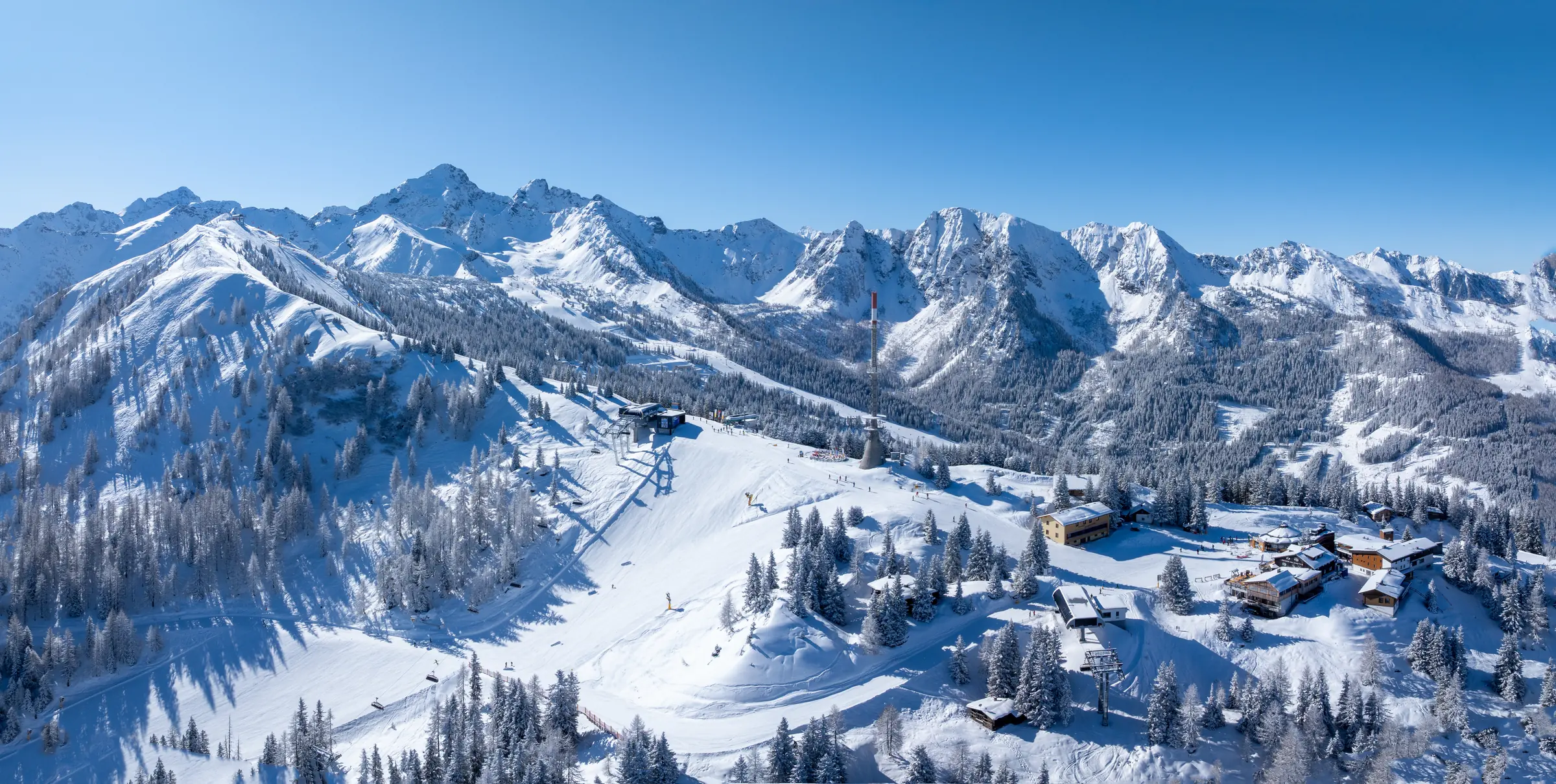
The name Planai refers both to a mountain and to a large ski area. The Nightrace uses only a limited section of it. Anyone who confuses the summit elevation with the slalom’s starting elevation gets the wrong picture. For this profile, the relevant figures are those for the race course published by the organiser.
This limited focus is one of the profile’s strengths. It is about the slalom down to the stadium and its recurring movements. The long descent from the mountain belongs to another day. Keep the two separate, and you can plan the race evening at your own pace without having to fit in a mountain tour.
The slalom course in numbers
- 01
Start and finish: 958 and 744 metres.
- 02
Course length: 596 metres.
- 03
Vertical drop: 214 metres.
- 04
Maximum gradient: 52%.
A short slope with a tight rhythm
596 metres is a manageable length for a race course. The slalom fills it with a tight sequence of changes in direction. The published profile lists more than two hundred metres of vertical drop between start and finish. This means you are looking at a dedicated race slope below the much larger ski area, not a descent from the Planai summit.
The gates set a new line for each run. The slope remains the same, but the exact sequence of turns changes. Our suggestion for watching: first observe only one skier’s rhythm, then watch the transition into the next section of terrain. This helps you recognise differences without immediately trying to convert every movement into an assumed time.
A spot near the finish is particularly useful for seeing the final turns and the reactions after the finish line. How much of the upper slope you can see depends on the specific area. Check the official stadium layout and the corresponding ticket category. A grandstand name alone does not promise a complete view.
From World Cup Mountain to Night Race
The World Cup came to the Planai in 1973. The 1982 and 2013 Alpine World Ski Championships are also part of Schladming’s racing history. The local editorial team links these events to the town’s development as a host venue. The present-day image of the evening race therefore has a longer history behind it.
The first World Cup night slalom took place in 1997. The organiser’s magazine describes this step as the beginning of a new chapter. Floodlights and the proximity of the finish area to the town changed the setting in which spectators experience the slalom. For us, this connection explains much of the event’s character: the slope becomes the centre of an evening.
For 2027, the organiser offers separate tickets for the giant slalom and slalom, as well as a combination ticket. The figures above apply specifically to the published slalom profile. They are not figures for the giant slalom. When planning, choose the discipline first and then the appropriate evening; the current programme is available from the organiser.
Two runs change the evening for spectators
A slalom is decided over two runs. For visitors, this means there is a break between the first impression and the decision. We recommend planning the evening as one continuous event. Anyone who leaves for the next destination after the first run sees a different part of the event from someone who stays until the final run.
The strength of a stadium position is that you can compare the recurring movements on the same slope. One skier takes a turn more tightly, while another moves more calmly towards the next gate. These differences become easier to read over time. On a short slope in particular, it is worth staying in one specific spot.
The evening is less suitable if what you are mainly looking for is a quiet, long day of skiing with an early return to your accommodation. The Nightrace has a different focus. Keep the race evening separate from a long circuit through the interconnected ski area. Your holiday does not need to be filled with as many kilometres as possible for the trip to be worthwhile.
From the Railway Station to the Finish Slope
The organiser names Schladming as the destination railway station and describes public bus connections and event shuttles. Plan the final journey using the latest visitor information. For the return trip, what matters is the connection after the final run. A ski bus route that is useful during the day is not sufficient evidence for this.
Where you stay can significantly change the evening. Schladming may allow short walks, while Rohrmoos or Haus place the daily focus on other sides of the mountain. This is a sensible trade-off if skiing makes up most of the trip. In that case, clarify in advance how you will get back from the race slope and check the actual stops.
Begin your accommodation search with one decision: should the daily journey to the ski access point or to the spectator area be short? If you want to leave after the final run, plan the return journey first.
Sources
- Slalom race course and key figures, Nightrace organiser, accessed 22 October 2026 (in German) ↗
- Magazine with the history of the Night Slalom since 1997, Nightrace organiser, accessed 22 October 2026 (in German) ↗
- Ticket overview and disciplines for 2027, Nightrace organiser, accessed 22 October 2026 (in German) ↗
- Travel by train, bus and shuttle, Nightrace organiser, accessed 22 October 2026 (in German) ↗
- Nightrace and accommodation planning, Schladming-Dachstein Tourismus, accessed 22 October 2026 (in German) ↗
Inspiration, knowledge and gear for people who want more from the outdoors.