Wissen
Gran Risa: Giant slalom in the shadow of the forest
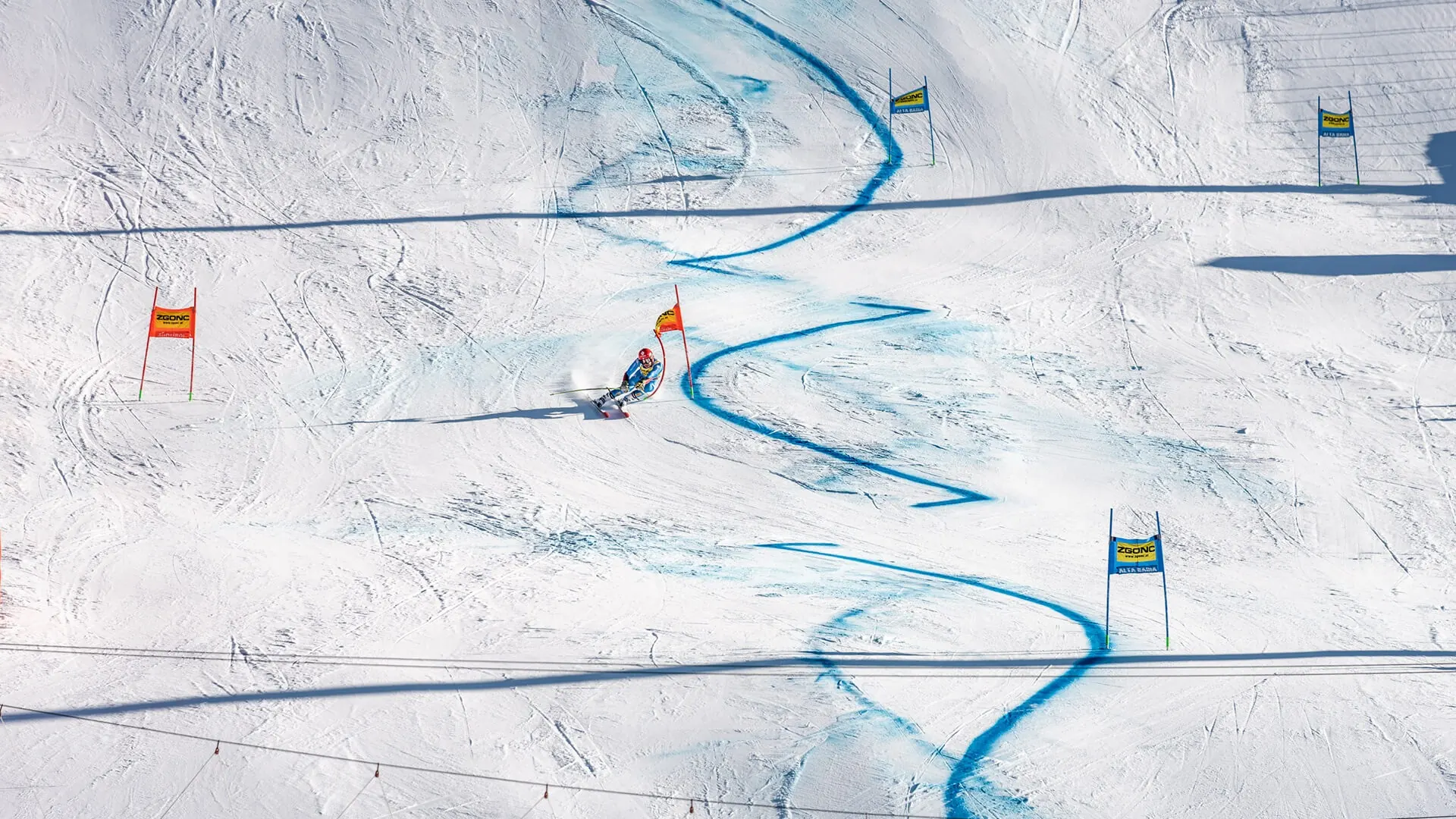
448 metres of vertical drop over just over 1.2 kilometres: Gran Risa in Alta Badia, its key sections and your route to the finish slope.
Gran Risa runs through the forest to La Villa. Between the trees are steep sections, turns and short transitions that define the giant slalom. You can recognise a course where one turn sets up the next. Alta Badia’s vast panorama fades into the background for the racers. Here, it is all about the line.
Giant slalom means a course with wider changes of direction than slalom. On Gran Risa, this challenge meets a shaded forest slope and a compacted snow surface prepared specifically for the race. Spectators therefore see both the terrain and the preparation at work. For a first visit, we recommend the designated finish area in La Villa.
The forest setting is more than a backdrop for photos. It helps you identify the race corridor spatially within the wider area. From the plateau, you can place the mountains and connections; on Gran Risa, individual turns and waves. Both perspectives belong to Alta Badia, but they require a different view.
Gran Risa: Giant slalom profile
- 01
Start and finish: 1,868 and 1,420 metres.
- 02
Length according to the organiser: 1,225 metres.
- 03
Vertical drop: 448 metres.
- 04
Maximum gradient in the technical profile: 69 per cent.
The forest slope below Piz La Ila
The course is located on Piz La Ila above La Villa. Alta Badia Tourism describes the forest setting and shade as defining features. Gran Risa therefore differs clearly from the open slopes on the plateau. A trip to the wide pistes in the surrounding area gives you a different impression from looking into this race corridor.
The organiser publishes a separate technical profile for the giant slalom. We use its figures in the box. They apply to the race variant described; the slalom has a lower start. If you mix up details for the full public piste and the race course, you may arrive at apparently contradictory lengths or gradient figures.
For your understanding, this distinction matters more than an extra decimal place. Look at the start of each competition and at the shared finish area. The course provides a fixed framework, while the gates define a specific line within it. The slope length alone does not tell you how a run is set.
Steep sections, waves and a hard surface
The official description mentions steep sections, turns and the so-called cat’s backs. These are terrain features that the turns have to be adapted to. Watch the transition from one wave into the next turn in particular. There, you can see whether the movement on the ski continues smoothly or has to be reorganised.
The organiser explains one feature in detail: water is injected into the snowpack to compact it for the race. This treatment creates a hard base. It is part of race operations and a good reason not to read television footage as a preview of an ordinary holiday slope. Open public pistes may be in a different condition.
For us, this combination is what makes the slope interesting. Giant slalom requires a precise sequence of turns, while the terrain repeatedly disrupts it. A strong run can therefore sometimes look unspectacular. If you focus only on large skidding movements, you may miss the quieter solution to the same section.
A fixture since 1985
The first World Cup on Gran Risa took place in 1985. The verified local editorial team describes the regular inclusion of the giant slalom since 1990. This history traces a development from an individual venue to a slope whose name represents a particular technical challenge. The forest remains its defining spatial feature.
The organiser now maintains separate profiles for giant slalom and slalom. For you, this means two possible perspectives on the same finish slope. The tighter gate sequence in slalom changes the rhythm; in giant slalom, the connection between the wider turns has more room. Choose which competition to attend based on your interests and the current programme.
We deliberately do not use a historic winning time as a benchmark for your visit. Course setting and conditions determine the time. It is more informative to observe the same section within a single run. You do not need to know a complete results list for this. Watching the movement between the gates is worthwhile even without that prior knowledge.
La Villa: Finish grandstand and the final stretch
The organiser offers finish grandstands and describes travel to La Villa. By train, it recommends Bruneck as a starting point for continuing into the Gadertal valley. Check the specific bus connection and then the walk to your entrance. A local address is not the same as an access point.
A finish grandstand is our recommendation if you want to follow the race in context and see the arrivals. It does not replace a direct view of the upper forest sections. Conversely, a spot on the slope does not give you a clear view of everything happening in the finish area. Choose according to the perspective you are actually travelling for and the permitted routes.
Start your accommodation search with one decision: should the daily journey to the ski lift or to the viewing area be short? For a race-focused trip, check La Villa first; a base on the plateau requires a separate return journey for the race evening.
Sources
- Alta Badia World Cup organiser: technical profile and race preparation, accessed 22 October 2026 (in Italian) ↗
- Alta Badia World Cup organiser: finishing grandstands, accessed 22 October 2026 (in Italian) ↗
- Alta Badia World Cup organiser: travelling to La Villa, accessed 22 October 2026 (in Italian) ↗
- Alta Badia Tourism: Gran Risa and its forest setting, accessed 22 October 2026 (in German) ↗
- Alta Badia Tourism: ski area and villages on the plateau, accessed 22 October 2026 ↗
Inspiration, knowledge and gear for people who want more from the outdoors.