Training & Health
Giant slalom explained: What you can take from World Cup turns for carving
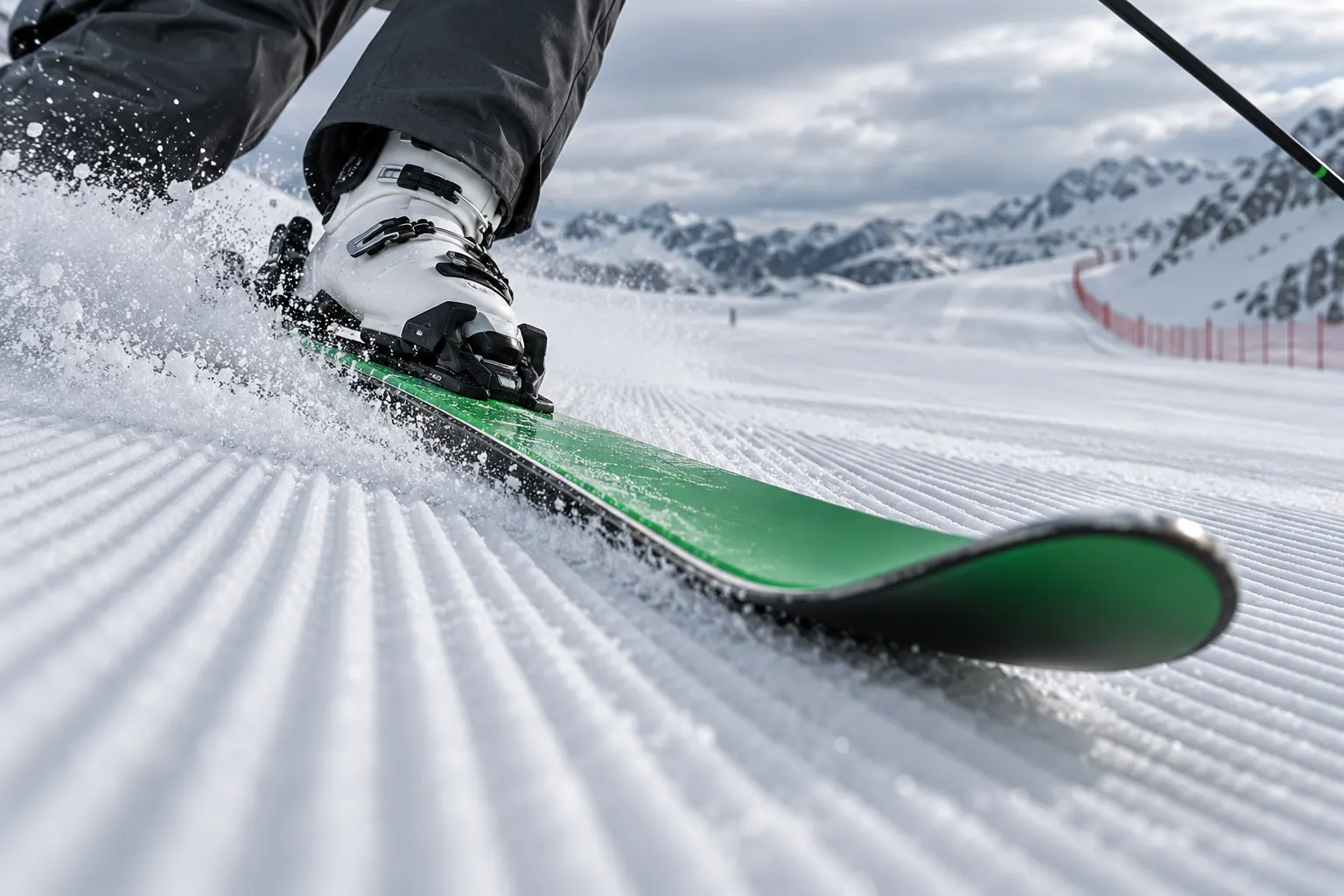
The World Cup starts in Sölden with giant slalom on 24 and 25 October. How this turn works, why the pros use skis with a 30-metre radius and what can help you on a red run.
The key points at a glance
- 01
According to the FIS, World Cup giant slalom skis have a minimum radius of 30 metres, while piste racecarvers usually have 16.5 to 19.5 metres.
- 02
The skis and edge angle determine the turn radius together. More edging makes the arc tighter, but requires considerably more strength.
- 03
You can adopt the principle: apply pressure to the outside ski early and progressively, use one pressure phase per turn, and look towards the next edge change.
- 04
Leave the pros’ speed and edge angles on the race course. According to the ASU analysis for 2024/25, the knee is the most common injury in German skiing.
What happens on the Rettenbachferner and what it has to do with your ski day
On 24 and 25 October, the world’s best giant slalom skiers will race the first World Cup event of the winter in Sölden. From the outside, it looks easy. Long, rounded arcs, hardly any snow spray and a line as straight as if drawn with a ruler.
The interesting part is that the physics are the same as in your carving turn on a red run. An edged, weighted ski bends and follows an arc on its edge. The differences are the equipment, speed and forces involved.
Understanding giant slalom therefore also helps you understand your own carving. It shows which parts of World Cup technique belong on a recreational piste and which do not. You can find out how to experience the race weekend on site in our article Sölden in October.
Radius comparison
- World Cup giant slalom skis, minimum value
- 30 m
- Racecarvers for the piste
- 16.5–19.5 m
- Slalomcarvers
- 12.5–13 m
- Minimum length of men’s race skis
- 193 cm
The World Cup figures come from the FIS specifications for the 2026/27 season, while the piste-ski radii come from the DSV skiTEST 2025/26. A World Cup giant slalom ski therefore has almost twice the radius of a racecarver. For women, the minimum length is 188 centimetres.
Why the ski makes the turn, not you
The radius printed on the ski is called the sidecut radius: the circular shape created by the wide tip, narrow waist and wide tail. It is not the radius you actually ski.
The edge angle also determines the arc you ski, meaning how steeply the ski stands against the snow. A study in the specialist journal Sensors simplifies it as follows: ski radius equals sidecut radius multiplied by the cosine of the edge angle. If you put a 17-metre racecarver on a 45-degree edge, the model gives an arc of around 12 metres. A World Cup ski with 30 metres would produce around 21 metres. This is a rough calculation, not a measurement. But it shows why the pros need so much space.
The downside of edging: the steeper the edge, the more force is needed to bend the ski far enough for the whole edge to grip. Without that force, the ski slips. More edge angle is therefore not automatically better.
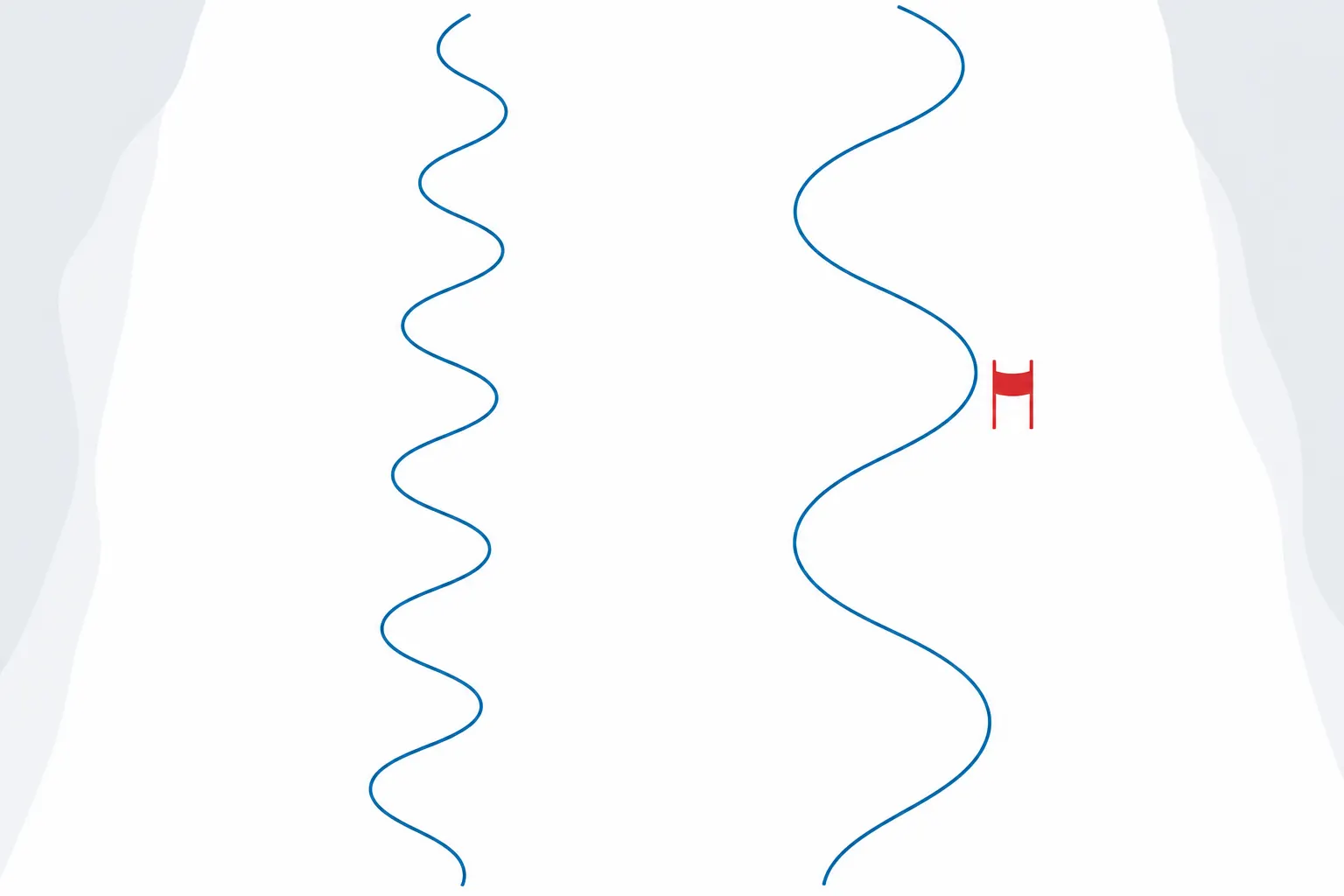
When carving, every point of the edge follows the same track. In a drifted turn, the ski also slips sideways. It is not an either-or choice. Even in the World Cup, skiers drift when the line requires it.
One turn, four phases
Sports science divides a giant slalom turn into four sections. The German Ski Instructors’ Association (DSLV) describes the same turn using an image that is easy to remember: the turn clock. The fall line, the direct route downhill, is at 3 o’clock.
| Phase | On the turn clock | What happens |
|---|---|---|
Initiation | 12 o’clock, edge change | The skis switch to their new edges and the body tips into the new turn |
Direction change I | 12 to 3 o’clock | Pressure builds on the outside ski and the ski bends |
Direction change II | 3 to 6 o’clock | The greatest forces occur and the ski steers out of the fall line |
Exit | Around 6 o’clock | Pressure decreases and the next edge change follows |
For you, the key point is the transition from the first to the second half. If you only apply pressure in the fall line, all the pressure arrives at once. If you start early and progressively, you distribute it.
A field study of six European Cup athletes in the British Journal of Sports Medicine compared giant slalom skis with radii of 30, 35 and 40 metres. With the 40-metre ski, the forces after the gate were lower and the arcs larger, at the same edge angle. The ski steered itself less. This exact self-steering makes carving easy. But if the skier loses balance, it can also become a problem. More on that below.
Starting high or turning late
“Starting high” is something racers constantly hear from their coaches. It means starting the turn early above the gate so that the arc remains long and carved.
A study of 17 skiers in the journal Frontiers in Sports and Active Living compared two lines. In the S-line, long, carved turns begin well above the gate, with only a short straight section in between. In the Z-line, the skier travels straight towards the gate for longer and then turns sharply, with a greater risk of slipping. The surprising result: both lines can be equally fast. The skiers were faster when they lost less energy while turning, regardless of the strategy.
For the recreational piste, this means that the rounded, early-started turn is the calmer option. You do not have to ski it to be fast. You ski it because it saves energy and remains predictable.
What you can adopt: distribute pressure instead of forcing it
The DSLV dedicated its 2024/25 training programme to the motto “Direction before speed”. The drills fit well with what the World Cup shows. You can perform all of them either drifted or carved.
| Drill | How to ski it | What it gives you |
|---|---|---|
Long and rounded | Apply progressive pressure to the outside ski as you change edges, increasing it until the end of the turn | A long, distributed pressure phase: stable, easy to control and gentle on the joints |
Short and angular | Start with little edge angle, increase edge angle and pressure at 2 o’clock, then release again at 4 o’clock | You feel how a short, strong pressure phase tightens the arc |
Turning before edging | Turn the skis without weighting them, then edge them with pressure only from 3 o’clock | You learn to separate turning and edging, then combine them deliberately |
The association also gives three tips that have an immediate effect. Move your gaze from one edge change to the next, not to the ski tips. Ski the turn in one continuous movement: one pressure phase should be enough. And complete each turn before starting the next.
For joint-friendly skiing, the DSLV explicitly recommends the opposite of what looks spectacular: distribute pressure well and avoid pressure peaks. The World Cup line and joint-friendly skiing therefore lead to the same image. A rounded turn with pressure beginning early.
Pole use is also part of the technique. You can calculate here whether your poles are the right length.
What is best left to the pros
A review article in the specialist journal Die Orthopädie reports measurements by the German Ski Association showing forces of more than three times body weight while skiing. In the World Cup, knee injuries are the most common injury. The most common mechanism has a name: Slip-Catch.
A video analysis of 20 World Cup ACL tears in the American Journal of Sports Medicine describes it as follows. The skier loses pressure on the outside ski during the turn, extends the knee to regain grip and the inside edge suddenly catches. The knee rotates inwards and is forced into a knock-kneed position. Ten of the 20 cases happened this way, all while turning.
The picture is different for recreational carvers. Among 220 people with ACL injuries, a forward twisting fall was the most common mechanism, accounting for 54 per cent.
What does this mean for you? Be careful about jumping to the conclusion that carving damages the knees. The ASU does not record how people were skiing, and whether a larger ski radius protects the knee on a recreational piste has not been studied. Better technique is not a guarantee of protection either. A study of 38 female skiers over 40 found no automatic link between better technique and better knee stabilisation.
One finding from the same study is very practical. The thigh muscles became significantly fatigued over the course of the ski day, and a 45-minute lunch break produced no measurable recovery. Plan your more demanding runs for the morning instead. In the afternoon, ski more rounded turns at a slower pace.
Which ski suits your turns
You do not need a World Cup giant slalom ski for recreational pistes. Its 30-metre radius demands speed and space that you rarely have there. According to the DSV skiTEST, racecarvers are based on race skis but have more practical radii, and also require “space and speed”.
Which radius is right for you?
- 1
If you enjoy long, fast arcs on wide pistes
a racecarver with a radius of 16.5 to 19.5 metres is a good fit
- 2
If you like short, tight turns and ski cleanly
a slalomcarver with around 13 metres is a closer match
- 3
If you mainly ski comfortably and on many types of piste
an all-round ski gives you more flexibility than a race model
- 4
If you notice your thighs burning in the afternoon
ski shorter sections with breaks instead of maintaining your speed
Right for you if …
Advanced skiers who ski confidently on red runs and want to control their turns more deliberately
Probably not for you if …
Anyone who mainly skis on crowded pistes or off-piste: control and short turns matter more there than long arcs
You will find racecarvers, slalomcarvers and all-round skis together with ski helmets and ski goggles for fast days.
Frequently asked questions
Why do World Cup skiers use such long skis?
The FIS requires them. For World Cup giant slalom skis in the 2026/27 season, the minimums are a 30-metre radius and a length of 193 centimetres for men, and 188 centimetres for women. With a larger radius, the ski steers itself less, and research suggests that this self-steering plays a central role in serious knee injuries in racing.
What is the difference between carving and drifting?
When carving, every point of the edge follows the same track and the ski cuts through the snow. When drifting, the ski also slips sideways. Both are part of skiing, and the DSLV explicitly allows its drills to be performed in both forms.
Will my turns become tighter if I edge more?
Yes, but only if you build up enough pressure for the ski to bend. Otherwise it slips. On a recreational piste, an early-starting, distributed pressure phase is usually the better choice than a large edge angle.
Is carving bad for your knees?
It cannot be said that simply. The knee is the most common skiing injury, but accident statistics do not record skiing technique. What helps is adapting your speed to your ability and the traffic, and not leaving demanding runs until the end of a long day.
Which ski is right for me if I want to learn to carve?
According to the DSV skiTEST, racecarvers with 16.5 to 19.5 metres require speed and space, while slalomcarvers are intended for sporty skiers with very good technique. If you are still consolidating your carving, it is better to seek advice on all-round models.
Equipment for your carving days
Skis, helmets, goggles and clothing for fast days on the piste.
View alpine ski equipment ↗Sources
- FIS: Specifications for Alpine Competition Equipment 2026/27 ↗
- Spörri et al. 2016: Sidecut radius and the mechanics of turning, British Journal of Sports Medicine ↗
- Thorwartl et al. 2023: Ski bending curvature, roll angle and radial force, Sensors ↗
- Delhaye et al. 2020: Line strategy in giant slalom, Frontiers in Sports and Active Living ↗
- Bere et al. 2011: ACL injury mechanisms in World Cup alpine skiing, American Journal of Sports Medicine ↗
- Ruedl et al. 2011: ACL injury mechanisms in carving skiers, International Journal of Sports Medicine ↗
- Köhne et al. 2022: Germany as a winter sports nation, Die Orthopädie (in German) ↗
- Hermann et al. 2023: Muscular fatigue in alpine skiing in women over 40, IJERPH ↗
- ASU Ski: Accidents and injuries in alpine skiing 2024/25 (in German) ↗
- DSLV: Further training 2024/25 “Direction before speed!” (in German) ↗
- DSV skiTEST 2025/26: Race carver (in German) ↗
- Stiftung Sicherheit im Skisport: FIS Rules of Conduct (in German) ↗
Inspiration, knowledge and gear for people who want more from the outdoors.