

Training & Health
Your first half marathon: how to prepare

Sawe ran 1:59:30 in London, a mark for the history books. Here is how to prepare for your own first half marathon and reach the finish without frustration.
The essentials at a glance
- 01
Before your first half marathon, you should be able to run 10 km continuously or 60 minutes comfortably. Everything else can be built over 12 weeks.
- 02
A conservative plan with two or three runs per week beats an ambitious five-day plan you abandon after three weeks.
- 03
A negative split means running the second half faster than the first. It helps prevent the classic fade after kilometre 16.
- 04
Finishing matters more than a target time on your first attempt. Chase a personal best next time.
- 05
Tapering in the final two or three weeks is essential: reduce volume, keep some intensity and sleep more.
Sawe and the London breakthrough
1:59:30. Four figures that changed the running world. At the 2026 London Marathon, Kenyan Sabastian Sawe became the first person to break two hours in an official race. What Eliud Kipchoge achieved in Vienna in 2019 only under laboratory conditions is now part of the official record books.
This is where it gets interesting: Sawe’s pace was around 2:50 minutes per kilometre. For comparison, if you finish your first half marathon at 6:30 per kilometre, you are running at less than half the speed of the fastest man in the world. Sounds sobering? It is not. It shows what sport really is: a broad spectrum, and you are not racing the world’s elite.
Your half marathon is not Sawe’s marathon. It is your personal world record. That is what this guide is about.
Why the half marathon is the perfect goal
The 21.1 kilometres are not Europe’s most popular race distance by accident. A half marathon is long enough to be a real challenge, yet short enough to train for alongside work, family and sleep.
A marathon often calls for 18 to 20 weeks of training and several runs lasting more than three hours. For a half marathon, 12 weeks and one 90- to 120-minute long run at the weekend are often enough. That is also why half-marathon events are booming: Hamburg, Mainz, Berlin and Vienna often sell out months in advance.
And honestly, crossing a half-marathon finish line changes how you see your body. That is simple physiology.
Are you ready? The prerequisites
Before the training plan comes an honest check. A half-marathon plan only works if you bring a base with you. Otherwise, your tendons, bones and motivation can all become overloaded in the first two weeks.
As a beginner, you should be able to run 10 kilometres continuously or 60 minutes comfortably without your breathing falling apart. If you are not there yet, that is no disaster. Add an eight-week build-up first and plan for 20 weeks rather than 12.
Still looking for the right running shoes?
From cushioned trainers for long runs to lightweight racing shoes, SportFits has models for every pace and distance.
Explore running shoes ↗The 12-week training plan
A good half-marathon plan rests on three building blocks: easy runs, a long run at the weekend and a moderate tempo session or fartlek. That is enough. More can easily be too much for a beginner.
The logic is simple: easy runs develop your aerobic base, capillaries and tendons. The long run prepares your mind and legs for the distance. The tempo session makes you faster, but it is a bonus on top of the foundation.
In the final two or three weeks before race day, reduce your volume by 30 to 50 per cent. This is called tapering, and it is where many first-timers get nervous. Trust the plan: fresh legs matter more on race day than an extra 18 km three days beforehand.

| Day | Session | Duration / distance | Intensity |
|---|---|---|---|
Monday | Rest day or mobility | 20–30 min | Very easy |
Tuesday | Easy run | 40–50 min | Conversational pace |
Wednesday | Strength training or rest | 30–45 min | Moderate |
Thursday | Tempo session or fartlek | 45–60 min | Challenging |
Friday | Rest | Recovery | |
Saturday | Easy run | 30–40 min | Conversational pace |
Sunday | Long run | 75–105 min | Easy and controlled |
Weeks 1–4: Build your base
Easy runs, long runs up to 75 minutes and one moderate tempo session per week. Aim: tolerate the volume without overloading your body.
Weeks 5–8: Increase the distance
Long runs up to 105 minutes, plus the first longer tempo sections of 2–3 km at half-marathon pace. This builds confidence for the distance.
Weeks 9–10: Add race specificity
The longest run is 110–120 minutes or 18 km. Add a progressive run with the final 5 km at race pace. This is the key session of the plan.
Weeks 11–12: Taper
Reduce volume by 30–50 per cent while keeping some intensity. In the final week, run only short, easy sessions and a few strides. Prioritise sleep.
Pacing strategy: the negative split
If you take away one tip from this article, make it this: run the second half faster than the first. This is a negative split, the strategy many top marathoners use for personal bests, including Sawe in London.
The reason is simple: you start with adrenaline, fresh legs and full glycogen stores. Go out too fast and you pay for it twice over after kilometre 16. Runners call that the wall. Start the first 10 kilometres deliberately slower, then pick up the pace in the second half. You will usually reach the finish more comfortably and often faster.
A practical rule: run the first 10 km 5–10 seconds per kilometre slower than your target pace. It feels unnaturally slow at the start. That is the point. Work out your target pace beforehand with our Pace and finish-time calculator.
Nutrition, recovery and tapering
Training only works with recovery. It sounds obvious, but this is where many beginners struggle. If you run two or three times a week, you need rest days between sessions. Otherwise planned training stimuli turn into creeping overload.
For food, the rule is simple: nothing new on race day. Test what your stomach tolerates in training, whether that is a banana, bread with honey, muesli or porridge, and eat the same on race day. Trying energy gels or a new sports drink for the first time during the race is a reliable way to discover the course toilets.
One final note: tapering means running less. It does not mean stopping completely. Short, easy sessions in the final 10 days keep your legs fresh. Complete rest can leave them flat. Trust the process.
The most common beginner mistakes
What speaks for it
Train conservatively: two good weeks beat one perfect week followed by three injured ones
Keep the long runs in the plan. They are the foundation.
Practise race pace in training, for 3–5 km at half-marathon pace
Stick to the taper even when your legs feel restless
Make finishing the primary goal. Chase a personal best next time.
What to weigh up
Starting too fast, the classic mistake that ruins the second half
Skipping long runs because they take time
Packing too many hard sessions into one week
Ignoring the taper and going full gas until five days before the race
Starting with an aggressive target time and losing confidence
Race day: pace, fuelling and mindset
Three things decide race day, and none of them is talent. First, pace: start slowly. Really slowly. If runners who later collapse overtake you in the opening kilometres, you are doing it right. Second, fuelling: eat a familiar, carbohydrate-rich meal 2–3 hours before the start. Drink at aid stations during the run, not constantly but regularly.
Third, your mindset. Kilometres 14 to 18 feel hard for most first-timers. That is normal. Prepare a few mantras: “Three more songs.”, “To the next bridge.”, “I am running for myself.” It may sound a little esoteric, but it works. Ask anyone who has finished a half marathon.
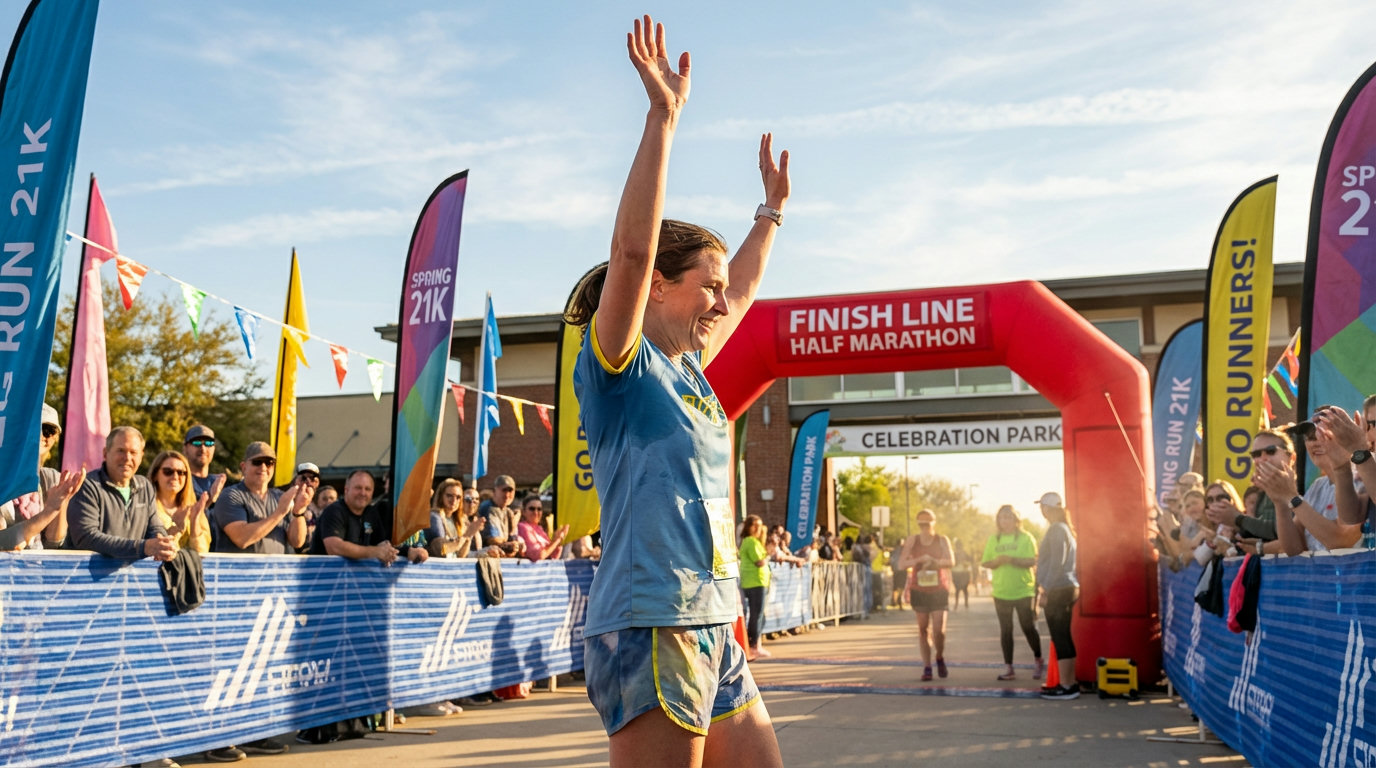
Then comes the finish line. Take a photo. Be proud. Think about the second half, perhaps even a marathon. But first: recover.
Ready for the finish line?
Breathable performance tops, running tights and lightweight jackets make every kilometre more comfortable.
Shop running and fitness clothing ↗Frequently asked questions
Can I run a half marathon without having run 10 km before?
In theory, yes. In practice, it is not a good idea. Without a 10-km base, injury risk rises sharply. Tendons and bones need weeks to adapt to running loads. Allow 16 to 20 weeks rather than 12 and build your base first.
What pace is realistic for a first half marathon?
For beginners, 2:00 to 2:30 hours is a typical target range, roughly 5:40 to 7:00 minutes per kilometre. Even pacing and finishing matter more than speed. Chase a personal best next time.
How many training sessions do I need each week?
For half-marathon beginners, two or three runs per week are enough, combined with one strength session. More frequency only helps once your body and routine can handle it consistently.
What should I eat on race morning?
Eat a carbohydrate-rich, easily digested meal 2–3 hours before the start, such as porridge with a banana, toast with honey or rice pudding. Use exactly what you tested in training. Never try something new on race day.
What does a negative split do for me?
Running the second half faster than the first helps prevent the classic fade after kilometre 16. A controlled start usually leads to a faster finish and a much better running experience than going out too hard.
How important is strength training for runners?
Very important. Strength training can support efficient running and resilience. For most recreational runners, one 30-minute session per week covering the trunk, legs and single-leg stability is enough. Think functional strength rather than bodybuilding.
More on running and training
Useful tools and related content from the SportFits magazine
Sources
- Sportschau: Sawe breaks the two-hour barrier
- Runner’s World: The ultimate half-marathon guide
- laufen-total.de: Half-marathon training plan for beginners
- ASICS: Half-marathon training plan for beginners
Inspiration, knowledge and gear for people who want more from the outdoors.