
Know-how
Staying dry isn't luck. Here's how your rain jacket works.
What makes a jacket waterproof, how much hydrostatic head do you really need and why do you sometimes still get wet? See it here in the lab and in the pressure test.
The Lab
What makes a rain jacket waterproof
Rain beads off on the outside, while heat escapes as vapour on the inside. The membrane sits between them. How the layers are constructed affects the weight, feel and how much rain the jacket can handle.
1 / 4
From the outside
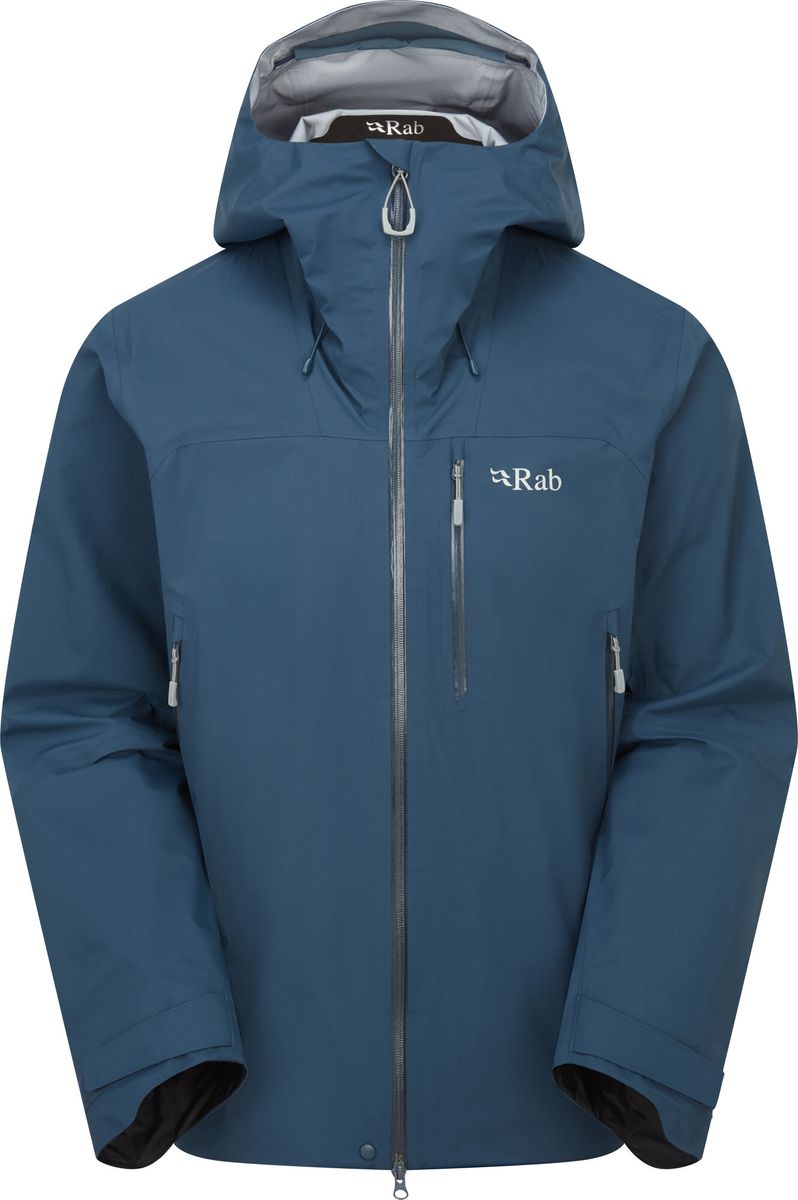
The Rab Firewall Mountain Jacket in Tempest Blue, one of our best-selling 3-layer jackets. Zoom in with + and we’ll go into the fabric.
↓ Rain stays outside
↑ Vapour escapes outwards
Typical of 3-layer jackets
The tough one: for long hikes, a rucksack and hours of rain.
Strong for long hikes, mountains, steady rain
Popular 3-layer jackets:
The Experiment
Why am I still getting wet?
It’s usually not rain but your own vapour. Set what you’re doing and how it’s raining, then see what happens under the jacket.
It gets clammy inside.
You produce a bit more vapour than gets out. The rest condenses on the inside of the jacket. That’s not a leak, that’s sweat.
- Open the vents: zips under the arms let warm air out.
- Slow down a bit or wear one layer less underneath.
Jackets with pit zips:
Simplified model: shows the principle, not measurements of individual jackets.
Hydrostatic head
How much pressure can the fabric withstand?
Hydrostatic head indicates how much water pressure a fabric can withstand before water penetrates. 10,000 mm is about 1 bar, equivalent to the pressure from a 10-metre column of water.
- Rain from above only presses lightly.
- Rucksack straps press the water into your shoulders and back.
- Sitting and kneeling on wet ground press hardest.
That’s why more reserve pays off on long rainy days with a pack.
Hydrostatic head: what the figure really tells youHow much can they take?
Tap a Jacket: we’ll show it to you in the buying guide.
Good to know
Questions we often hear
Waterproof or water-repellent: what's the difference?
Water-repellent means drops bead off the surface until the fabric eventually becomes soaked. Waterproof means a membrane or coating keeps water out, and the seams are taped. For proper rain, you need waterproof.
Why am I still wet under the jacket?
Usually it's sweat, not a leak. When you're exerting yourself, more moisture builds up than even a good membrane can move out, so it condenses inside. Slow down, open the ventilation zips and wear one fewer layer underneath.
2, 2.5 or 3 layers: what do I need?
For town and everyday use, 2 layers with a lining are comfortable to wear. 2.5 layers are light and fit in any bag, ideal as an emergency jacket. 3 layers are the most robust if you're out in the rain for a long time with a rucksack.
How much hydrostatic head is enough?
For outdoor use, 10,000 mm is a good starting point. More headroom is worthwhile if you're walking in the rain for hours, kneeling or carrying a heavy rucksack, as this increases pressure on the fabric. More isn't automatically better, though: seams, zips and the water-repellent finish matter too.
How do I care for my rain jacket?
Wash it according to the care label, preferably with detergent for technical clothing and without fabric softener. Dirt and skin oils weaken the water-repellent finish. Many manufacturers recommend applying a little heat afterwards so water beads off again. Follow what your jacket's label says.
Which size should I choose?
A rain jacket is your outermost layer, so there should be room for a fleece underneath. Raise your arms: the sleeves shouldn't ride up. Check the brand's sizing system, as some use UK sizes or clothing sizes. The size guide is on every product page.
Ready for your jacket?
Find the right one now
Five questions in the finder, advice by voice or text, and all jackets sorted by use in every available colour.
Go to buying advice