

 Buying advice
The days are getting shorter. Your runs aren’t.
Which head torch is right for you? Our best-selling models, explained honestly: how bright they are, how long they last, what they’re good for and where their limits are. Find yours in five questions or ask our advisor.
By the end of October, it’s dark at five.
The finder
Find your headlamp in 5 questions
Question 1 of 5
What do you need it for?
All headlamps
Headlamps by use
Running & training
Lightweight and secure on your head.
Mountains & rough ground
For the approach, ridge and walk back.
Hiking & camping
For huts, tents and walks back.
Lots of light
For long nights and fast paces.
Values marked H come from the manufacturers.
The beam
How far does the light really reach?
A forest path with no moon, seen from above. Each lane is one torch: how far do you see the roots, how far the path, and what stays in the dark?
Compare up to three torches Tap a torch to show or hide it.
Black Diamond Astro 30055 m Beam distance
Fork in the path visible, signpost only as an outline, barrier not visible.
- roots sharp
- 9 m
- path visible
- 28 m
- outlines only
- 55 m
Black Diamond Spot 400-R100 m Beam distance
Signpost visible, barrier only as an outline, reflector post not visible.
- roots sharp
- 16 m
- path visible
- 50 m
- outlines only
- 100 m
Lupine Blika BT X 4SC255 m Beam distance
Barrier visible, reflector post and Edge of the woods only as an outline.
- roots sharp
- 40 m
- path visible
- 128 m
- outlines only
- 255 m
- visible (1 lux and more)
- outline only (0.25 to 1 lux)
- missing: in the dark
Calculated from the beam distance to ANSI/PLATO FL1 (0.25 lx at the end). Brightness falls with the square of the distance; spill light, fog and terrain are not taken into account.
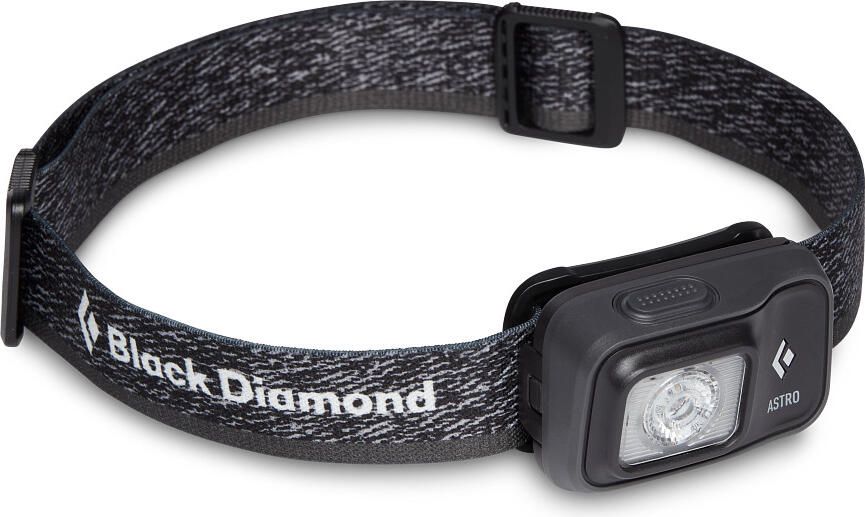
Black DiamondAstro 300
55 mBeam distanceH
Roots sharp up to 9 m · path up to 28 m
- Light output
- 300 lm
- Burn time
- up to 140 hH on the lowest setting
- Weight
- 100 gH
- Power
- Rechargeable battery or batteries
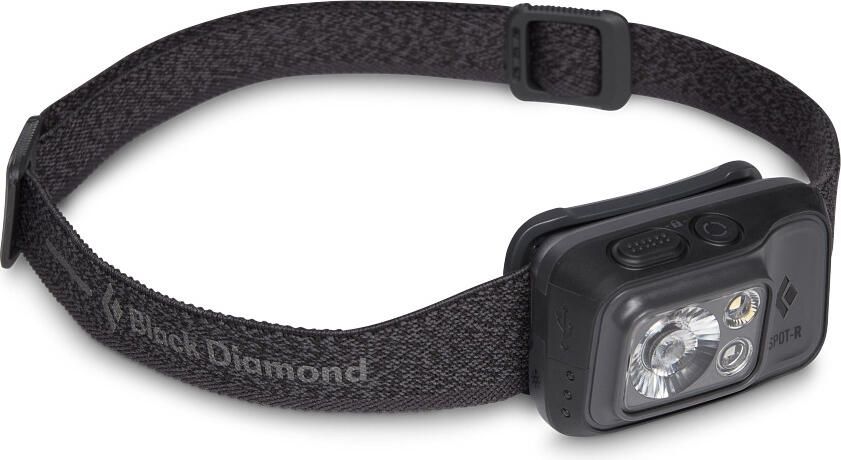
Black DiamondSpot 400-R
100 mBeam distance
Roots sharp up to 16 m · path up to 50 m
- Light output
- 400 lm
- Burn time
- up to 225 h on the lowest setting
- Weight
- 116 g
- Power
- Rechargeable battery
LupineBlika BT X 4SC
255 mBeam distanceH
Roots sharp up to 40 m · path up to 128 m
- Light output
- 2,400 lm
- Burn time
- up to 12 hH on the lowest setting
- Weight
- 85 gH nur Lampenkopf, ohne Akku
- Power
- Rechargeable batteryH
Values marked H come from the manufacturers.
Three things the spec sheet makes sound different
- Lumens are not beam distance
Lumens measure the total amount of light. How far it reaches depends on how tightly it is focused: a narrow beam carries further, a wide one lights up more of the ground at your feet. Here: the Black Diamond Astro 300 puts out more light than the Silva Smini Fly (300 lm against 250 lm) but reaches 55 m instead of 80 m.
- The end of the beam is full-moon light
Under ANSI/PLATO FL1, beam distance is where only 0.25 lux still arrives. That is about as bright as a full moon: at the end of the beam you see outlines, not roots or stones. You see the path up to about half the beam distance.
- Burn time is for the lowest setting
The long run time on the spec sheet applies to the weakest setting. FL1 measures until only 10% of the initial brightness is left. On full power the torch lasts much less.
Comparison
All headlamps at a glance
| Product | Brightness (level) | Brightness | Beam distance | Weight | Power | Price from |
|---|---|---|---|---|---|---|
| Black Diamond Spot 400-R | For paths & trails | 400 lm | 100 m | 116 g | Rechargeable battery | €42.95 |
| Silva Explore 6 | For rough ground & speed | 700 lm | – | 116 g | Rechargeable battery | €64.55 |
| Black Diamond Icon 700 | For rough ground & speed | 700 lm | 140 mH | 300 gH | Rechargeable battery or batteriesH | €74.85 |
| Silva Explore 7 | For rough ground & speed | 700 lm | – | 116 g | Rechargeable battery | €64.55 |
| Black Diamond Astro 300 | For paths & trails | 300 lm | 55 mH | 100 gH | Rechargeable battery or batteries | €21.75 |
| Silva Discover Hybrid | For paths & trails | 500 lm | 80 m | 93 g | Rechargeable battery or batteries | €58.75 |
| Silva Smini Fly | For tents & close range | 250 lm | 80 m | 38.5 g | Rechargeable battery | €40.35 |
| Lupine Penta | For rough ground & speed | 1,100 lm | 120 mH | 86 g | Rechargeable battery | €148.90 |
| Black Diamond Astro 300-R | For paths & trails | 300 lm | 55 mH | 100 gH | Rechargeable battery | €32.65 |
| Silva Discover | For paths & trails | 500 lm | 80 m | 68 g | Rechargeable battery or batteries | €44.25 |
| Silva Scout 3XT | For paths & trails | 350 lm | – | 84 g | Rechargeable battery or batteries | €30.45 |
| Silva Seek 320 | For paths & trails | 320 lm | 82 mH | 92 g | Rechargeable battery or batteries | €24.99 |
| Lupine Penta Pro 4SC 5700 K | For rough ground & speed | 1,400 lm | 140 m | 60 g | Rechargeable battery | €288.90 |
| Lupine Blika BT X 4SC | For rough ground & speed | 2,400 lm | 255 mH | 85 gH | Rechargeable batteryH | €468.90 |
| Lupine Piko BT X 4SC | For rough ground & speed | 2,100 lm | 215 mH | 60 g | Rechargeable battery | €418.90 |
Prices at our last check; current prices are in the shop. Values marked H come from the manufacturers.
Guide
How to find the right headlamp
From the end of October, it gets dark at around five. If you still run, hike or work in the garden then, you need a headlamp suited to the path ahead. Here is what matters and how to read the manufacturers’ specifications.
How many lumens does a headlamp need?
For a tent, hut and map, 50 to 100 lumens is enough. For walking on woodland paths, 200 to 300 lumens is comfortable. If you run in the dark or move quickly over rough terrain, 400 lumens or more is better, as you need to spot roots earlier when moving fast.
More lumens does not automatically mean better visibility. The figure describes the total amount of light, not where it falls. Full power often lasts only a few hours.
| Use | Guide value | What to look for |
|---|---|---|
| Tent, hut, reading | 50 to 100 lm | wide beam, red light |
| Hiking on paths | 200 to 300 lm | weight, battery or rechargeable battery |
| Running in the dark | from 400 lm | secure fit, beam distance |
| Mountains and rough terrain | from 500 lm | beam distance, operation with gloves |
What does beam distance mean?
Beam distance indicates how far the beam still delivers 0.25 lux to the ground. That is as bright as a full-moon night. This was defined by the ANSI/PLATO FL1 standard, which many manufacturers use for their measurements.
At the end of the stated beam distance, you can therefore only see outlines. For walking at a brisk pace, the bright area in front of you matters. A lamp with a focused beam reaches further at the same number of lumens than one with a wide beam.
Why does the battery last less time than stated?
The longest run time in the specifications almost always applies to the lowest setting. Under FL1, measurement continues until only ten per cent of the initial brightness remains. At full power, many lamps manage two to six hours.
Cold makes a difference too. Rechargeable batteries and disposable batteries deliver noticeably less in freezing conditions. For long winter nights, it is worth carrying a spare battery in an inside pocket or using a lamp with a battery as a backup.
Rechargeable battery, disposable batteries or both?
A built-in battery charges conveniently via USB and is practical for an evening walk. On multi-day trips without a power socket, AAA batteries have the advantage because you can buy them almost anywhere. Hybrid lamps accept both.
What does the protection rating tell you?
- IPX4: protected against splashing water, enough for rain.
- IPX7: according to IEC 60529, withstands brief immersion up to 1 m for 30 minutes.
- IPX8 and IP67/68: longer immersion, with the conditions defined by the manufacturer.
What is red light for?
Red light is less dazzling. Your eyes stay adjusted to the dark, and if you are sitting in a tent or with a group, you do not shine the light into other people’s faces.
Last updated:
Good to know
Questions we often hear
Lumens or beam distance: which matters more?
Lumens describe how much light a lamp gives out; beam distance describes how far the beam reaches. For running on trails, both matter; for a tent or hut, less light with a wide beam is enough.
Rechargeable battery or batteries?
A rechargeable battery is convenient to charge via USB. Batteries can be replaced on the go when there’s no socket nearby. Some lamps can use both.
How many lumens do I need for running?
For runs in the dark, 400 lumens is a good starting point; on rough ground, you’ll probably want more. It’s also important that the lamp doesn’t wobble while you run.
Is a head torch waterproof in the rain?
That’s what the protection rating tells you. IPX4 protects against splashes and rain; IPX7 withstands brief immersion. Every lamp on this page shows the rating if the shop or manufacturer provides it.
Why does the lamp run for less time than stated?
The longest runtime usually applies to the lowest setting. At full power and in cold weather, the battery runs out considerably faster.
Manufacturer information: Black Diamond Icon 700 · Black Diamond Astro 300 · Silva Discover Hybrid · Lupine Penta · Black Diamond Astro 300-R · Silva Discover · Silva Seek 320 · Lupine Blika BT X 4SC · Lupine Piko BT X 4SC · as of 7 October 2026. Product details from the product pages on sportfits.eu.